0

Current conditions: Spring-like temperatures have arrived in New York City, with a high of 62 degrees Fahrenheit today • The death toll from the flooding in Nairobi, Kenya, has risen to at least 42 • Heavy rain in Peru threatens landslides amid what’s already been a deadly wet season.
THE TOP FIVE
1. Oil prices top $100 per barrel
It only took a week. But, as I told you might happen sooner than later, oil prices surged past $100 per barrel for the first time since 2022 as the war against Iran continues. The latest hit to the global market came when Kuwait and the United Arab Emirates started cutting production over the weekend at key oil fields as shipments through the Strait of Hormuz ground to a halt. In a post on his Truth Social network, President Donald Trump said prices “will drop rapidly when the destruction of the Iran nuclear threat is over,” calling the rise “a very small price to pay for U.S.A.” In response, oil analyst Rory Johnston said Trump’s statement would only spur on the market craziness. “No one who has any idea how the oil market works is buying it — all this does is make it seem like Trump believes it, which means the base case length of this disruption is growing ever-longer,” he wrote. “Tick. Tock.”
The war’s effect on energy markets isn’t just an oil story. As Heatmap’s Matthew Zeitlin wrote, it’s also a natural gas story. Similarly, as Matthew wrote last week, the winners of the market chaos run the gamut from coal to solar panels.
2. The U.S. generated a record amount of electricity last year
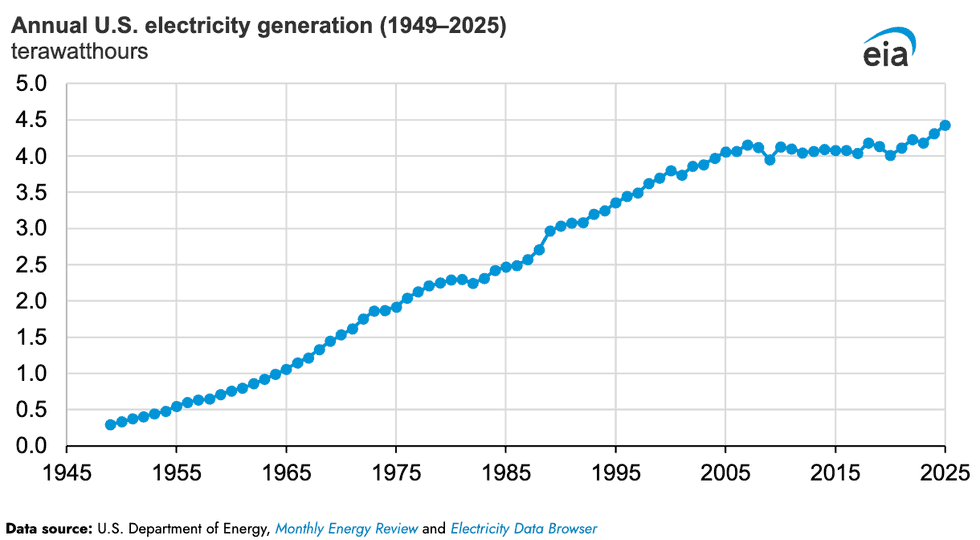
The numbers are in. Last year, the United States generated 4,430 terawatt-hours of electricity. That’s up 2.8% from 2024, which previously had been the highest annual total in the Energy Information Administration’s record books, which date back to 1949. Residential electricity sales grew 2.2%, while commercial surged by 2.9% and industrial rose by just 0.7%.
3. France’s power mix reaches 95% low carbon
France produced a record 521.1 terawatt-hours of low-carbon electricity in 2025 as upgrades to existing nuclear reactors allowed the fleet to produce more power, according to data from the grid operator RTE. The latest report is not yet public on RTE’s website, but NucNet reviewed the findings. The electricity mix has largely remained steady for the last two years. France first achieved a 95% low-carbon grid back in 2024, RTE data shows.
Sign up to receive Heatmap AM in your inbox every morning:
* indicates required
Email Address *Our Privacy Policy & Terms Apply.
4. Qcells starts up solar production in Georgia again
Qcells has resumed solar panel assembly at its plant in Cartersville, Georgia, following a series of delays. By the end of this year, the South Korean-owned company said it plans to have the capacity to pump out 3.3 gigawatts of solar panels per year. “We are proud to be back to work manufacturing the American-made energy the country needs right now,” Marta Stoepker, head of communications at Qcells, said in a statement. “Like any company, hurdles have and will occur, which requires us to adapt and be nimble, but our overall goal remains the same — to build a complete American solar supply chain.” The moves comes as MAGA warms to solar power as part of a broader “renewables thaw” that Heatmap’s Jael Holzman reported is part of a legal strategy.
Roughly two hours away, SK Battery America laid off nearly 1,000 workers at its factory northeast of Atlanta as automakers cool on electric vehicles. Friday marked the last working day for 958 employees, according to a federal filing the Associated Press reviewed.
5. Wave energy startup breaks records in pilot project
A wave energy startup hoping to harness one of the trickier sources of renewable power just broke a record with its latest pilot project. Last month, Eco Wave Power deployed its EWP-EDF One technology Jaffa Port in Israel. The pilot test lasted nine days last month under moderate conditions with daily average wave heights between one and two meters. Throughout the test, the project generated about 2,000 kilowatthours of electricity. “Not only did we continue stable production during moderate wave conditions, but we also experienced the highest waves recorded at our site to date,” Inna Braverman, Eco Wave Power’s chief executive, said in a statement to the trade publication Offshore Energy. “Achieving record average and peak power production during 3-meter wave events provides meaningful validation of our technology’s performance potential as we scale toward commercial projects.”
THE KICKER
Scientists discovered a molecular trick used by a unique group of plants to convert sunlight into food. Hornworts are the only known land plant that possesses internal compartments that concentrate carbon dioxide similarly to algae. A new study by researchers at the Boyce Thompson Institute, Cornell University, and the University of Edinburgh suggests that genes from the plants could be used to breed more resistant crops such as wheat. “This research shows that nature has already tested solutions we can learn from,” said Fay-Wei Li, a co-author of the study, said in a statement. “Our job is to understand those solutions well enough to apply them where they're needed most — in the crops that feed the world.”