
0
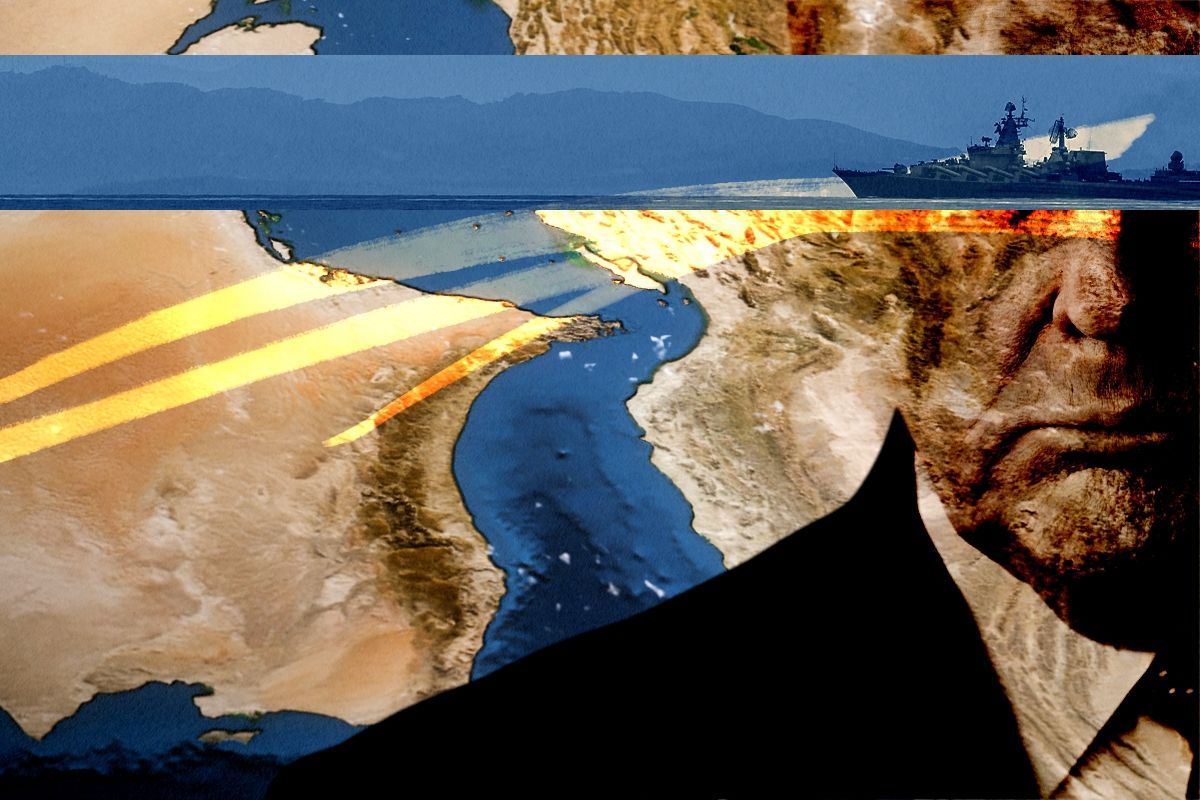
After negotiations between the United States and Iran broke down Sunday without a deal, the United States Central Command said it would “begin implementing a blockade of all maritime traffic entering and exiting Iranian ports” Monday morning.
It’s hardly like traffic through the Strait of Hormuz had been unencumbered before that. The strait has been largely closed to through traffic since the beginning of March thanks to the threat of Iranian strikes on ships going in and out of the Persian Gulf. That has remained the case even after the ceasefire deal was supposed to have opened up the waterway last week. Only a few countries have been able to get their tankers out, mostly those with close trade relationships with Iran, including China.
President Trump has been seeking to reverse that state of play and open the strait to non-Iranian traffic (e.g. oil, liquified natural gas, and fertilizer coming in and out of the Gulf states), whether by badgering European allies to help clear the strait and by having U.S. Navy ships traverse the channel to clear mines and demonstrate it’s safe to navigate. He appears to have ultimately settled on blockading the blockaders.
The president said Monday on Truth Social that 34 ships had sailed through the strait on Sunday, a number that has not been confirmed by third party sources. In the run-up to the U.S. blockade, about 10 to 12 ships were sailing through the strait per day, according to marine data service Kpler and The New York Times.
So, is the blockade an escalation of U.S. pressure on Iran? A violation of the ceasefire? A “pacific blockade” designed to pressure Iran without resorting to direct strikes? And how would it work, anyway?
I spoke with Nicolas Mulder, an assistant professor of history at Cornell University and the author of The Economic Weapon: The Rise of Sanctions as a Tool of Modern War, to try and get some of my questions answered. This interview has been condensed and edited for clarity.
Let’s start from the beginning. What is a naval blockade? And how does it different from typical naval warfare?
A naval blockade is actually interesting because it is a form of warfare that has been quite regulated for quite a long time already under international law. A lot of our modern understanding of the laws of belligerence and neutrality actually comes from blockades because they impose an important stricture on international maritime traffic. As a result, they raise all sorts of questions about who wars are fought between, and what wars mean for the civilian economies of the countries involved, and what they mean for the relationship of the belligerent states and third countries.
For most of U.S. history, the U.S. was not the blockader, but the neutral wanting to bypass blockades. The reason that the United States concretely intervened in the First World War and began to really involve itself with the power politics of Eurasia in 1917 is because it insisted on its neutral rights to trade with Britain when Germany had declared an unrestricted submarine warfare campaign that was effectively a blockade of the British Isles.
Even before that, the Union used it against the Confederacy.
In the 18th century, all the big great power wars — the Seven Years War, the various succession wars, the Napoleonic Wars — all of those involved blockades.
What I find interesting is that we have this ceasefire. We have these negotiations, which are apparently still going on. But then we also have the blockade. You seem to be arguing that blockades are a part of warfare. So, is this implying that the U.S. Navy is still potentially going to be shooting at stuff, even if there’s a so-called ceasefire?
That’s the big uncertain aspect of the current situation. We are not back into the same war that we were in last week before the ceasefire took effect. The way I would interpret this is that it’s a kind of fudge. From the perception of the Trump administration, it needs to do something to not look weak, but at the same time wants to avoid the risks of a full resumption of kinetic warfare and a massive air campaign, which they had pursued for six weeks to very mixed and disappointing effects.
The one historical parallel that I think can help us make sense of what they may be attempting to do now is the practice in the 19th century of “pacific blockade.” There were several conflicts, beginning in the 1820s with the Greek War of Independence and then through a whole bunch of Latin American wars and Asian conflicts, where European great powers would blockade small countries — not to declare war on them, but to prevent any of their ships from entering or leaving to put serious pressure on them.
What they were doing in that situation was to use wartime levels of pressure without initiating the full war because they knew that the target states were basically too weak to retaliate and did not have the naval power to contest that blockade.
How can we see this operation in Iran as part of a continuum of using these strangulation-type strategies against much weaker opponents?
One way to interpret what they’re trying to do now is to apply that Venezuela-Cuba template to Iran, and to wager that if they play this carefully, they might be able to bring real economic pressure to bear without provoking Iran into as full-scale a retaliation as it was undertaking before.
But that Venezuela-Cuba template is difficult to implement in the case of Iran for two simple reasons. One is just that Iran has, of course, shown that it has quite a lot of military capacity to retaliate with drones and missiles, and also mines and small ships and submarines. It also has the ability to widen its own maritime disruption in the region, for example by working with the Houthis to really stem the flow of traffic through the Bab-el-Mandeb Strait.
What works in the Western Hemisphere, where the United States has a really unrivaled military dominance, may not be reproducible in this strategic theater.
What does the geography tell you about the ability to impose or contest a blockade like this?
They may be doing it with multiple rings, or multiple screens — a light initial screen, and then bigger barriers of ships a bit further away, so as to not risk most of their force too close to the Iranian coastline. We saw in the early phase of the war that some carrier strike groups began to operate over time further and further away from the Iranian coast, presumably to avoid the risk of being hit with missiles and drones.
In this case, one of the questions is, what kind of resources are needed to keep that going? The U.S. did run a blockade against Iraq for most of the 1990s that was in the Persian Gulf itself, which is very narrow. Iraq’s ports are a tiny sliver of land that ends in the Persian Gulf. So that was a very small stretch of coastline.
Iran should still be manageable, but it will require a wider screen, and potentially one that really crosses the entire Arabian Sea somewhere from the southern coast of Oman, diagonally, northeastwards to Pakistan, or at least the Pakistan-Iranian border, and potentially a bit further out. And if there is also interference in the Red Sea, then the U.S. Navy is going to have to route most of disabled forces all the way around Cape of Good Hope to move that whole force into the Indian Ocean.
I think that the Red Sea contingency is quite important to how this shapes up.
CENTCOM said yesterday that this blockade is on ships going in and out of Iranian ports. I wonder if this is unique historically — both a blockade of Iran and trying to impose freedom of navigation elsewhere?
It’s interesting, right? Because indeed, there is the commitment to freedom of navigation. But then it also has been suggested that the U.S. Navy will stop all ships that have paid any toll or transit fee to the [Islamic Revolutionary Guard Corps], and that paying that toll ipso facto would make their passage illegal. For that I don’t know any good historical precedent.
The other historical precedent is probably actually the Ottoman Empire and Russia and World War I. The Ottoman Empire was bottling up Russia’s Black Sea Fleet in the Black Sea by its control over the Turkish straits, which actually imposed a really serious, long run cost on the Russian economy. It’s one of the things that really fed us in the Russian Revolution. But at the same time, the Ottoman Empire was itself being blockaded by British and French forces in the Mediterranean.
Iran is blockading [Gulf Cooperation Council] states selectively — though of course, it is allowing through some shipments. But those shipments are then going to be intercepted, presumably by the Americans. So the de facto result of it is that no one is really going to be able to leave the Gulf. And that’s kind of where I see this game theoretically ending up.
So it seems like the result of this won’t be hugely different than what things were a few weeks ago, just with fewer Iranian ships getting out.
Also ships of those countries that negotiated transit with Iran.
If you looked at the news coming out of Asia and the diplomatic communiques of a large number of Asian states that brokered bilateral arrangements with Iran — so Pakistan, India; Bangladesh had done so; China, of course — but also countries that have otherwise fairly good links with the United States — the Philippines, Malaysia, Vietnam — all of them had essentially accepted that some payment to the IRGC was now the new cost of doing business. They were so desperately in need of energy supplies for the population that they decided to enter negotiations, even if, in principle, they would prefer freedom of navigation.
The likely diplomatic contestation or diplomatic issues coming out of this blockade are also going to be related to Asia, and that’s where I would focus our attention.