0

Current conditions: A storm corridor is set to pummel a swath of the United States from the Plains to Great Lakes for the next days • Super Typhoon Sinlaku is barreling toward Guam, where it is poised to make landfall as the equivalent of a Category 5 hurricane, while to the south Cyclone Vaianu forces hundreds of evacuations on New Zealand’s North Island • Santo Domingo, the Dominican Republic’s sprawling capital, is facing days of intense thunderstorms as floods displace cars in the Caribbean’s largest city.
THE TOP FIVE
1. Trump threatens to blockade the Strait of Hormuz as Iran talks collapse
Contrary to popular parlance, the Strait of Hormuz hasn’t been closed these past few weeks. It’s just been closed to any cargo not approved by the Iranian government. As I told you last week, a Wall Street analyst who went on a Gonzo reporting mission armed with Cuban cigars and packets of Zyn nicotine pouches to the Persian Gulf chokepoint concluded that billions of dollars of goods were passing through the waterway, but only on Iranian-flagged ships or Chinese vessels enjoying the benefits of political alignment with the Islamic Republic. After talks this weekend failed to reach a deal to fully reopen the Strait of Hormuz, the United States is planning a naval blockade to prevent any ships from passing and subject Tehran to the same pressure Washington is facing from the closure. That’s what President Donald Trump announced Sunday in a series of posts on Truth Social. In a reversal of last week’s ceasefire deal, Trump said the U.S. would “interdict every vessel” in international waters that passed through the Strait of Hormuz after paying Iran a toll, calling such a levy “illegal” and “world extortion.”
Oil prices spiked again in response to the president’s announcement. Already, as Heatmap’s Robinson Meyer reported last week, the war has cost Americans $17 billion at the pump. And even with the ceasefire in place, the end of the energy shock looked hazy at best, analyst Rory Johnston said on the most recent episode of the Heatmap podcast Shift Key.
2. Viktor Orbán’s defeat in Hungary could disrupt the country’s big nuclear project
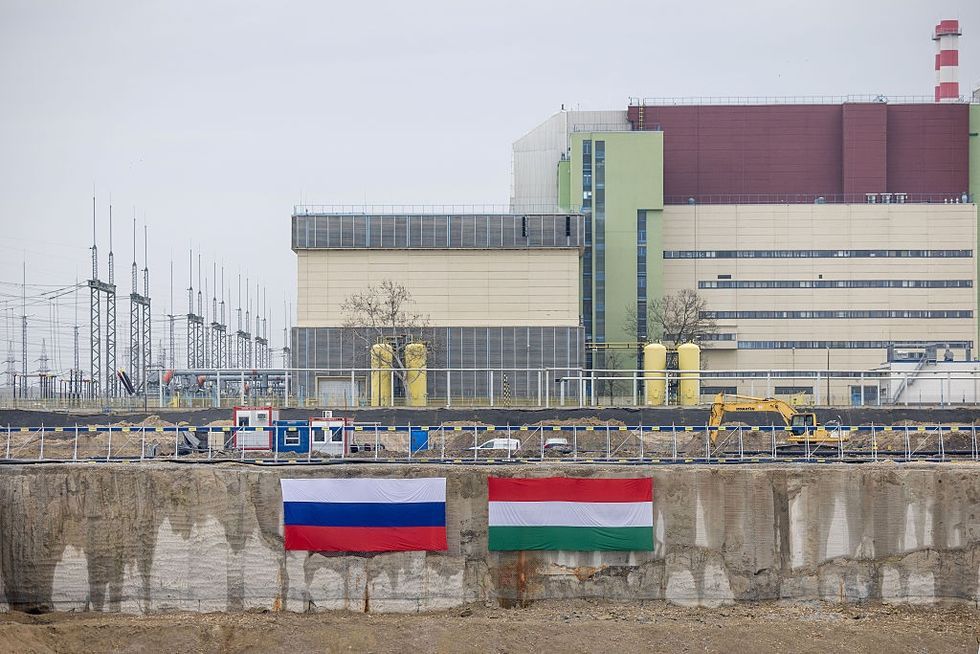
For nearly two decades, Viktor Orbán ruled over Hungary with an increasingly tight-gripped fist, maintaining the closest relationship between Russia and any NATO country and providing what’s widely considered a blueprint for the West’s illiberal right to reduce checks on the power of the ruling party in a democracy. In February, his government oversaw the official start of construction on Paks II, a major new nuclear project Hungary hired the Russian state-owned Rosatom to build. Now Orbán’s 16-year tenure is coming to an end after rival conservative Péter Magyar won Sunday’s election in a landslide. During the heated campaign, which saw Vice President JD Vance visit Hungary to campaign on Orbán’s behalf in the closing days, Magyar depicted the incumbent right-wing ruler as a corrupt authoritarian selling out the country to its former Soviet imperial rulers in Moscow and vowed to rebuild Budapest’s ties with the European Union and NATO. That could spell trouble for Paks II. The project has stood out as the Kremlin’s last new commercial foothold in the West’s nuclear industry. At the start of the Ukraine war in 2022, Finland canceled a domestic joint venture with Rosatom. The U.S. nuclear giant Westinghouse, meanwhile, has cut deal after deal to supply Russian-made VVER reactors in Slovakia and Bulgaria with America-made fuel assemblies. Last summer, the Orbán administration said it had, as a result of its chummy relationship with the Trump administration, persuaded Washington to exempt Paks II from U.S. sanctions. The project’s fate under a Magyar government is uncertain, though at least one expert I spoke to on Sunday afternoon suggested the new prime minister may seek to renegotiate the deal with Rosatom to provide for more EU oversight or better terms. Canceling Paks II, which would significantly bolster the grid in a country already reliant on nuclear power for nearly half its electricity, seems unlikely at this point.
Meanwhile, Russia is getting some new competition from a European rival. Until recently, Rosatom was the only foreign company willing to invest in nuclear reactors in India, where a civil liability law passed in 2010 threatened to bankrupt developers if any accident occurred. In December, as I reported to you at the time, India passed legislation reforming the statute in a bid to attract more overseas investments into its growing atomic power sector. It’s working. The U.S. nuclear heavyweight Holtec International, which is attempting to build its 300-megawatt small modular reactors in Michigan, has expressed interest. Now the French nuclear giant EDF is exploring potential projects in the world’s most populous nation, World Nuclear News reported last week. In another bullish sign, regulators in South Korea, the democratic world’s most competent reactor builder, just approved the country’s latest plant to start up.
3. Argentina overhauls glacier protection law, clearing the way for mining
Argentina’s right-wing President Javier Milei notched a major legislative win last week after lawmakers in the lower house of the country’s legislature approved an overhaul of a landmark glacier protection law in a 137-to-11 vote. The victory opens “the door to mining near some of South America’s most important freshwater reserves,” the Financial Times reported, by giving provincial authorities greater discretion to determine which glacial areas warrant protection. The bill already passed in the Argentinian Senate, meaning Milei only needs to sign the legislation. He’s expected to do so. Milei pitched the bill as a way to free up areas “incorrectly classified as glaciers” to mineral extraction as his government seeks to tap Argentina’s rich lithium resources. But critics aren’t so sure. “This will not give investors the legal certainty they are looking for,” Andrés Nápoli, executive director of the Environment and Natural Resources Foundation, told the newspaper.
Milei signed a critical minerals pact with the U.S. in February as the Trump administration looks to secure non-Chinese supplies of key metals.
Sign up to receive Heatmap AM in your inbox every morning:
* indicates required
Email Address *Our Privacy Policy & Terms Apply.
4. Sam Altman’s house hit with a Molotov cocktail as violent opposition to data centers mounts
Maybe the attacker was angry about data centers. Maybe the assailant took issue with OpenAI itself, or the way Sam Altman — a lightning rod figure in the American tech industry and the subject of a recent investigation in The New Yorker that raised questions about a uniquely powerful executive’s judgment — operates. Maybe the man who threw a Molotov cocktail at Altman’s San Francisco home on Friday was just compelled by illness or altered brain chemistry to act out violently against a public figure who’s been unmissable in the media. But the fact that the incident occurred less than a week after a gunman fired bullets into the home of an Indianapolis city councilmember who spoke out in support of a data center project does appear to be part of a worrying trend of violence. As Heatmap’s Jael Holzman wrote last week, the Indianapolis shooting, in which (thankfully) the lawmaker and his young son were not hurt, was the third such incident this year, “indicating the bubbling angst against data centers really does have potential to turn violent.”
In a post on his personal blog, Altman shared a photo of his husband, Oliver Mulherin, and their 1-year-old son and said he had “underestimated the power of words and narratives” amid what he admitted was an “extremely intense, chaotic, and high-pressure few years in the artificial intelligence industry. “A lot of the criticism of our industry comes from sincere concern about the incredibly high stakes of this technology. This is quite valid, and we welcome good-faith criticism and debate,” Altman wrote. “I empathize with anti-technology sentiments and clearly technology isn’t always good for everyone. But overall, I believe technological progress can make the future unbelievably good, for your family and mine.”
5. Battery recycler Ascend Elements will file for bankruptcy
Battery recycling startup Ascend Elements will file for bankruptcy this Thursday, according to Bloomberg. The Massachusetts-based company raised more than $1.1 billion in equity and grants over the past 11 years as it sought to build out production from its factory reprocessing old batteries into cathode material in Georgia. But “the financial difficulties were insurmountable,” the company said.
THE KICKER
Last summer, I told you about an abandoned green hydrogen project in Australia amid a spate of cancellations worldwide. But now a new 1.5-gigawatt project, the Murchison Green Hydrogen facility in Western Australia, has been selected for a fast-track approval under the national government’s new pilot program to speed up permitting, according to Hydrogen Insight. The program is reserved for projects of “national significance.”