
0
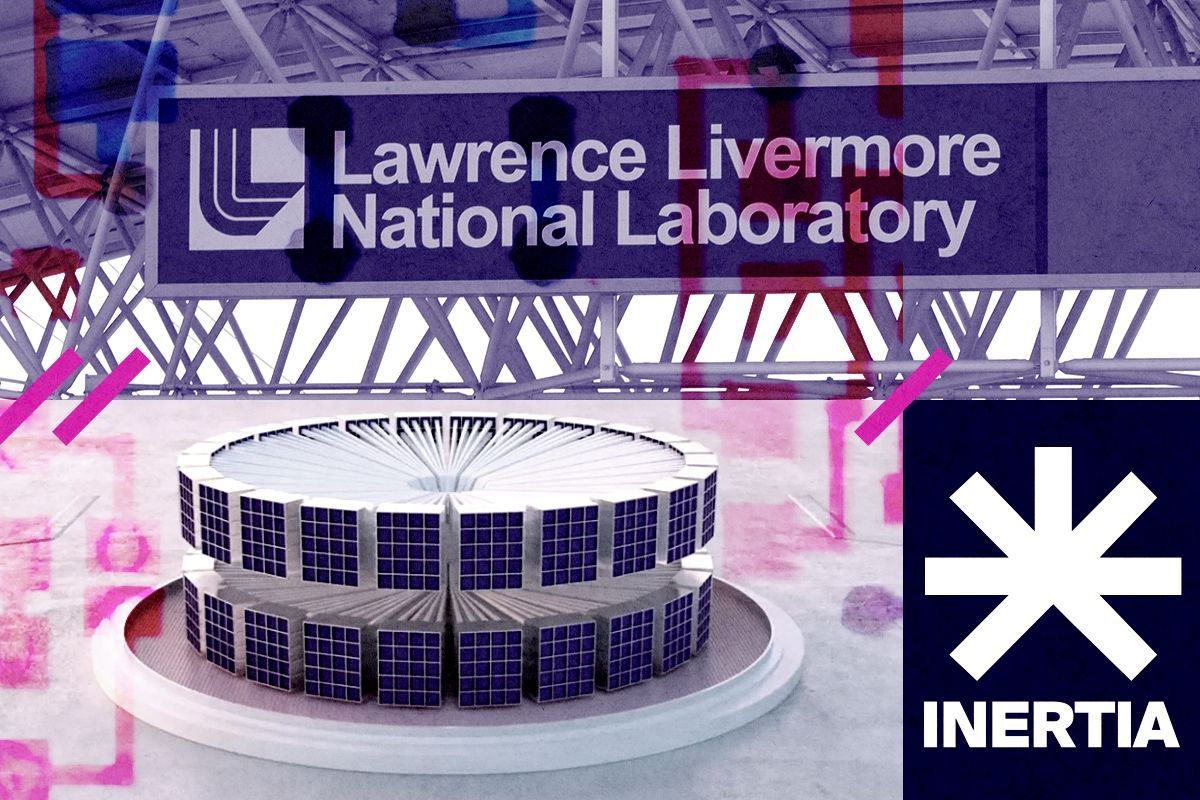
I’ll admit, I thought I might be done covering fresh fusion startups for a while. In the U.S., at least, the number of new industry entrants has slowed, and most venture capital now flows towards more established players such as Commonwealth Fusion Systems and Helion. But in February, a startup called Inertia Enterprises made headlines with its $450 million Series A raise. It’s aiming to commercialize fusion using the physics pioneered at Lawrence Livermore National Laboratory, the only place yet to achievescientific breakeven — the point at which a fusion reaction produces more energy than it took to initiate it.
That achievement first came in 2022 at the lab’s National Ignition Facility in Berkeley, California. On Tuesday, Inertia announced that it’s deepening its partnership with Lawrence Livermore, creating one of the largest private sector-led partnerships in the history of the national lab system. This collaboration involves three separate agreements that allow Inertia to work directly with the lab’s employees on research and development, while also giving the startup access to nearly 200 Lawrence Livermore patents covering fusion technology.
The startup’s team isn’t merely a group of enthusiasts galvanized by the national lab’s fusion milestone. Alongside Twilio’s former CEO Jeff Lawson and fusion power plant designer Mike Dunne, Inertia’s other co-founders is Annie Kritcher, a senior employee at Lawrence Livermore who has led the physics design for NIF’s fusion energy experiments since 2019.
“We’re not starting from zero,” Kritcher told me, putting it mildly. “And that was really, really important to me when I decided to co-found this company.” Or as Lawson told me after the company’s fundraise in February, “the government put 60 years and $30 billion into NIF trying to get that thing to work.”
The technical approach pursued by Lawrence Livermore — and now by Inertia — is called inertial confinement fusion. In this system, high-powered lasers are directed at a millimeter-scale pellet of fusion fuel, typically a mixture of the hydrogen isotopes deuterium and tritium. The laser energy rapidly compresses and heats the pellet to extreme temperatures and pressures, driving the nuclei to fuse and releasing enormous amounts of energy. But NIF didn’t build its system for commercial purposes. Rather, its primary mission is to support the domestic nuclear weapons stockpile by recreating the extreme conditions inside a nuclear detonation, allowing scientists to study how U.S. weapons perform without conducting explosive tests.
To translate the lab’s research into a commercially viable device, Kritcher explained, Inertia must significantly increase the lasers’ efficiency and power output, targeting a system roughly 50 times more powerful than existing lasers of its class. The startup is also working to scale production of its fusion targets to drive down costs and enable mass manufacturing.
Inertia is not the only company attempting to commercialize this general approach, however. Back in 2021, as Lawrence Livermore moved closer to its breakeven moment, the future founders of the startup Xcimer Energy were taking note. Convinced that the fundamental physics of inertial confinement had been proven, they thought, “if we’re going to do this, we have to do it now,” Xcimer's CTO, Alexander Valys, told me a few years ago. He and his co-founder quit their day jobs, and Xcimer went on to raise a $100 million Series A round in 2024. Others joined in on the hype, too — the Fusion Industry Association reports 13 fusion companies that were founded or emerged from stealth between summer 2022 and summer 2023, a record for the sector.
Kritcher told me that none are adhering as closely to NIF’s successful design as Inertia. “There are fundamental technical differences between us and the other laser approaches,” she told me, explaining that while Xcimer and others are using broadly similar methodologies to produce a hot, dense plasma, the underlying physics behind their plan diverges significantly. Xcimer, for instance, is developing a novel laser architecture that hasn’t yet been demonstrated at scale, along with a different fuel capsule design than the one validated by NIF.
Kritcher will be allowed to continue her work at the lab thanks to what the company describes as a “first-of-its-kind agreement” enabled by the 2022 CHIPS and Science Act, which allows scientists at the national labs to participate in commercialization efforts with the goal of accelerating the transfer of knowledge to the private sector.
For the fusion engineer, it’s the ultimate dream come true. She first arrived at Lawrence Livermore as a summer intern in 2004, just before her senior year at the University of Michigan, and “fell in love with the lab and the NIF project,” which was still under construction at the time. She opted to attend the University of California, Berkeley for her masters and PhD in nuclear engineering so that she could continue her work there.
“I was starstruck by the possibility of fusion energy and [it having] such a big impact on humanity, and that really kept me going for a long time,” she told me. But after the NIF facility was finally completed in 2009, it failed to achieve ignition by its initial 2012 target.
By then, Kritcher was a postdoctoral fellow, and attention at NIF began to shift toward supporting the nation’s nuclear stockpile. Fusion energy was “always in the back of my mind, driving me day to day,” she said, “but you sort of forget about it, and you lose a little bit of that excitement and spark.” Under her guidance, NIF ultimately reached that watershed moment, which has since been replicated numerous times. And when it did, "it just reopened all those old inspirational feelings and motivations and excitement and it was like a 180 turning point where we all just go, oh, fusion energy is possible again with this approach.”
Many of the lab’s employees feel similarly, she said, and this close collaboration will allow some of the nation’s foremost experts in inertial confinement to work with the startup across a range of technical capabilities, including “the laser side, the target fabrication side, the simulations team side, the code development side, our physics design side,” Kritcher enumerated.
Inertia is looking to bring its first pilot plant online in the “2030s to 2040s,” she told me. By contrast, Commonwealth Fusion Systems — the most well-capitalized company in the sector — plans to connect its first plant to the grid early next decade, while Xcimer is targeting 2035. Kritcher is unfazed, though. While she acknowledges that other companies might complete their facilities sooner, she argues that Inertia still has an upper hand given that NIF effectively serves as the startup’s demonstration plant, something no other company has built.
Not to mention that all of the sector’s projected timelines remain highly speculative. There are serious technical and economic challenges that would-be fusion energy companies will have to overcome — Inertia not excepted — and the industry’s status 10 years down the line remains anyone’s guess. What’s crystal clear, however, is that a serious new contender has entered the race.