
0

Microsoft has begun telling suppliers and partners that it is pausing future purchases of carbon removal, according to two people who have been informed of its plans.
The news deals a potentially major setback to the fledgling carbon removal industry, which has relied on Microsoft’s voluntary corporate buying as an anchor source of early demand. The technology giant has made the overwhelming majority of carbon removal purchases in recent years.
It’s not yet clear whether the company could still increase its investment in existing projects or when it might resume purchases in the future.
In a statement, a Microsoft spokesperson denied that the company was indefinitely pausing all of its purchases. “We continually review and assess our carbon removal portfolio along with market conditions for the optimal balance on our path to carbon negative,” she said.
Industry data suggests that Microsoft has done more than any other private company — and arguably any organization on Earth — to support early-stage technologies that could withdraw or eliminate carbon dioxide from the atmosphere.
It has purchased 45 million tons of carbon removal, according to its own releases. The next-largest buyer of carbon removal credits — Frontier, a coalition of large companies led by the payments processing firm Stripe — has bought 1.8 million tons of carbon removal.
Microsoft made 90% of all carbon removal purchases worldwide last year, according to data from the third-party industry monitor CDR.fyi. The company is generally cited as making somewhere between 79% to 90% of all historic carbon removal purchases.
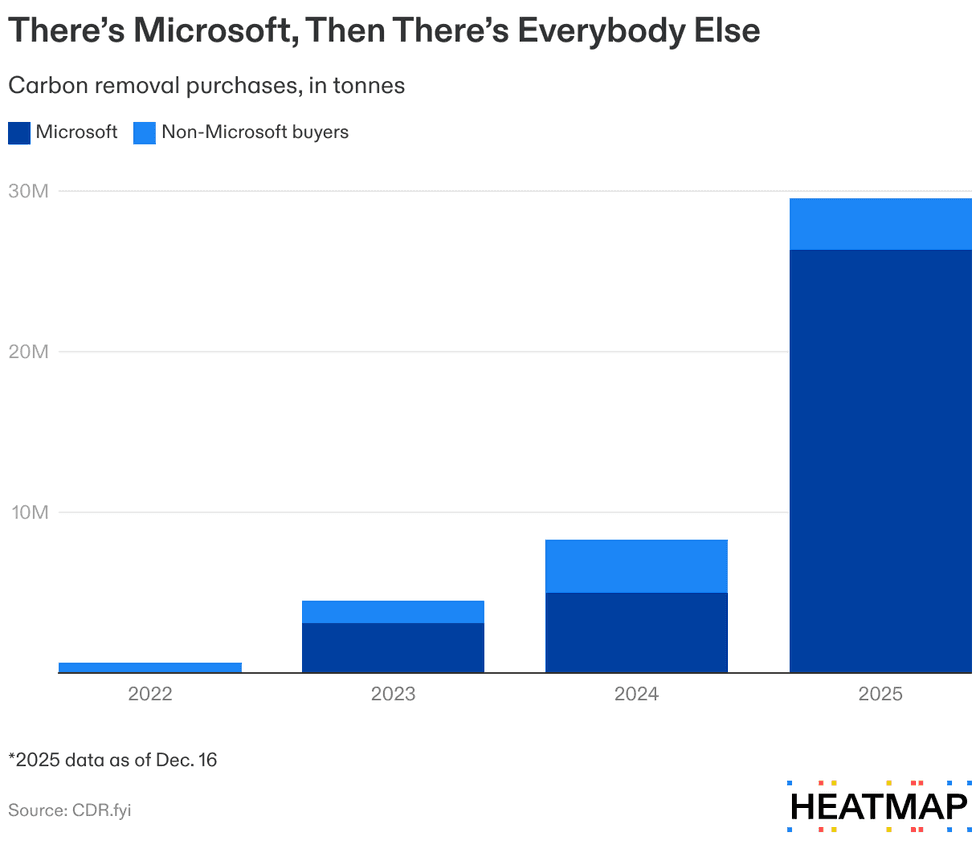
Microsoft also published guidelines about what it considered “ideal” carbon removal projects, setting de facto early industry standards for technologies including direct air capture, soil carbon management, and enhanced rock weathering.
The tech company has backed carbon removal in large part to meet its aggressive internal climate goals. Microsoft has pledged to become “carbon negative” by 2030, meaning that it must remove more greenhouse gases from the atmosphere than it emits within four years. The company also aims to eliminate its half century of historic carbon emissions by 2050.
Like other major tech firms, including Google and Meta, Microsoft has struggled to square its years-old climate goals with the urgent need to power energy-hungry AI data centers. But it has generally been seen as more environmentally friendly than other tech firms.
When Heatmap polled climate insiders late last year, Microsoft and Google were seen as the two AI tech developers who were “best” on climate. (Meta and Amazon got failing marks.)
It’s not clear that Microsoft anticipated ending its carbon removal program so quickly. It announced its most recent purchase of CDR credits only three days ago, when it bought more than 620,000 tons of credits from an indigenous-owned bioenergy carbon capture and storage project in Saskatchewan, Canada.
The Intergovernmental Panel on Climate Change considers carbon removal — technologies and methods that can reduce the amount of heat-trapping pollution in the atmosphere on century-long time scales — to be essential to meet the Paris Agreement’s climate goals.
By 2050, the world will need to remove 7 to 9 billion tons of carbon dioxide each year in order to hold to its Paris targets, according to an independent 2024 report.
Microsoft’s apparent pause comes at a lean time for the carbon removal industry, because the Trump administration has declined to spend — and in some cases even reassigned — funds previously authorized to encourage the development of the technology. For instance, the Energy Department says it plans to use more than $500 million in carbon removal funding to prop up aging coal plants.
Congress has been more generous to carbon removal, which has historically drawn more bipartisan support than other clean energy technologies. The 2026 federal spending law included more than $116 million to support carbon removal research and set up a federal purchasing program. With Microsoft’s shift, that purchasing scheme will be more important than ever.