0
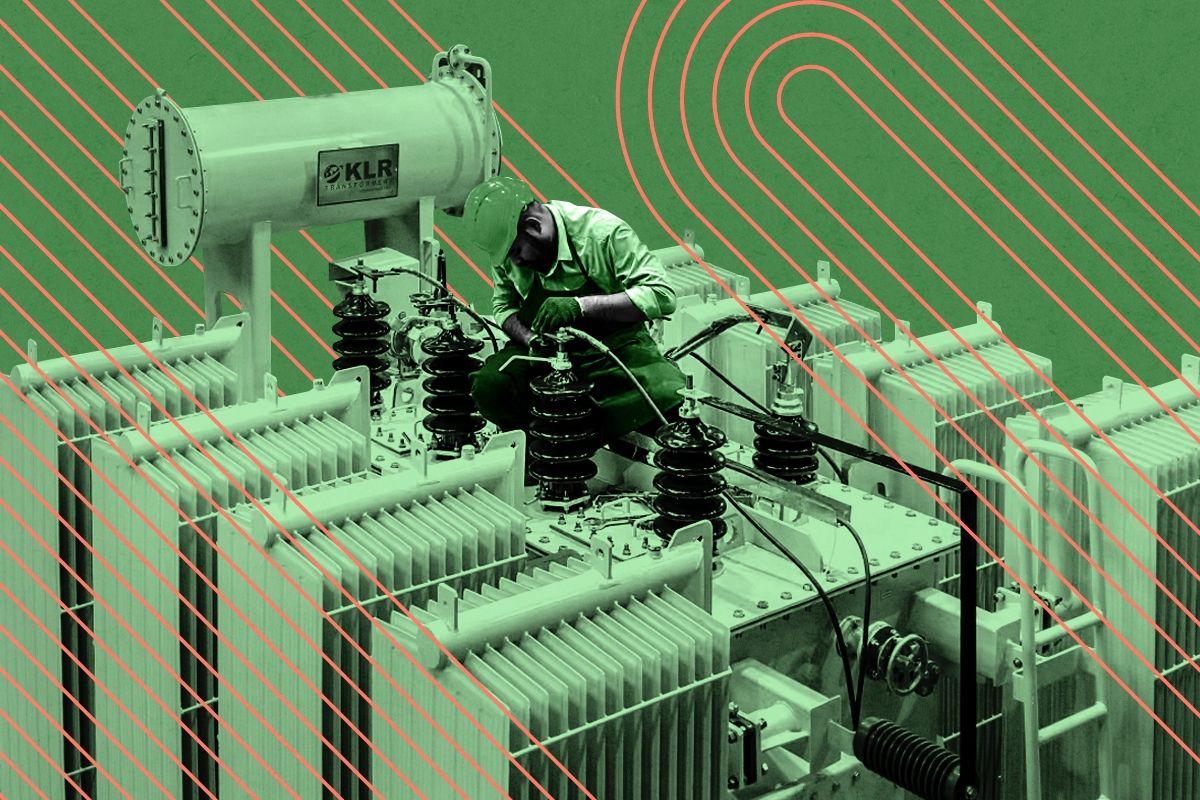
Transformers are the unsung heroes of the energy transition. These bulky devices come in a range of forms, from canisters mounted on distribution lines to garage-sized industrial units at substations and metal boxes on concrete pads outside apartment buildings. But regardless of form, they all serve a single essential purpose: adjusting voltage — either up, which is more efficient for long-distance transmission, or down for safe delivery to end users.
“If you’re getting an EV charging station, you need this equipment. If you’re building a large industrial facility that uses electricity to run the process, you need this equipment. Solar, battery storage plants, and wind energy projects need these. Data centers need these,” Anirudh Reddy, CEO of the power grid equipment startup Ayr Energy, told me. “It’s omnipresent.”
But ever since Covid scrambled global supply chains, the world has been staring down a severe transformer shortage. Even as economywide electrification accelerated, with rising electric vehicle adoption and rapid renewables deployment, the system failed to recover. Lead times for high-voltage transformers can now exceed two, three, even four years, raising costs and slowing the deployment of renewables and electrification projects.
While many of the big traditional players like Hitachi, Siemens Energy, and GE Vernova are still working to expand production, there’s now a group of startups looking to address the issue from other angles.
Reddy’s company, Ayr, is tackling it head on by standardizing transformer component designs and tapping underutilized manufacturing capacity in India to cut delivery times from years to months. Then there’s the growing field of startups that includes DG Matrix, Heron Power, and Amperesand, which are commercializing solid-state transformers for powering data centers, charging EVs, and solar and storage projects. This novel tech could offer an appealing replacement for today’s low- and medium-voltage transformers, as it provides grid services beyond just passive voltage conversions in a more efficient, compact package.
Right now, the most acute bottleneck and longest lead times are for high-voltage transformers, which is where Ayr sees the largest opportunity. These units step up a power plant’s output to transmission-level voltage for long-distance delivery, before stepping it back down to medium voltage at substations. These transformers can be the size of garages or small houses. Even when supply chains were functioning normally, they still took around a year to manufacture.
To return to that timetable, Ayr is taking its cues from automotive companies, which Reddy told me rely on standardized components throughout most of the manufacturing process and defer vehicle customization — think special features, finishes, and trims — until the final stages. When applied to transformers, this means equipment that is designed “such that you can address specification for a variety of projects and a variety of customers with the same architecture,” Reddy told me, allowing the company to shorten the time from initial customer engagement to final product delivery.
It all raises the question, why haven’t these equipment manufacturers been building more standardized transformers all along? Reddy blames it on a fundamental disconnect between transformer manufacturers and project developers. “That dialog never really happened. It was a very linear information flow,” he told me, with customers typically submitting bespoke specifications at the outset. That forced manufactures to build around these requirements from day one, making the whole supply chain and manufacturing process needlessly customized and complex.
But many of those unique design elements aren’t really necessary, Reddy said. Ayr often asks developers to tweak their specifications to align with a standardized model, which he told me yields no difference in overall project performance. That lets Ayr place orders with its Indian manufacturing partners in advance based on expected demand.
Surplus capacity in India is key to this business model, of course. Unlike U.S.-based manufacturers or those that export transformers and components to the U.S. — such as Mexico, Canada, and China — Reddy said Indian factories stayed ahead of local demand, even as electrification in the country ramped up. Lower labor costs allows factories to operate below peak capacity, providing an opportunity for Ayr to swoop in and contract with them immediately — even though many had previously produced almost entirely for the Indian market.
“It’s a highly manual, labor intensive process when you’re building bespoke heavy electric equipment. So the overhead of a factory that’s not producing equipment is pretty high,” Reddy told me. “Doing so in the U.S. would kill the company. Doing so in India, not so much.”
Ayr only emerged from stealth about seven months ago, and in the past year alone, Reddy said it’s built a backlog of over half a billion dollars in signed equipment orders, representing over 20 gigawatts of projects. The company started deploying its transformers and other backlogged power infrastructure in the middle of last year, and Reddy said it’s expecting its first high-voltage transformer to come online this quarter. So while the company has received early backing from venture firm General Catalyst — $3.5 million according to Pitchbook — Reddy told me it has no need to raise additional capital at this time.
Other transformer startups pursuing solid-state technology are bringing in plenty of venture capital — DG Matrix raised a $140 million Series B round and Heron Power raised a $60 million Series A round, both in February, while Singapore-based Amperesand secured $80 million last November — though their technology is only just beginning to commercialize. While conventional transformers rely on copper coils and iron cores to magnetically adjust voltage, solid-state transformers use power semiconductors — often made from silicon carbide — to perform voltage conversions electronically, while also enabling capabilities such as bidirectional power flow, AC/DC conversion, real-time voltage regulation, and rapid response to power surges.
But while these companies can also help ease the transformer shortage, their value proposition is distinctly different and likely to take longer to materialize than Ayr’s. For one, current solid-state transformer designs do not scale practically or economically to the high voltages required for the transmission grid. Instead, this novel tech is a better candidate to replace medium-voltage transformers on the distribution grid or low-voltage transformers inside facilities. This includes converting the low-voltage DC power produced by solar panels and batteries into medium-voltage AC power for the grid, delivering medium-voltage power from the grid to data centers and EV charging systems, and transporting low-voltage power around the data centers themselves, such as at the server rack level.
DG Matrix, for one, is primarily focused on data center applications for its solid-state transformers, which it initially plans to use to manage power generated onsite. The startup’s differentiating feature is its ability to balance electricity from multiple sources simultaneously, regardless of whether they’re operating on AC or DC power. For example, the company’s so-called “multi-port” device can integrate electricity generated from solar panels, natural gas generators, batteries, and the grid to provide power to data centers “in any ratio we want,” the company’s CEO Haroon Inam told me. It can also provide power back to the grid as needed.
Without such a unit, managing all these different sources would require significantly more space and numerous separate electrical components — protection equipment, multiple transformers for stepping voltage up or down, and converters to switch between AC and DC power. DG Matrix’s device thus promises to cut costs while boosting efficiency and reliability, especially for microgrid applications.
Now, Inam told me, the startup is looking at a “multi-billion dollar pipeline” for supplying low-voltage power to data centers for distribution inside the facilities themselves. It’s working to scale production at its North Carolina manufacturing facility, aiming to reach full capacity by July before pursuing a further expansion.
Heron Power, by contrast, is targeting a broader slice of the energy infrastructure market — in addition to data centers, it’s also seeking partnerships with operators of utility-scale solar and battery projects. Whereas DG Matrix is focused on coordinating onsite power from multiple sources, Heron is primarily interfacing with the grid, designing medium-voltage solid-state transformers that can step down power for delivery to end users such as data centers, and step up low-voltage power from solar and batteries to feed into the distribution grid — all without needing separate inverters for AC/DC conversions.
“It does what a traditional transformer does, but it also does what switchgear does, what tap changers do, what capacitor banks do, and what a synchronous condenser does, in a single package, managed in real time by software,” Heron’s CEO Drew Baglino told me via email.
During Baglino’s prior tenure leading the development and deployment of Tesla's EV Superchargers and large-scale battery storage systems, he constantly found conventional transformers to be “a supply chain constraint, a deployment bottleneck, and a physical hazard,” leading him to believe there simply had to be a better way. But because solid-state designs are driven by software-controlled power electronics rather than fixed hardware, that fundamentally shifts the paradigm, he said. “A traditional transformer that's wrong for the job gets ripped out and replaced. A Heron Link gets a firmware update.”
The company has publicly announced just two customers to date, but they’re big ones — clean energy developer Intersect Power and data center developer Crusoe. Overall, Heron said it’s secured over 50 gigawatts worth of orders, and is now working to build out a U.S.-based factory capable of producing 40 gigawatts of transformers annually, with initial production beginning next year.
Even if the transformer shortage resolves sooner rather than later, Inam doesn’t expect it to dampen interest in DG Matrix’s technology or solid-state transformers overall. Their ability to integrate multiple energy sources, he told me, “provides a more economic path to distributed generation” — especially as microgrids become an increasingly common way to circumvent the interconnection queue and generate power onsite.
“The fastest area of demand growth for transformers is for new energy technologies like solar, batteries, and data centers,”Baglino told me. So while he declined to speculate on when the shortage will end, he too expects continued demand. As for Reddy, he thinks the supply crunch is unlikely to fully ease until after 2030, when he predicts leading manufacturers will be able to fully ramp up the new transformer facilities and expansions that they’ve announced. .
At any rate, the frenzied data center buildout certainly shows no signs of waning, with the International Energy Agency projecting that global data center electricity consumption will double by 2030 and more than double in the U.S., where it will rise by about 2.3x. And with recent volatility in fossil fuel prices likely to accelerate the electrification of certain markets, transformers are set to remain as ubiquitous and critical as ever.
To meet the moment, Baglino said, “What's needed is the same concentration of focus, urgency, and scale that transformed electric transportation, directed at the infrastructure that powers everything else.”