0
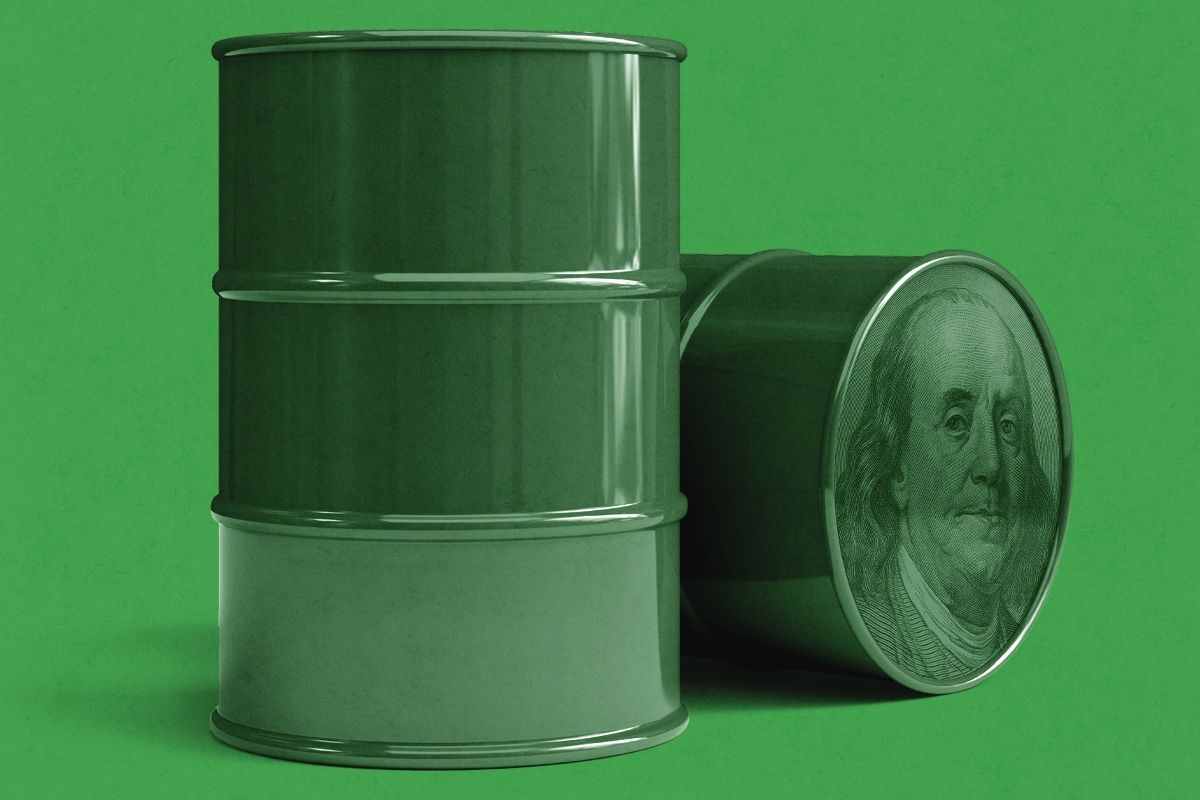
Oil prices are all over the place as markets reopened this week, climbing as high as $120 a barrel before crashing to around $85 after Donald Trump told CBS News that the war with Iran “is very complete, pretty much,” and that he was “thinking about taking it over,” referring to the Strait of Hormuz, the artery through which about a third of the world’s traded oil flows.
Even $85 is substantially higher than the $57 per barrel price from the end of last year. At that point, forecasters from both the public and the private sectors were expecting oil to stick around $60 a barrel through 2026.
Of course, crude oil itself is not something any consumer buys — but those high prices would likely feed through to higher consumer prices throughout the U.S. economy. That includes the price of gasoline, of course, which has risen by about $0.50 a gallon in the past month, according to AAA, — and jet fuel, which will mean increased travel costs. “Book your airfares now if they haven’t moved already,” Skanda Amarnath, the executive director of the economic policy think tank Employ America, told me.
High oil prices also raise the price of goods and services not directly linked to oil prices — groceries, for instance. “The cost of food, especially at the grocery store, is a function of the cost of diesel,” which fuels the trucks that get food to shelves, Amarnath told me. Diesel prices have risen even more than gasoline in the past week, by over $0.85 a gallon.
“We’ll see how long these prices stay elevated, how they feed their way through the supply chain and the value chain. But it’s clearly the case that it is a pretty adverse situation for both businesses and consumers.”
The oil market is going through one of the largest physical shocks in its modern history. Bloomberg’s Javier Blas estimates that of the 15 million barrels per day that regularly flow through the Strait of Hormuz, only about a third is getting through to the global market, whether through the strait itself or by alternative routes, such as the pipeline from Saudi Arabia’s eastern oil fields to the Red Sea.
Global daily oil production is just above 100 million barrels per day, meaning that around 10% of the oil supply on the market is stuck behind an effective blockade.
“The world is suddenly ‘short’ a volume that, in normal times, would dwarf almost any supply/demand imbalance we debate,” Morgan Stanley oil analyst Martjin Rats wrote in a note to clients on Sunday.
The fact that the U.S. is itself a leading producer and exporter of oil will only provide so much relief. Private sector economists have estimated that every $10 increase in the price of oil reduces economic growth somewhere between 0.1 and 0.2 percentage points.
“Petroleum product prices here in the U.S. tend to reflect global market conditions, so the price at the pump for gasoline and diesel reflect what’s going on with global prices,” Ben Cahill, a senior associate at the Center for Strategic and International Studies, told me. “What happens in the rest of the world still has a deep impact on U.S. energy prices.”
To the extent the U.S. economy benefits from its export capacity, the effects are likely localized to areas where oil production and export takes place, such as Texas and Louisiana. For the economy as a whole, higher oil prices will improve the “terms of trade,” essentially a measure of the value of imports a certain quantity of exports can “buy,” Ryan Cummings, chief of staff at Stanford Institute for Economic Policymaking, told me.
Could the U.S. oil industry ramp up production to capture those high prices and induce some relief?
Oil industry analysts, Heatmap founding executive editor Robinson Meyer, and the TV show Landman have all theorized that there is a “goldilocks” range of oil prices that are high enough to encourage exploration and production but not so high as to take out the economy as a whole. This range starts at around $60 or $70 on the low end and tops out at around $90 or $95. Above that, the economic damage from high prices would likely outweigh any benefit to drillers from expanded production.
And that’s if production were to expand at all.
“Capital discipline” has been the watchword of the U.S. oil and gas industry for years since the shale boom, meaning drillers are unlikely to chase price spikes by ramping up production heedlessly, CSIS’ Ben Cahill told me. “I think they’ll be quite cautious about doing that,” he said.