0
Current conditions: A megastorm is pummeling the Midwest with a blizzard and the Northeast with torrential rain that, in some places, will occur in intense bursts of more than an inch per hour • Triple-digit temperatures as high as 110 degrees Fahrenheit are coming for the Southwest in the next few days, weeks ahead of the historical norms • Days after a magnitude 6.3 earthquake hit Chile, a magnitude 5.3 tremor struck off the coast of El Salvador and Honduras.
THE TOP FIVE
1. Chris Wright: ‘There’s no guarantee’ gas prices will come down
Get ready to feel the pinch. With Iran promising to drive up the global cost of oil past $200 per barrel, U.S. Secretary of Energy Chris Wright issued a stark warning. During an appearance on ABC News’ This Week, the Trump administration’s energy chief urged Americans to prepare for belt-tightening. Gas prices have already risen $0.76 per gallon on average since the start of the war — and more than $0.51 just in the past week. GasBuddy said prices surged “at one of the fastest rates” in years. Prices may come down in the next few weeks, Wright added, but “there’s no guarantees in wars at all,” he said. “This is short-term pain to get through to a much better place.”
2. Revolution Wind has come online
Revolution Wind is on. On Friday, the 704-megawatt offshore wind farm started pumping electricity onto New England’s grid from off the coast of Rhode Island. As the turbine array neared completion, the Danish developer Orsted was forced into battle against the Trump administration’s attempts to yank permits from the project — and won repeatedly, as Heatmap’s Jael Holzman wrote. “Revolution Wind is adding affordable, reliable American-made energy to New England’s grid, helping to meet growing energy demand and lower consumer costs,” Amanda Dasch, Orsted’s chief development officer, said in a statement.
That same day, Vineyard Wind 1, the first phase of the project owned by Avangrid and Copenhagen Infrastructure Partners off the coast of Massachusetts, installed its final turbine, the New Bedford Light reported. “U.S. offshore wind continues to power forward,” the Oceantic Network, a pro-offshore wind nonprofit, said in a statement cheering the domestic offshore wind industry for “demonstrating its true potential every day.”
3. Energy Department puts up $500 million for refining critical minerals
The Department of Energy is offering up to $500 million in funding to companies that refine and recycle critical minerals. On Friday, the Office of Critical Minerals and Energy Innovation filed a notice of funding opportunity. The agency said it sent officials to Japan to meet with allies on critical minerals. “Critical minerals processing is a vital component of our nation’s critical minerals supply base,” Audrey Robertson, the assistant secretary of energy, said in a statement. “Boosting domestic production, including through recycling, will bolster national security and ensure the United States and our partners are prepared to meet the energy challenges of the 21st century.”
The Trump administration announced plans last month to build out a $12 billion mineral stockpile, as I wrote at the time. Reporting in the South China Morning Post last week suggested the U.S. could run out of key rare earths in just two months if China chose to completely cut off supplies. Add the U.S. government to the list of people covered under the headline Heatmap’s Katie Brigham put out last September: “Everybody wants to invest in critical mineral startups.”
Sign up to receive Heatmap AM in your inbox every morning:
* indicates required
Email Address *Our Privacy Policy & Terms Apply.
4. Trump approves a $5 billion oil drilling project in the Gulf
The Trump administration greenlit a $5 billion oil drilling project in ultradeep waters of the Gulf of Mexico despite what The New York Times described as “protests from Democrats and environmental activists who said the venture posed significant risks to wildlife and communities.” The project from BP would produce 80,000 barrels of oil per day from six wells starting in 2029 in an area of seafloor roughly 250 miles off the coast of Louisiana. Dubbed Kaskida, it would be the British energy giant’s second deepwater project in the Gulf since the Deepwater Horizon explosion in 2010 set off the worst oil spill in U.S. history.
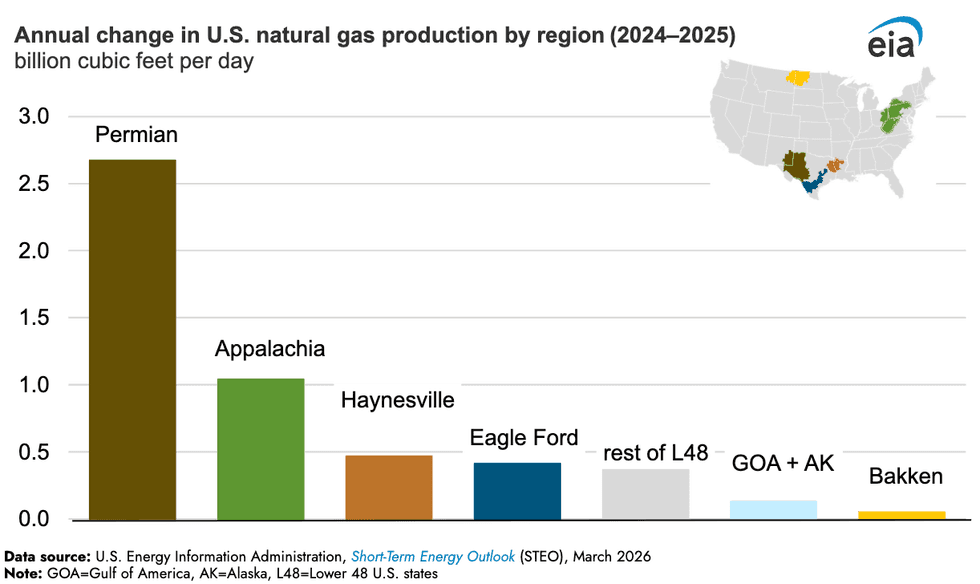
Natural gas production, meanwhile, hit a record in 2025, growing by 5.3 billion cubic feet per day, according to the latest analysis from the Energy Information Administration. Three regions — Appalachia, the Permian, and Haynesville in Louisiana — accounted for 67% of the total production increase and 81% of the growth.
5. Germany comes out against the EU’s nuclear plans
Germany regrets phasing out nuclear power. More than half the country now wishes the government hadn’t shut down the last nuclear power plants in 2023, polls show. Chancellor Friedrich Merz called the phaseout “a huge mistake” with “strategic consequences.” Ursula von der Leyen, the German politician who currently serves as president of the European Commission and the European Union’s figurehead, likewise described her native country’s atomic exit as “a strategic mistake.” Despite the rhetorical alignment, the government in Berlin is coming out against the EU’s nuclear expansion plans. In a statement last week, Federal Minister Carsten Schneider called nuclear reactors “high-risk technology” and said “setting up new reactors on a notable scale would require very large amounts of money that would then not be available elsewhere.” Rather, he said, “alternatives have long since been available,” such as wind and solar. “As far as Germany is concerned, instead of chasing a nuclear mirage, we will focus our resources on better, safer, and more economic alternatives,” he said. “Our country has become a much safer place thanks to our phase-out of nuclear power.” Soaring electricity prices and surging coal use suggests otherwise.
Switzerland, meanwhile, has not only halted its nuclear phaseout. Now the country is considering a bill that would allow construction of new reactors, NucNet reported.
THE KICKER
As the world gets hotter, it’s going to be raining men. Well, at least it might be for the reptilian versions of The Weather Girls, the singers behind the 1982 hit. American alligator eggs incubated around 86 degrees Fahrenheit tend to produce females, while temperatures near 91 degrees yields males. But the effects of temperature on squamates, the large and diverse group of reptiles that includes lizards and snakes, had been largely overlooked. New research on leopard geckos, which is set to be published in Developmental Biology by a group of Japanese scientists, found that about 79 degrees is the best temperature for females, while about 90 degrees leads to males. The study “contributes significantly to the broader understanding of the evolutionary plasticity and molecular complexity by which environmental cues direct biological fate,” Shinichi Miyagawa, Tokyo University of Science professor who authored the study, said in a press release.