GLOBALVARS
0
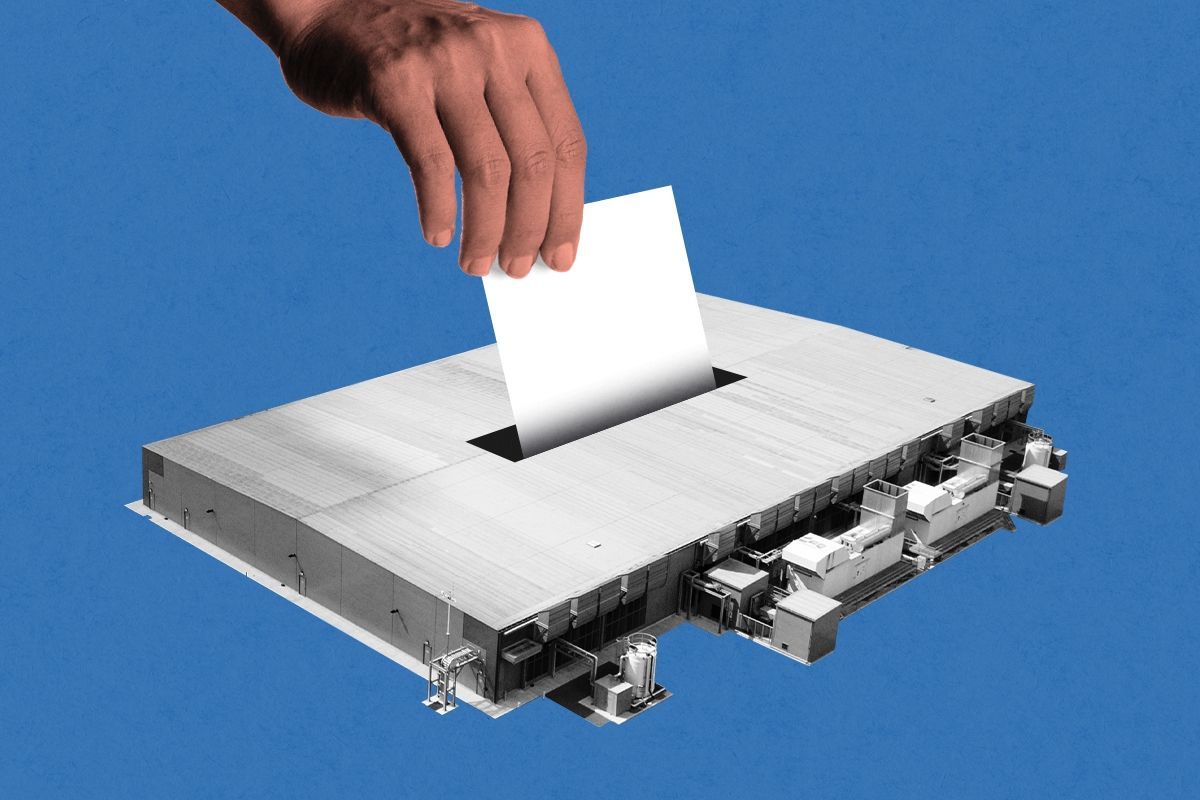
Early voting began last week for control of the Salt River Project, the large water and electric utility that serves the Phoenix metropolitan area. Due to a convoluted series of events dating back to 1903, it is the only major election in the United States since before the Civil War that still requires voters to be landowners, with the value of one’s vote tied directly to how much land one owns. If you’re on a sixth of an acre, as many people in the Valley are, you get one-sixth of a vote. If you’re a renter, you get zero. Large landowners may get hundreds.
Because only an estimated 1% of eligible voters actually cast ballots in the SRP races — until recently, to learn if you even could vote, you had to call the corporate secretary on the phone — the utility has been a target for clean-energy and environmental groups, who see the election as a high-leverage opportunity to flip the traditionally more conservative board, council, and presidency, and press for more investment in renewables. Despite being located in one of the country’s sunniest regions, only around 8% of the SRP’s portfolio is solar. In recent years, groups like Lead Locally, the Sierra Club, and Jane Fonda Climate PAC have helped put six renewable energy advocates on the 14-member board.
“We’ve been gradually building towards the majority, and this is the year we can realize that,” Arizona State Senator Lauren Kuby, who ran for an SRP board seat in 2024 and lost, told me. Also up for election this year are Sandra Kennedy and Casey Clowes, a young Sunrise Movement activist, who are running together for president and vice president of the board, marking a significant push by clean-energy advocates for greater control.
If the slate fails to make a dominant showing, the alternative is “a board that’s pushing for more fossil fuels, and that’s going to be really bad,” Nick Arnold, a political committee chair for the Sierra Club Grand Canyon Chapter, told me. The Salt River Project would become “ground zero for an even worse cost‑of‑living crisis than we’re already seeing across the country,” he added — especially given the recent influx of data centers.
Though many Phoenix-area data centers are located outside the SRP voting area, a Heatmap analysis found at least 60 across 40 distinct locations within the SRP’s voting territory that are already operating or under construction. “What we’ve seen is that land that has been stewarded by a family trust has been reclassified into an LLC to be sold off for data center development, which makes it ineligible to vote in the SRP election,” Arnold said.
Because land is directly tied to votes in the SRP election and businesses can’t vote, the more acres in corporate hands, the fewer votes available for candidates of any stripe. With the margins in SRP elections often in the high hundreds or low thousands, a few large data centers can make the results unpredictable. Data center companies purchased roughly 500 acres of land within the Salt River Project boundaries in 2024 alone, the analysis found, chunks of which would have counted as votes in prior years. Though much of that land was located in odd-numbered districts, which don’t vote this year (again, this is a very strange kind of election), what’s certain is that the voter rolls are changing — and influence is being redistributed.
The strangeness also creates a potentially complicated flip side for the clean energy advocates, who are wary of data centers encroaching on the Valley’s limited water resources: In theory, the more landowners who sell to data center developers, the stronger small voters will become in the SRP elections as large, single-voter-owned parcels are taken off the map.
Large landowners tend to prefer the status quo. In Kuby’s previous attempt at getting a seat on the board, she lost to an alfalfa farmer and son of a former SRP president who named one of his LLCs Hitler Management as a “joke.”
“All [Kuby’s opponent] had to do was call up 10 to 20 of the largest-acre voters and make sure they get their ballot in for him,” Arnold said. “It’s that easy for status quo pro‑fossil‑fuel people to whip their votes, as opposed to adding up to that same amount across a bunch of 0.1- to 0.4-acre homes.”
Yet despite the potential rebalancing of the scales, shenanigans still abound. Ahead of the 2024 election, for example, one longtime agricultural family transferred around 217 acres from an LLC, which can’t vote, into a trust, which can, according to an investigation by Stephanie Chase of the Energy & Policy Institute, an anti-fossil fuel watchdog group. After the family’s preferred candidate won by a margin of 263.88 votes — 76% of which was attributable to the hastily thrown-together trust — the family then transferred the land back into an LLC and sold it to a data center.
I spoke to Chase about her report, and she told me she sees the data center component as mostly incidental. “The bigger story,” she said, “is the outsized influence that large landowners have in the SRP races because of how their voting scheme is set up.” But she also noted that “eventually, if a data center is developed [on the family’s land], they’re going to have influence and say in how any contract between SRP and that data center company gets developed or agreed upon.”
In seeming confirmation of how intertwined the SRP elections and data center issues are, developer Edgecore is reportedly planning a massive “technology and employment hub” on the Dobson Farm, the Dobsons being another major landowning family in the Valley. Chris Dobson is also running for SRP president this year.
Meanwhile, both Edgecore and Google, which is building its own data center complex in Mesa, have donated to Arizonans for Responsible Growth, a political action committee linked to Turning Point USA, the far-right political group founded by Charlie Kirk. (Google recently pulled back money from the PAC, potentially over concerns about bad press, the Phoenix New Times reports.)
Turning Point’s entry into the SRP race has caused major alarm among clean energy organizers; a spokesperson for the slate of clean-energy candidates told Axios they’re being outspent 10-to-1. But Ken Clark, who is part of the coalition and running for election in District 6, told me that the conservative group’s efforts could still backfire. Because of the hoops voters have to jump through to cast a vote in the SRP race, outcomes have historically been determined by which side is better at motivating voters to request ballots. “I do believe that Turning Point USA is inadvertently registering — for lack of a better word — a lot of people who are probably uncomfortable with their message or uncomfortable with data centers,” he told me.
Heatmap Pro’s opinion model, which forecasts data center and clean energy opposition based on proprietary polling and demographic data, backs up Clark’s instinct, showing that people in Phoenix’s Maricopa County strongly oppose the development of data center projects.
It remains anyone’s guess how, or even whether data centers will affect the outcome of the 2026 SRP elections, which conclude on April 7. But they seem all but certain to in the coming years. Since the margins of the Salt River Project elections are often in the high hundreds or low thousands of votes, even a single data center that takes votes off the map could, in theory, tip the balance of a race — perhaps even against the data centers themselves.
“The board has the power to either make things more affordable or double down on fossil fuels and supply the data centers with energy subsidized by ratepayers,” Arnold said. “It’s a scary two paths that we’re looking at this year.”