0
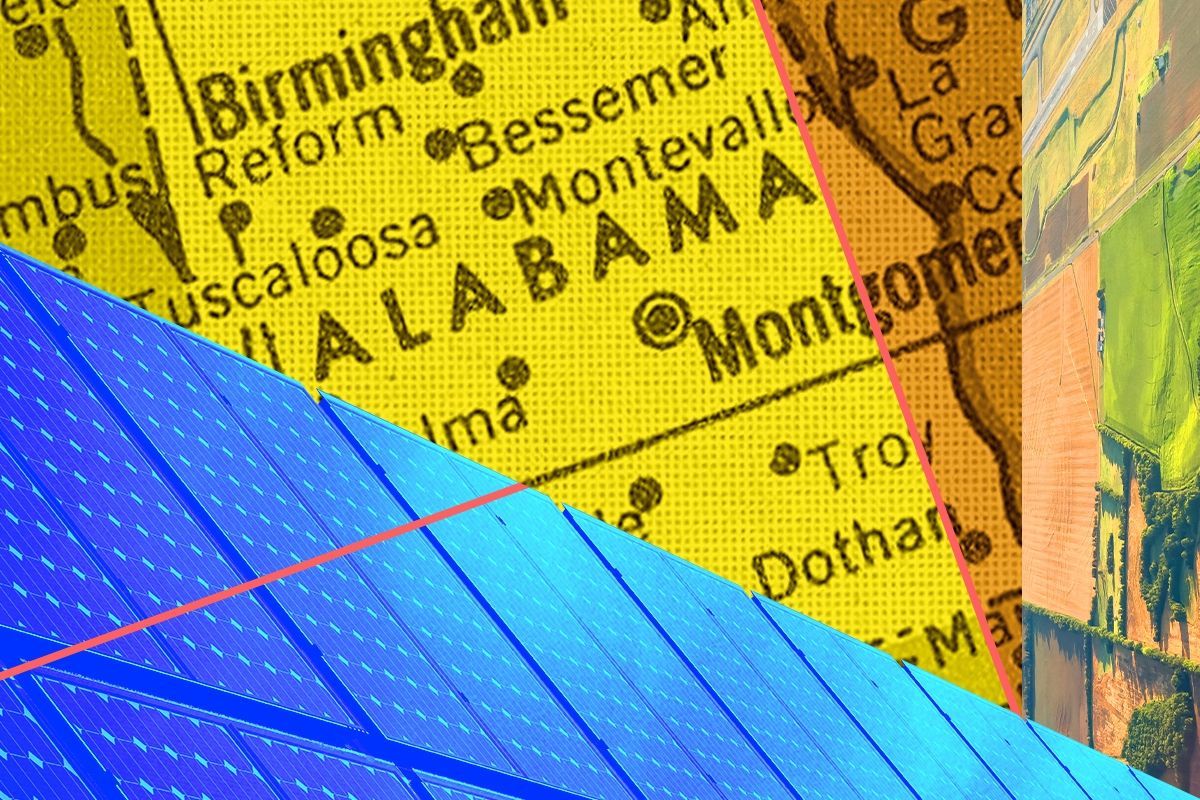
It started as a brawl between Meta and a small Alabama town over a solar farm. Now it’s become a push to ban utility-scale solar across much of the state.
Stockton, Alabama, is a teeny, unincorporated town of fewer than 1,000 people. It’s a conservative community in Baldwin County, south of the state capital of Montgomery, where homeowners are very concerned about nature conservation, as it is surrounded by undeveloped bucolic Gulf Coast forest and swampland. And right now, Stockton residents are hopping mad over a giant solar farm that would power a data center in Montgomery owned by tech giant Meta Platforms Inc.
Meta is working with developer Silicon Ranch to construct a huge solar farm to help power an expansive data center campus in the capital. The Alabama Public Service Commission approved the project last winter through a process opponents say was rushed. Whether the surprise of the solar farm was intentional or not, the approval sent shockwaves across the region. Worse, under state law, county officials say they aren’t allowed to regulate land use within unincorporated and unzoned areas, leaving local elected bodies with little recourse.
That left state-wide elected bodies to muster a response. The Meta-Silicon Ranch project in Stockton also frustrated some Republicans in the state legislature, giving rise to SB 354, a bill that would ban new utility-scale solar projects across most of Alabama for at least a year. The bill was reported out of the state senate’s transportation and energy committee on March 11 with one exception added allowing the Tennessee Valley Authority to add new solar capacity. But anywhere else? This bill would stop big solar farms in their tracks. If enacted, the ban would take immediate effect.
We’ve seen a lot of local bans like these in towns and counties. We’ve also seen states restrict wind farms. But as far as I know, this would be the first time a state issued a blanket ban on solar projects.
SB 354’s author is State Senator Greg Albritton, who represents Stockton. At the bill’s hearing earlier this week, he compared his legislation to the ways towns, cities, and counties have in recent years paused solar and wind projects to develop hypothetical regulations.
“What I’ve done with this bill — what I’m doing here, at this point — is I’m asking we pass this, a moratorium on construction of any new ones until we can get answers on any policies and procedures,” Albritton told the committee.
The odds of the bill’s final passage and enactment have yet to come into focus, and Governor Kay Ivey previously supported the Meta data center campus. But there’s also clear precedent in Alabama for taking an action like this. In 2013, Alabama temporarily banned wind energy projects in response to a conflict over an Apex Clean Energy proposal near Stockton in Baldwin County. The state then explicitly gave counties like Baldwin the power to reject turbines.
If Alabama can ban wind for a while, why wouldn’t it try the same with solar?
“There was a wind farm nobody wanted. It’s like the same scenario on repeat,” Meagan Fowler, president of opposition group Friends of the Tensaw River, told Gulf Coast radio show Mobile Mornings in an episode published March 11. Fowler said she hopes the bill can advance while legislators also work in language explicitly granting the county power to regulate solar farms. “Our hope is that this regulation might make Silicon Ranch want to go somewhere else because that’s what happened with the wind turbine thing.”
John Dodd, policy director for the pro-renewables organization Energy Alabama, told me a House companion bill to the one-year ban was introduced yesterday, but the group’s aim is to “effectively kill it,” he said, or try to get legislators to narrow the focus of the ban just to Stockton and Baldwin County.
“SB 354 would impose a blanket, statewide prohibition on new large-scale solar facilities — something that isn’t defined — for an entire year. That’s not targeted oversight. That’s effectively hitting the kill switch on an entire industry overnight,” Dodd told me in a statement. “In a state that prides itself on being pro-business and welcoming to investment, that sends a troubling signal.”
The Stockton solar farm is planned to begin full construction in 2027, and the process will take between a year and 18 months, according to Silicon Ranch’s recent statements to local media. The project still requires a building permit from Baldwin County and a water permit from the U.S. Army Corps of Engineers.
Silicon Ranch could not provide comments by publication time, and Meta did not respond to a request for comment.