GLOBALVARS
0

Current conditions: As a dangerous heat dome settles over the central and eastern United States, evapotranspirate, or “sweat,” from corn has rendered Iowa and Illinois more humid than the Amazon • Temperatures just topped 100 degrees Fahrenheit in Zagreb, where intense thunderstorms are deluging the Croatian capital today • Hanoi, Vietnam, is in the midst of a week of severe thunderstorms.
THE TOP FIVE
1. U.S. weighs banning foreign inverters
In May 2025, Reuters broke news that the U.S. government had discovered rogue communications devices in the inverters that converted the direct current flow of electricity from certain Chinese-made solar panels to the alternating current needed to patch the generators onto the grid. Now, more than a year later, Reuters is out with another scoop indicating that the Trump administration is preparing to slap new import restrictions on foreign-made inverters, particularly from China. The prohibition being drafted by the Federal Communications Commission would apply to all new foreign models of inverters and could be published as early as this year, unnamed sources told the newswire.
Chinese manufacturers such as Huawei and Sungrow currently dominate the inverter market. Earlier this year, the Texas startup SolarEdge started shipping inverters from its factory in Austin to buyers in Europe. But the global inverter market was on track to contract by 2% this year as policy changes in China, the U.S., and Europe created more uncertainty for solar.
2. Florida bans municipalities from setting net-zero goals
The self-described “free state” of Florida has stripped municipalities of their right to set targets for bringing the local economy’s planet-heating emissions to net zero. A new law known as HB 1217 prohibits local governments from pursuing net-zero goals, though legal experts said the legislation will not necessarily upend existing climate targets in at least 10 cities and counties including Fort Lauderdale, Miami, Orlando, and Leon County, where the capital city of Tallahassee is located. “It’s certainly meant to scare municipalities and local governments from trying to do things to further net-zero policies,” Bradley Marshall, senior attorney at the advocacy group Earthjustice, told Inside Climate News. “Now, its exact impact and what it exactly prohibits is probably up for some debate. Things that are adjacent to it — emissions reductions and even climate change reduction policies — on their face will not run afoul at all of a ban on adopting a net zero policy.” The move comes two years after Florida’s governor, Ron DeSantis, signed a bill stripping the words “climate change” from state policies.
The Trump administration, meanwhile, has accused New York State of violating U.S. Department of Agriculture standards to make prime farmland available for large-scale solar development. In a letter sent last week to New York Governor Kathy Hochul, Secretary of Agriculture Brooke Rollins warned the state against fast-tracking solar projects on prime farmland, and gave Albany 30 days to “explain why New York is moving away from USDA’s prime farmland standards and what it’s doing to protect these irreplaceable agricultural resources.”
Sign up to receive Heatmap AM in your inbox every morning:
* indicates required
Email Address *Our Privacy Policy & Terms Apply.
3. Spain built more solar than its grid could handle
The pain in Spain is felt mainly by the investors who paid to build out all the solar panels now harvesting the sun on the plain. In just the past six months, the European country has already surpassed its annual record for the number of hours when the owners of solar farms must pay users to take electricity during sunny peak hours, when the sheer volume of panels now turning sunshine into power pushes midday prices well below zero. The glut has kept electricity prices in Spain among the lowest in Europe, with rates roughly half of what Germans pay. But at least four Spanish projects or companies have gone up for sale, according to a Bloomberg tally. The head of Catalonia’s regional utility, L’Energètica, said: “The economics have deteriorated so sharply that investors are trying to exit at steep discounts.”
Investors in the sector had expected that Spain would upgrade its grid and deploy more batteries as the country’s solar sector boomed. But the mismatch between the volume of generation and the capacity of wires, batteries, and offtakers to distribute or make use of that electricity has only grown since the April 2025 blackout that plunged most of Spain and Portugal into darkness. Since then, Spain’s national grid operator, Red Eléctrica, has grown more aggressive in ordering solar farms offline to avoid disruptions to the frequency and voltage of the distribution system. The country has vowed to undertake more than $34 billion in grid upgrades by 2030.
4. Germany could restart five nuclear reactors in as little as five years
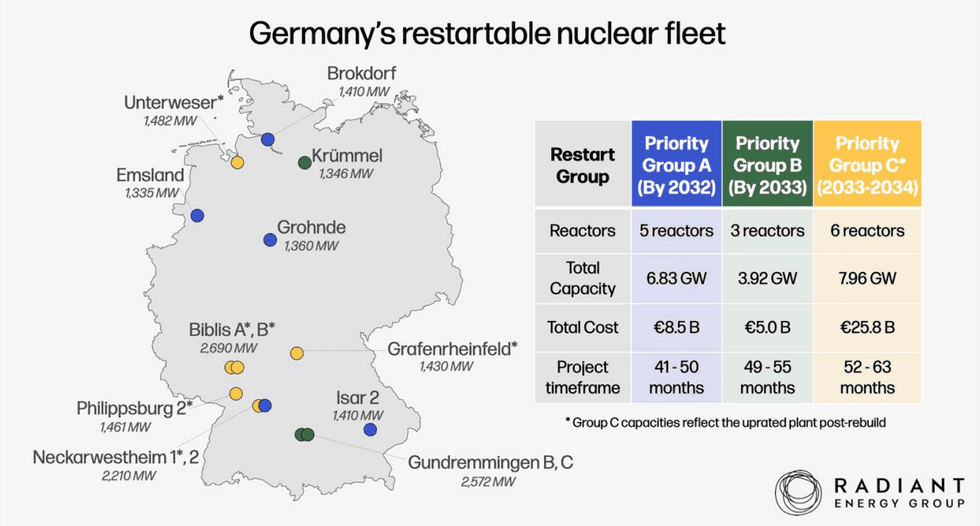
In the three years since Germany shut down its last nuclear power station, the country’s leaders have repeatedly called the phase out a mistake, but seesawed on whether the plants that haven’t yet seen the wrecking ball could be restored to operation. A new study by the nuclear consultancy Radiant Energy Group has found that the most recently shuttered five reactors, all pressurized water reactors, could be returned to service in 2031. “Germany’s nuclear phaseout was presented as permanent and irreversible. In reality, it is neither,” the report concludes. “The shuttered fleet remains to a large degree intact, with most of the value in each site preserved; every major component can be repaired or replaced using procedures demonstrated at comparable plants worldwide; and the economic case for restart is strong.”
5. Italy’s oil giant invests in Argentina’s big natural gas project
Well over half of Argentinians claim Italian ancestry. The South American nation’s future natural gas molecules might now declare a similar background. Eni, the Milan-based national oil company of Italy, inked a deal last week to buy a 32% stake in three upstream blocks of Argentina’s Vaca Muerta basin. Located in the mountainous western province of Neuquén, the discovery is widely considered the most promising natural gas find in Latin America, so vast The Rio Times said it could “reshape South America’s energy map.” In a statement, Eni’s chief operating officer, Guido Brusco, said: “Vaca Muerta is one of the world's richest unconventional basins in terms of resources: our participation positions us across the entire value chain, from Argentine upstream to the supply of LNG to international customers, creating value while contributing to global energy security.”
Meanwhile, Brazil’s national oil company just notched a record output from at the flagship field of its Santos Basin offshore basin. The field is now producing a record 1.1 million barrels of oil daily, surpassing the previous peak set in October of a million barrels per day, according to Oil Price. The milestone comes as Brazil ramps up production of oil and gas, despite its left-wing government’s expressed concern over climate change.
THE KICKER
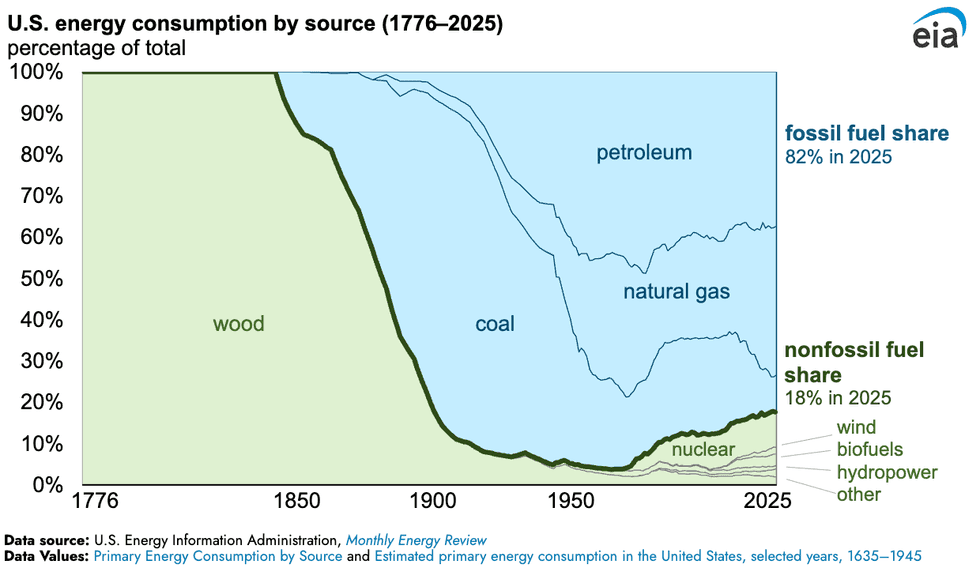
New analysis by the Energy Information Administration shows this nation was founded on … renewables. Now, of course, that was primarily wood until hydropower came around in roughly the 1880s. But coal, which surpassed wood in 1885, was the real innovation behind the energy transition away from chopped trees. At a combined 18% of total energy consumption in the U.S., non-fossil sources such as wind, water, and nuclear reached what appears to be the highest point since 1900 last year.