GLOBALVARS
0

Current conditions: Flooding from heavy rains in Ivory Coast and Ghana has killed at least 71 people so far • Barreling northwest of the Philippines, Tropical Depression Henry could strengthen into a storm by this evening • Philadelphia is roasting in 100 degrees Fahrenheit and bracing for thunderstorms as France and Paraguay prepare for Saturday’s World Cup knockout game.
THE TOP FIVE
1. NRC proposes major nuclear energy overhauls
On Wednesday afternoon, the Nuclear Regulatory Commission pitched two sweeping overhauls of the nation’s rules for building atomic power stations. The first proposal calls for replacing a radiation protection standard called As Low as Reasonably Achievable, or ALARA, with hard dose limits. “This rulemaking is raising the bar on clarity in our regulations. It is not lowering the bar on our safety standards,” Ho Nieh, the NRC chairman, told a small group of reporters on a call. “Dose limits for members of the public? They are not changing. We’re just really putting in clarifications on how to address doses below regulatory limits.” The second proposal expands the menu of options available to developers pursuing licensing through one of the NRC’s existing pathways, allowing some novel approaches to weighing the risk of certain technologies to factor into older processes.
The announcement came the same day the Department of Energy reached a milestone in its reactor pilot program. Launched last year, the program set a goal of three of its 10 participating companies building test reactors and splitting atoms for the first time by July 4. On Wednesday, the startup Deployable Energy, which is seeking to commercialize a 1-megawatt reactor, said it had reached criticality on its Unity test reactor at the Idaho National Laboratory, becoming the third developer after fellow microreactor companies Aalo Atomic and Valar Atomics to sustain a chain reaction within its reactor. “Yesterday, we accomplished a significant milestone on a timeline many thought was unachievable,” Secretary of Energy Chris Wright said in a statement. “Advanced nuclear technologies like Unity will help power the next generation of American industry, strengthen our energy security, and ensure the United States remains the world’s nuclear innovation leader.”
2. PJM can’t even keep up with the forecasts on its own electricity demand
PJM Interconnection’s struggle to muster up enough electricity generation to meet surging demand from data centers and air conditioners is well known at this point. But the difficulty the nation’s largest power grid system has just predicting how much electricity it will need raises real concerns over whether PJM can keep the lights on. Between 4 p.m. and 5 p.m. ET today, demand for electricity in PJM Interconnection could top out at 166 gigawatts, according to the energy consultancy ICF. That’s roughly 10 gigawatts higher than PJM’s projected summertime peak of 156 gigawatts for all of this year. “Because PJM’s planning methodology relies on a rolling 30-year historical weather average, it operates under the assumption that the future will resemble the past,” ICF wrote in a memo. “This modeling creates systemic risk, underestimating the frequency and severity of future extreme weather events.” As Heatmap’s Matthew Zeitlin wrote last month, PJM territories such as New Jersey have seen average bills soar from about $91 to $140 over the past five years, while prices are up some 52%, per data from the Heatmap-MIT Electricity Price Hub.
In New York City, meanwhile, Mayor Zohran Mamdani has urged residents in the five boroughs to keep air conditioners set to 78 degrees to conserve electricity and avoid brownouts. “A stable grid means the AC stays on, and lives are saved,” he wrote in a post on X. “Let’s ease demand — and get through the heat — together.” New York’s statewide grid operator has warned for months that the zone that includes New York City and its surrounding suburbs is at risk of outages due to a gap between supply and demand that virtually matches the output of the Indian Point nuclear plant that shut down in 2021.
3. The U.S. is withholding 75% of the billions set aside for Puerto Rico’s grid
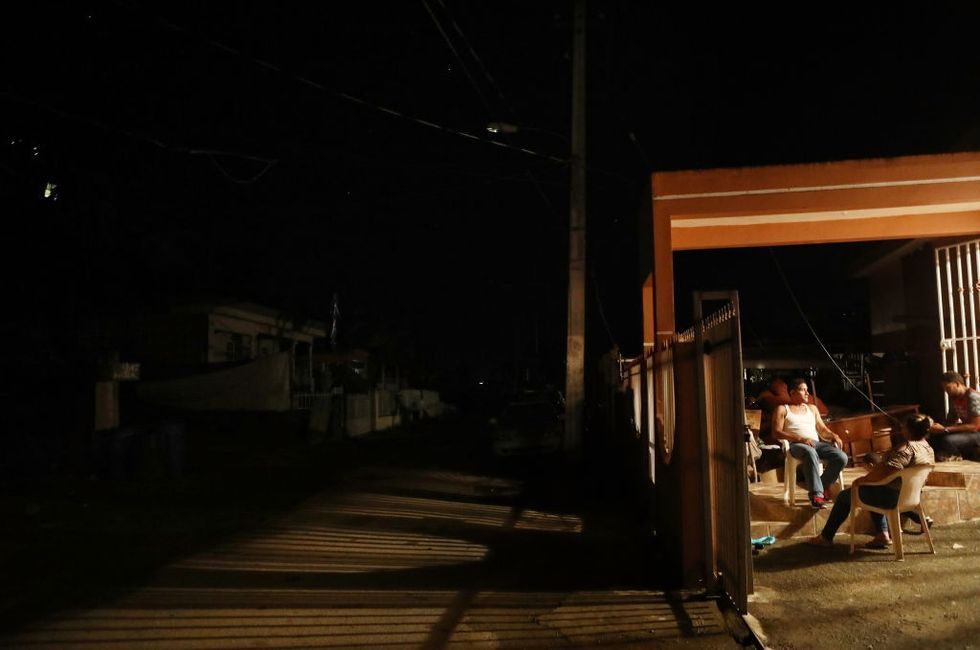
Of the $14.3 billion the federal government earmarked for the reconstruction of Puerto Rico’s grid, 75% of the funding remains unspent nearly a decade after Hurricane Maria laid waste to the U.S. territory’s electrical system. The Federal Emergency Management Agency alone is sitting on $8.4 billion, and just 400 of the 16,000 miles of transmission and distribution lines that were slated for tree trimming have had overgrown vegetation cleared. That’s all according to the findings of a new report from the Government Accountability Office, an independent federal watchdog within the government. One bright spot for Puerto Ricans has been the success of residential solar panels and batteries in supplying power during frequent outages. But the report notes that the Energy Department canceled up to $350 million in grants for installing solar panels on the homes of disabled and low-income Puerto Ricans. “The GAO report confirms what we’ve been saying for months: This administration’s shortcomings and the lack of coordination among all stakeholders have delayed the disbursement of funds,” Representative Pablo José Hernández Rivera, Puerto Rico’s resident commissioner, a nonvoting delegate to the U.S. Congress, said in a statement. “Puerto Rico needs less division and excuses and more teamwork with results.”
Sign up to receive Heatmap AM in your inbox every morning:
* indicates required
Email Address *Our Privacy Policy & Terms Apply.
4. West Virginia is getting a new rare earths processing hub
Last year, Wyoming, the country’s top coal-producing state, announced that its first new coal mine to open in decades would also produce rare earths. Now West Virginia, where the waning coal industry nevertheless remains a central part of the culture and economy, is getting in on the rare earths game. On Wednesday, an investment company led by the Trump administration’s former critical minerals czar unveiled plans to develop a new hub for refining rare earths out of ore in Rupert, a tiny mountain town in southeastern West Virginia. The project is being developed by the White House and led by Drew Horn, who worked as an adviser to the Energy Department and the Office of the Director of National Intelligence during Trump’s first term. Described as a “partnership,” the deal includes the Houston-based rare earths refiner Flash Metals USA, the industrial giant AmForge, and the Greenbrier Smokeless Coal Company, which already operates a metallurgical coal mine in Rupert.
“The initiative is backed entirely by private investment — not state government subsidies, taxpayer funding, or state incentives,” GreenMet, the investment company leading the project, said in a statement. “Instead, private investors recognized West Virginia’s abundant natural resources, skilled workforce, and strategic advantages, committing approximately $150 million to launch this first-of-its-kind processing hub.” While the future refineries aim to extract traces of rare earths left behind in coal mine waste, the project has already secured deals to buy more ore from Greenland, Canada, and Cameroon to beef up its output.
5. Electric trucks are muscling out hydrogen-powered alternatives in China
There was once a time when hydrogen fuel cells seemed like a serious rival to lithium battery packs as the energy source to power future passenger vehicles. But over the past decade, battery-powered electric vehicles won the market as prices came down and the infrastructure for buying hydrogen fuel lagged. Still, the limits of batteries — which are already very heavy in passenger cars, and weigh multiple tons when large enough to propel trucks — to affordably power tractor-trailer trucks seemed to leave the heavy-duty vehicle market open to hydrogen. But an article in the in-house magazine of Sinopec, China’s state-owned oil company, now calls into question hydrogen’s future in trucking in the People’s Republic, which has one of the most built-out networks for using the technology anywhere in the world. “In the past, it was generally assumed that electric vehicles would replace gasoline and hydrogen vehicles would replace diesel,” the Mandarin-language article reads, according to a translation I ran through Claude. “But with advances in EV technology and the development of charging and battery-swapping infrastructure, the traditional hydrogen vehicle scenarios of ‘medium-to-heavy loads and long range’ are now also trending toward being taken over by battery-electric heavy trucks.”
Meanwhile, in the inland Henan province, a pair of deep geothermal wells were connected to create a closed-loop system. The wells, dug nearly 11,500 feet deep, reach a temperature of nearly 245 degrees Fahrenheit. Once completed, the wells will be part of seven separate systems designed by developer Wanjiang New Energy to provide district heating. The technology, Think Geo Energy noted, “unavoidably draws comparisons to the closed-loop geothermal technology designed and built by Eavor Technologies,” whose CEO Mark Fitzgerald joined Heatmap’s Shift Key podcast last year.
THE KICKER
Build Your Dreams? More like Beat Your Deliveries. Chinese auto giant BYD delivered 557,090 fully electric vehicles in the second quarter of 2026 — trouncing the roughly 400,000 deliveries Tesla is expected to report for the same quarter, according to Electrek. We’ll find out later today when Tesla announces its latest earnings.