GLOBALVARS
0

It happened again. The Trump administration has struck a deal with an offshore wind developer to cancel another round of projects. My colleague Emily Pontecorvo has the full story: The Chicago-based company Invenergy has accepted $765 million to give up four offshore wind leases off the coast of New York, California, and Maine.
These deals might be legally suspect — Democratic state attorneys general sued to block them a few weeks ago — but the administration says more are coming. “The Department of Justice looks forward to continued cooperation from companies that are reevaluating their energy investments,” the official press release about today’s deal intones. I have to applaud the federal lawyer who chose the phrase “continued cooperation” here; it is suitably menacing while implying that developers who give in to the racket are somehow complicit.
If you read Heatmap, you knew a deal like this might be coming. As Emily writes, she predicted that Trump would target Invenergy for a deal back in April. Eyes now turn to the German developer RWE, which is sitting on two more leases and hasn’t yet taken a bargain.
Most observers have seen these deals as a front in the president’s war on wind power. And, of course, they are. But they should also be viewed as part of Trump’s peculiar attack on the economy of coastal states.
By Heatmap’s tally, the Trump administration has now terminated the leases for more than 14 gigawatts of planned offshore wind capacity, or roughly enough to power at least 6 million to 7 million homes. More than half of those gigawatts were initially planned to go to New York and New Jersey’s strained power markets (and on from there to New England and the Mid-Atlantic).
Another 3.4 gigawatts were planned for Maine’s power grid. Maine already suffers from some of the highest power bills in the country, according to Heatmap and MIT’s Electricity Price Hub; its rates have risen more than 10% in the past year.
California was slated to get another 4 gigawatts, and the Carolinas were due the last remaining gigawatt.
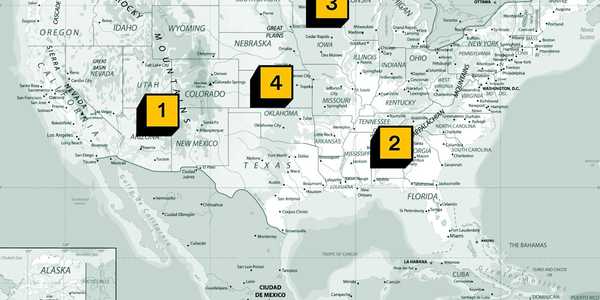
What’s funny — or perhaps fishy, given the maritime setting — is that administration officials seem to realize that they shouldn’t be taking so much electricity generation off the map. Today’s Invenergy deal includes a new quasi-quid pro quo arrangement: In exchange for giving up its offshore wind leases, Invenergy agreed to develop natural gas or geothermal power plants in Indiana, Wisconsin, Iowa, Kansas, and Missouri. (Previous deals countenanced only fossil fuel development, so I suppose this counts as a “win.”)
But of course, as Hilary Bright, who leads the pro-wind group Turn Forward, argued this afternoon, that doesn’t work. “These buyouts are not one-for-one ‘swaps’ for another kind of energy,” she said in a statement. These wind farms were meant to bring new generation capacity online in some of the country’s most stressed power markets. It doesn’t work to cancel them, then build new power plants in the middle of the country. New York is particularly power-constrained at the moment and faces a risk of summertime blackouts as soon as the end of this decade. Invenergy’s wind leases in the tristate area — or, as FIFA would call it, New York/New Jersey — were closer to operation than any of its other projects.
If and when blackouts arrive in Gotham, will New Yorkers look back and remember this moment? Or — somewhat more importantly to Trump — will voters in Maine and North Carolina, both of which have elections this November that will help determine the balance of the Senate. Whatever happens, we’ll be watching it here at Heatmap.