GLOBALVARS
0

Current conditions: Tropical Storm Arthur made landfall over Texas just hours after strengthening into the first named storm of the Atlantic hurricane season • Temperatures in Spain, France, and Portugal are forecast to eclipse 104 degrees Fahrenheit by this weekend • A fast-moving wildfire is scorching homes in the Beacon Hill area of Spokane, Washington.
THE TOP FIVE
1. U.S.-Iran deal will reopen the Strait of Hormuz and lift sanctions
On Wednesday, President Donald Trump signed a 14-paragraph memorandum of understanding with Iran to end the war. Under the deal, which is set for tougher negotiations over the fine details within 60 days, the Strait of Hormuz will reopen, the U.S. will lift sanctions on Iran and unfreeze billions of dollars, and Tehran will continue expanding its civilian nuclear program with a pledge not to seek an atomic weapon. Oil markets responded to the milestone with mixed results. The benchmark prices for oil produced in the U.S. and Europe tumbled about 2% on Wednesday, while the standard for crude from the United Arab Emirates jumped over 3%.
In other macroeconomic news: The Federal Reserve announced Wednesday that it was leaving its benchmark interest rate unchanged for the fourth straight time. Speaking at his first policy meeting since taking office, Kevin Warsh, Trump’s newly appointed Fed chairman, promised to “deliver price stability.” But CNN noted that most of Warsh’s colleagues signaled in their economic outlooks that they anticipated hiking rates again later this year. Rate cuts, as Heatmap’s Matthew Zeitlin has written, are key to boosting renewables, whose upfront costs make them sensitive to interest rates on capital.
2. Trump pays $765 million to kill four more offshore wind leases
The Department of the Interior has agreed to pay the developer Invenergy $765 million to cancel its four offshore wind leases, an amount equal to what the company paid the federal government for access to the areas. Like the administration’s previous deals to kill off as-yet-unbuilt offshore wind projects, Invenergy’s agreement is structured as a legal settlement. As Heatmap’s Emily Pontecorvo explained, the deal follows a similar $928 million arrangement with TotalEnergies announced in March, and an $885 million agreement with several joint ventures in April. That brings the total amount the administration has agreed to pay to end offshore wind leases to more than $2.5 billion to date.
A group of state attorneys general filed a legal challenge to those previous deals earlier this month that questions their use of the Judgment Fund, a functionally unlimited well of cash the federal government can use to settle ongoing or imminent lawsuits. Here’s Emily with more on the Judgment Fund and why using it may be tricky for the administration to defend.
3. Exclusive: Solar uses just 0.07% of prime U.S. farmland
Among the most poignant critiques of solar energy are its intermittency and the amount of land needed to generate vast quantities of power. Batteries are quickly solving the first part of that equation. But data from a new interactive map the Solar Energy Industries Association published this morning shows that solar today takes up just 0.04% of the total U.S. land area, and 0.07% of prime American farmland. There were zero states where solar used more than 0.5% of prime farmland, according to the data, which was shared exclusively with Heatmap. In fact, nearly every state has more abandoned prime farmland than solar-developed parcels. Nationally, there are 43 acres of abandoned prime farmland for every acre of solar on prime farmland. As a particularly jarring point of comparison, golf courses alone use 2.6 times as much prime farmland as solar, while suburban development just since 2014 uses roughly six times as much. “America depends on our land to grow our food, build our communities, and power our lives,” Tim Pawlenty, the newly-appointed chief executive of SEIA and a former Republican governor of Minnesota, told me in a statement. “Responsible land use means balancing all of those needs. This map helps provide important context by showing that solar and agriculture can thrive together. Solar development uses a very small amount of farmland compared to many other common land uses, while also delivering affordable energy, local tax revenue, and reliable income for farmers and landowners.”
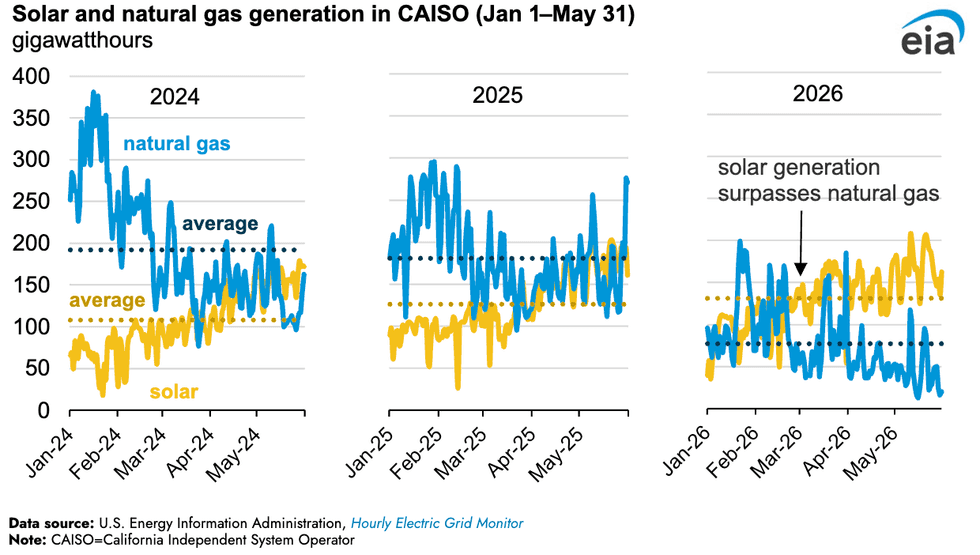
Solar, meanwhile, hit a major milestone in California. In the first five months of 2026, utility-scale solar generation in the California Independent System Operator surpassed natural gas power, according to a new analysis from the Energy Information Administration. Compared to the same five-month period in 2024, this year saw a 21% increase in solar generation. Gas-fired generation, meanwhile, sank by 60%.
Sign up to receive Heatmap AM in your inbox every morning:
* indicates required
Email Address *Our Privacy Policy & Terms Apply.
4. Switzerland and Estonia cruise toward legalizing new nuclear plants
Estonia’s parliament has passed a new bill creating the Baltic nation’s first complete set of rules for producing nuclear energy and overseeing its safety, NucNet reported, a key step toward building the NATO country’s first atomic power station. Meanwhile, Swiss lawmakers just rejected a bid to slow down legislation to allow for construction of new reactors again. Switzerland’s Council of States, its upper house of parliament, blocked a motion to refer a nuclear bill to the Federal Council ahead of a planned vote later this week.
In Sweden, the parliament approved legislation to streamline permitting for mining and processing uranium. The bill also included an amendment to open up more coastal sites to reactor development, World Nuclear News reported.
5. Solar tracking startup launches 100% American-made hardware
The U.S. is seeing the start of a solar manufacturing boom, perhaps best exemplified by the opening of the first fully integrated plant in Qcells’ factory. Now Soltec, a startup that manufactures tracking equipment to maximize power production, has launched a new line of hardware that it says is completely compliant with new restrictions on foreign imports. The company said it had spent the past year “reorganizing its U.S. supply chain with a clear objective: to provide customers with a highly localized supply network capable of meeting the domestic content requirements” of new federal rules. “By localizing its U.S. supply chain, Soltec helps customers pursue Made-in-USA tax benefits while improving cost competitiveness, delivery certainty, and resilience against tariffs, freight volatility and broader geopolitical disruptions,” Mariano Berges, Soltec’s chief executive, said in a statement. “The objective is to protect U.S. customers and provide greater execution certainty for their projects in an increasingly complex market environment.”
THE KICKER
In case you were wondering where former Secretary of Homeland Security Kristi Noem may turn up, here’s your answer: copper mining. The current special envoy to the Shield of the Americas, a pact of right-leaning Western Hemisphere countries, has joined NovaRed Mining, a junior miner that holds two early-stage copper exploration assets in Canada. Noem, who is taking an adviser role, boasts “extensive experience spanning economic development, infrastructure, energy, agriculture, national security and public-private collaboration,” the company said in a press release.