GLOBALVARS
0
This is an edition of Heatmap Daily, an evening review of the day’s news written by our executive editor. Sign up for it here.
El Niño is here.
The world’s largest ocean slipped into the weather pattern sometime between February and April, according to the National Oceanic and Atmospheric Administration, and the sea surface is now 2.8 degrees Celsius warmer than average in its benchmark region. When you chart ocean temperatures on a map, the “El Niño tongue” (yes, that is what scientists call it) clearly appears:
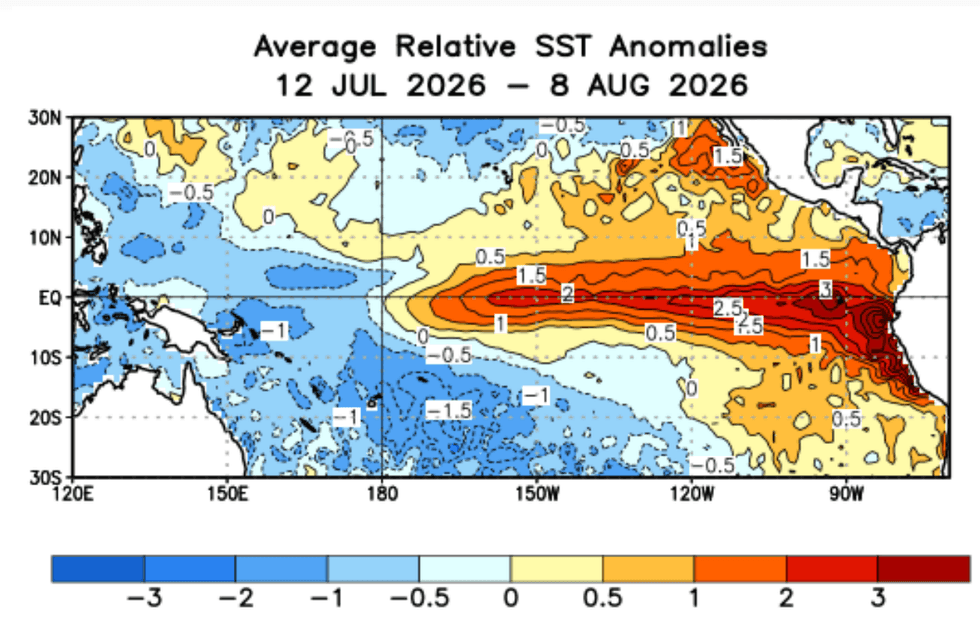
It might be more accurate to describe El Niño as something that happens to the planet, though. The Pacific occupies about one-third of Earth’s surface. When that third becomes unusually warm, it transforms weather around the world, driving wetter conditions in California, Central America, and South America; and drier weather in Asia, Africa, and Australia.
So far, so normal. El Niño is a standard fluctuation in the Earth’s climate system; we experienced the last one in 2023 and 2024.
But that is roughly where what’s normal about this year’s El Niño ends.
For one, this El Niño is far more intense than we should expect at this time of year. In an El Niño, the Pacific’s average temperature usually rises through the end of December or so; the phenomenon’s original name in Spanish, El niño de Navidad, alluded to the surprising arrival of warm currents in South America around Christmas. In the modern satellite era, the warmest El Niño ever measured happened in 2015, and ocean temperatures peaked at 3.1 degrees Celsius in November and December of that year. We called that a “Super El Niño” for just how abnormal it was.
Yet as I mentioned above, the Pacific is already 2.8 degrees Celsius (or roughly 5 degrees Fahrenheit) above normal — making this the third strongest El Niño ever measured in the satellite era — and it is only August. We still have four months to go, and this El Niño is already a record-smasher. More ominously, models expect that this El Niño could eventually grow to more than 4 degrees Celsius, or 7 degrees Fahrenheit, above normal.
What will that mean for the world? According to a recent Science study, the average El Niño can cost the global economy more than $3 trillion. The world is richer now than it was a decade or two ago, which should make it better able to withstand disaster. But this El Niño is so far out of sample that it’s hard to know what it could do.
And perhaps more importantly — as the climate scientist Zeke Hausfather, the guest of our new episode of Shift Key says today — it will offer a kind of preview of what the planet’s normalclimate will resemble a decade from now. This El Niño is likely to push 2027’s average temperature above 1.5 degrees Celsius, the nominal threshold at which countries hoped to limit warming as part of the Paris Agreement (although, as you’ll hear, it is ).
Which is all to say: I encourage you to listen to our new episode, which is available on Apple, Spotify, or RSS. (A transcript is also available for Heatmap subscribers.) We tackle questions including:
- Why do the models think this El Niño will be so bad?
- Why do we believe this El Niño could be the worst one in 500 or 1,000 years?
- Is climate change getting worse faster than we thought it would — is it accelerating?
There’s one thought that I didn’t include in the episode, however. Since late 2023, political discussion of climate change has decreased. This isn’t a phenomenon limited to any one faction of the Democratic Party — the progressives Abdul El-Sayed and Zohran Mamdani have downplayed climate policy roughly as much as, say, moderates like Mary Peltola and James Talarico have — but it is a clear trend. The American media’s coverage of climate change has declined during the same period. This “climate hushing” is not because politicians stopped caring per se, I think, but because nobody is sure how to talk about the issue in a politically useful way anymore, especially after the “climate = jobs” rhetoric that underpinned the Biden administration’s policy failed to retain voters in 2024.
I don’t believe (and think that political science has disproven) that extreme weather can “awaken” the public to climate change. Even against a gradually warming baseline, the weather — and public attention — shift far too often for that. But media coverage is loosely responsive to events. When the super El Niño of 2015 and 2016 smashed the then-record for the hottest year ever measured, it helped initiate a new era of public and elite concern about climate change. That El Niño’s heat waves, wildfires, and mass coral bleaching previewed the far worse disasters of the decade that followed. This El Niño’s disasters and broken temperature records couldbe worse — and even less ignorable.