GLOBALVARS
0

Current conditions: The devastating 7.4-magnitude earthquake that struck Colombia has left at least 111 dead • Severe thunderstorms once again caused ground stops at New York City’s airports, stranding your correspondent at Chicago O’Hare for the entire afternoon • Tropical Storm Chan-Hom is battering Tokyo.
THE TOP FIVE
1. The U.S. just recorded its hottest month ever
The United States sweltered through its hottest month in more than 130 years of analysis, breaking records set during the 1930s Dust Bowl. The average temperatures in the lower 48 states in July came out to 76.89 degrees Fahrenheit, 0.12 degrees above the value from July 1936. “Those who deny or dismiss U.S. climate change have hit a Waterloo moment of sorts,” wrote Yale Climate Connections.
The water levels in Lake Mead, meanwhile, have dropped to a record low as drought parches the American West. “This is a significant wake-up call,” J.B. Hamby, chairman of the Colorado River Board of California and the state’s lead negotiator, told The New York Times. “We need to have long-term solutions that are going to get us away from the precipice.”
2. China is sending vessels through the Arctic to carve out an ‘Ice Silk Road’
For years, the world’s great powers have jockeyed for control of the Arctic as climate change thawed sea ice enough to open new shipping routes across the frigid polar region. Now China is poised to launch its first regular container shipping service through the frigid North. On Monday, the Financial Times reported that Sea Legend, a Chinese cargo vessel that delivers to ports in Turkey and North Africa, will begin weekly service through the Arctic with a route following Russia’s northern coastline. Beijing is calling the approach its “Ice Silk Road.”
The Trump administration, meanwhile, told researchers Monday that it would stop funding the National Oceanic and Atmospheric Administration's lead report on how climate change is affecting the Arctic, Politico reported.
3. Federal court approves Trump’s request to reconsider Atlantic Shores offshore wind
The Trump administration won federal approval to reconsider the environmental review for the stalled Atlantic Shores offshore wind project off Atlantic City, New Jersey. Previously a joint venture between the French energy giant EDF and the oil behemoth Shell until the latter company pulled out following Trump’s reelection, the remaining developer had argued in court that the approval process completed under the Biden administration could not be reopened. While the company “points to various ways that it believes that Congress has limited” the Department of the Interior’s authority to reconsider a review, “none speak with the exquisite specificity to undercut” the government’s right to remand the approval, according to court documents Heatmap obtained last night. Acknowledging the potential for the White House to bog down the procedure in bureaucracy, the court said it will require the Trump administration to provide a status report for why a 120-day deadline for revisiting the review would not be possible. My colleague Jael Holzman had put the project on death watch last year.
Sign up to receive Heatmap AM in your inbox every morning:
* indicates required
Email Address *Our Privacy Policy & Terms Apply.
4. Tesla’s $17 billion chip factory will run on fossil fuels
If you listened to any of Tesla’s recent earnings calls, you know that Elon Musk has a lot of big plans for the company that don’t involve luxury electric vehicles with large in-dash homescreens. The company wants to mass produce humanoid robots. It’s promised to basically double America’s output of solar panels. And it’s aiming to build a $16.8 billion chip factory to rival Taiwan’s semiconductor industry. Yet that facility won’t be powered by Tesla’s solar. Instead, Musk said that his other company, SpaceX, will set up batteries and natural gas to keep the lights on for the plant. “The plant sits on the site of a former coal-fired power plant, and SpaceX plans to power it with newly built natural gas plants and batteries,” Electrek reporter Fred Lambert wrote. “So the compute future gets built on the same fossil ground as the past. Just swap coal for gas.”
5. China has emerged as the world’s new major oil power
At the start of the Iran War, a four-dimensional chess interpretation of President Donald Trump’s motivations posited that the conflict was actually about asserting control over China’s supply of hydrocarbons. Six months into the war, The Economist has declared China “the world’s great oil power.” Despite relatively limited domestic supplies, the People’s Republic managed to seize control over its energy fate through stockpiling, restricting exports, and curbing domestic demand by, for example, encouraging city dwellers to take mass transit and or cycle over driving. Among the other ways Beijing is limiting demand, as I have written previously: It’s pouring money into green hydrogen, ammonia, and methanol.
THE KICKER
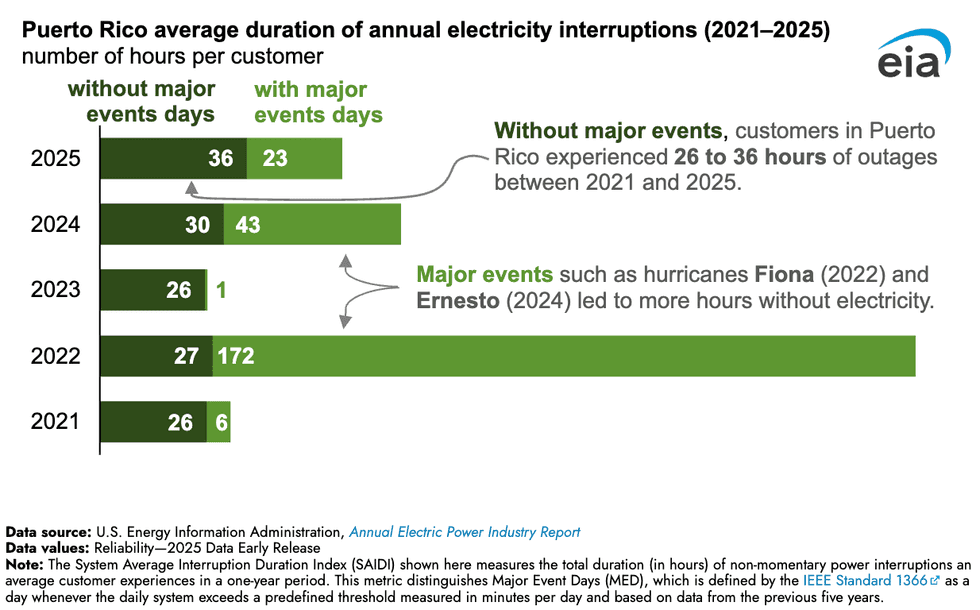
Puerto Rico’s blackouts got worse last year without extreme weather bringing on the outages. The latest data from the U.S. Energy Information Administration shows that the island’s beleaguered ratepayers suffered an average of 36 hours of power interrupts that were not caused by major events such as hurricanes. That’s 19% more than in 2024. Between 2021 and 2025, Puerto Ricans experienced a combined average of 29 hours of power loss each year.