GLOBALVARS
0
You might already know Jack Klein. Last summer, he went viral on TikTok for his videos documenting the heat on various New York City subway platforms, including recording a whopping “feels like” temperature of 130 degrees Fahrenheit at the 6th Avenue/14th Street L train station.
“No one had collected subterranean data within the New York subway system,” he told me. The results of his unsanctioned citizen science project — which covered seven highly-trafficked stations up and down Manhattan — attracted the attention of The Weather Company, Google Public Sector, and the New York Post (which called it a “quirky art project.”) Building on the success of his weird videos, Klein formally founded New York Lab last fall. There, he works to bring together engineers, scientists, and public health experts to lobby the Metropolitan Transportation Authority — a state agency, believe it or not, which holds the ultimate decision-making powers — to do more for the populations hit worse by extreme temperatures during their commutes.
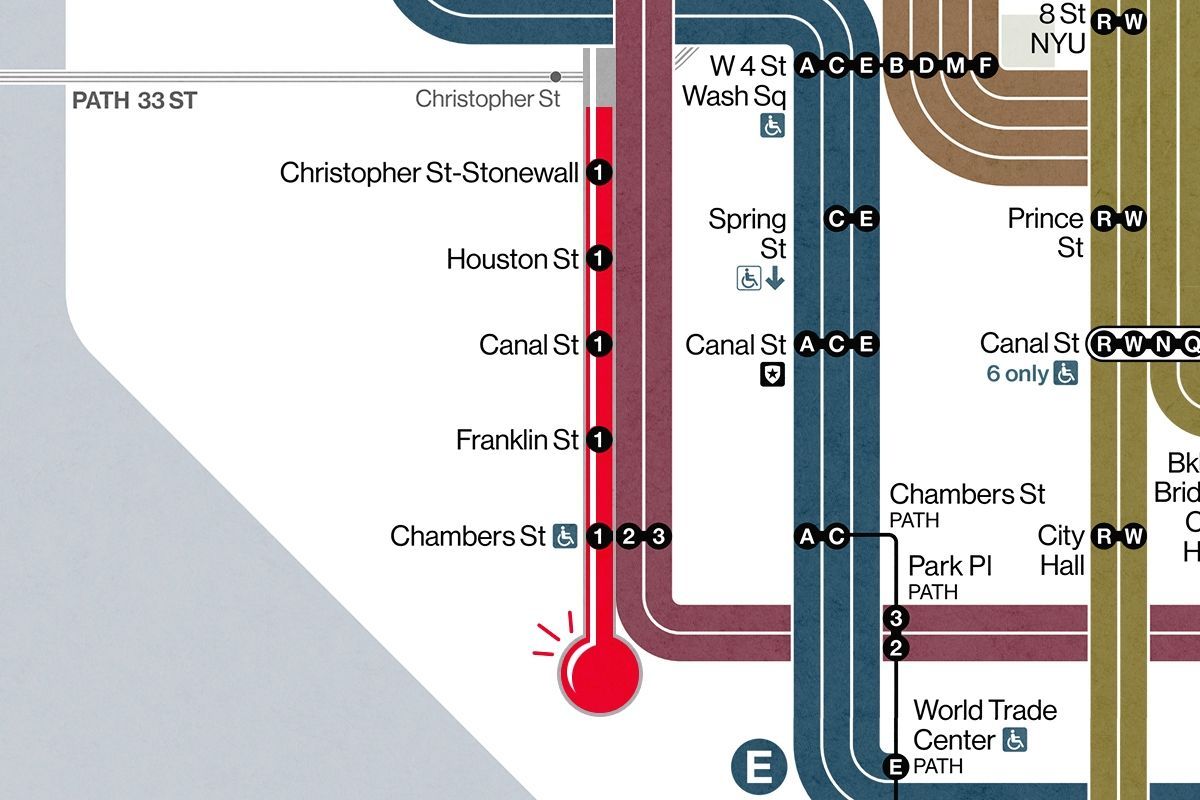
After many rejections and setbacks, it appears that someone is finally listening to Klein. On Tuesday, New York City Mayor Zohran Mamdani and New York Governor Kathy Hochul announced that the MTA is launching a feasibility study for the development of a thermal energy network at the Brooklyn Bridge-City Hall and Chambers Street station complex, funded by the New York State Energy Research and Development Authority. Essentially, the city and state want to know whether the stations are hot enough that the thermal energy could be captured — via 500-foot-deep boreholes that cool the platforms in the process — and used to warm nearby municipal buildings like City Hall in the winter.
I caught up with Klein to learn what he thinks about the project and what else the transit agency could do to bring relief to straphangers in the short term. Our conversation has been lightly edited and condensed for clarity.
What do you think about the location the city chose for this study?
I thought it was interesting they chose those stations. It seems like it’s a good place to test geothermal solutions because it sounds like there is a part of the tracks that isn’t being used, so they don’t have to stop service. That’s one of the challenges of these large infrastructure projects: The trains run 24/7, so you can’t really shut down the stations. [Editor’s note: The city also recently announced a multi-million-dollar restoration project for the Chambers Street station, funded by congestion pricing.]
Logistically it makes more sense because these other stations [I looked at] are really high in foot traffic — which I'm sure Chambers is, too — but because they're able to do the construction without disrupting traffic, they avoid a major roadblock. I feel like for a pilot, you don’t necessarily have to do it at the hottest station; the question is, what’s a hot station we can feasibly do this at?
Brooklyn Bridge-City Hall wasn’t a platform you monitored during your project last year, but the mayor’s office says it’s one of the hottest in the system, reaching 96 degrees Fahrenheit last summer. How does that compare with what you recorded?
I focused on the heat index, or the “feels like” temperature. They must be measuring the actual temperature of the station, but I don’t really ever go down there, so I don’t actually know. Of the stations I measured, 14th Street-Union Square and Times Square were in the 120s and 130s near the platform when the trains were in the station. So I imagine it’s quite similar.
Why was humidity important for you to factor in?
I remember two years ago, I had a digital thermometer, and I was pointing it at, like, a wet floor sign or the walls and floors of Union Square. There’s a shock value there, but it actually means nothing in terms of what my whole project is based around, which is that this is a health issue — especially for people in the most vulnerable populations, like the elderly, people with disabilities, pregnant people. So how do we measure what it actually feels like to stand waiting for a train? And we live in a subtropical environment, so humidity is a major factor. I mean, I’m literally sweating through my shirt in a [Brooklyn] school right now. There’s no AC, and it’s not even that hot; it’s just so humid.
And air-conditioned trains actually make the stations hotter, right?
It seems like one of the largest contributors to extreme heat in the stations during the summer is the AC onboard the trains. When a train pulls in, all the excess heat gets pushed onto the platform. You can feel that when you’re waiting for trains; when they pull in, it’s like an inferno of hot air on your face.
It’s a double-edged sword: They’re cooling the trains to be extremely cold, which is nice, but sometimes it’s a bit extreme, and it’s only making the stations hotter. I know there has been talk about not cooling them to such an insane degree, making them a bit warmer, so it wouldn’t heat the stations quite as much. But it’s a sort of paradoxical thing. There’s no right or wrong; it’s just the reality of having AC on trains. It makes the tunnels hotter and the stations hotter.
Did the possibility of a thermal energy network ever come up when you were talking with experts and the MTA about ways to deal with the subway heat?
Last summer, in September of 2025, the MTA issued a request for information on geothermal cooling technologies — specifically for the 168th Street 1 Station and the 181st 1 Station — because both are very deep, and there’s potential for Columbia and New York Presbyterian to use the heat during the winter. Some scientists and I, along with a geothermal engineering company I did this pro bono for, filled out a 14-question feasibility analysis. That was the RFI. Basically, it wasn’t a full analysis, but it was like, “If you were to pay us to do this, here’s what we could answer. Here’s a very quick explanation of how you could use boreholes. What other assets does the MTA already have that could be useful? How much money could you make off it?”
But now, we haven’t heard from the MTA in a year since our RFI. And I understand how RFIs work, which is that you don’t often hear back, but it does make me curious. What is the process for contracting out the pilot? Who gets chosen? Will we hear back? Because we did throw our hat in the ring a year ago, and now we’re hearing about it, and it’s obviously a direct result of those RFIs. So it’s exciting, but I’m also selfishly a bit like, Okay, well, are we going to be involved at all?
So you think there’s something to this idea, then.
I was relying on the engineers and scientists I partnered with to actually understand the technical side of these questions, but they are excited. They’re very confident in it.
The MTA put out another RFI in 2023 for geothermal, and though that didn’t go anywhere, there’s been talk about this for a while. That’s why this is exciting. But again, they announced the pilot, but it has to happen at one station, and there are all the financial and political hurdles still to come. So it’s cool that Mamdani is announcing it, but who knows what’s going to happen? Still, I think it’s the farthest the idea has gotten. And if they actually test it out, that’d be monumental.
What else could the MTA do to cool the stations down and keep people safe?
There’s another pilot right now [at the East Broadway Station] using radiant cooling technology, which runs pipes of water on the ceiling to soak up the heat. I’m focused right now on promoting access to water underground, more seating, and better ventilation — shorter-term, more adaptable, more realistic solutions. Because who knows how long these projects will take to actually implement in hundreds of stations?