0

Current conditions: The four-day Masters Tournament in Augusta, Georgia, is set to be the driest in 15 years, putting extra strain on the golf courses’ sprinkler systems • Severe Tropical Cyclone Maila is bearing down on Papua New Guinea and the Solomon Islands, deluging the autonomous island of Bougainville that is poised to vote to become an independent nation next year • A magnitude 6.2 earthquake just shook Indonesia’s Molucca Sea.
THE TOP FIVE
1. New Jersey legalizes nuclear
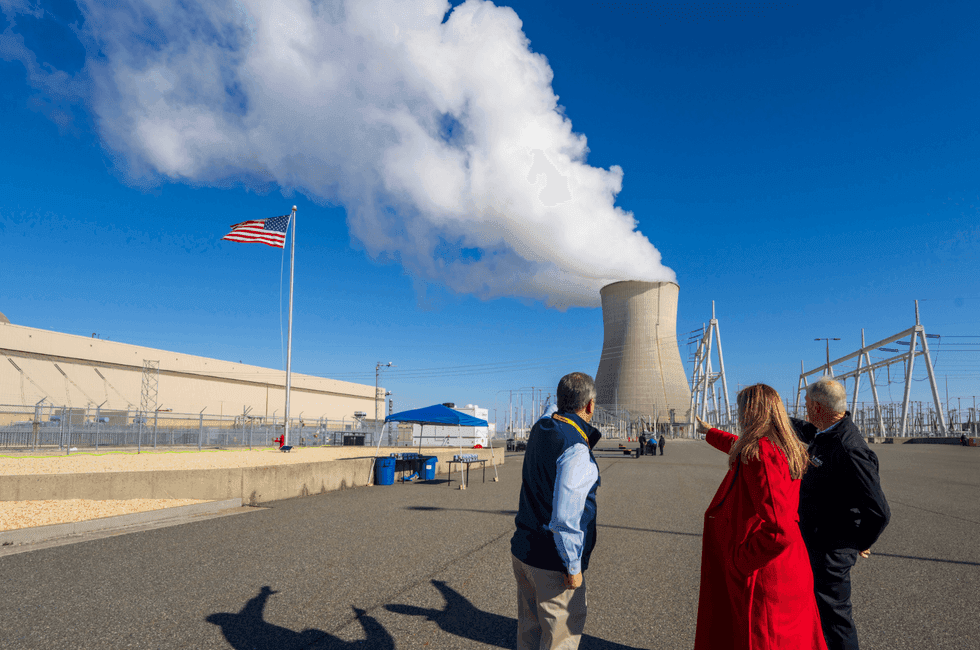
New Jersey just became the sixth state in the past decade to repeal its moratorium on building new nuclear reactors. The state enacted a de facto ban on atomic power construction in the 1970s, barring any permits for new plants until the federal government came up with a permanent solution for radioactive waste. But soaring electricity demand and a struggling buildout of offshore wind spurred Democratic Governor Mikie Sherrill to campaign last year on building at least a gigawatt of new nuclear capacity. On Wednesday, she signed legislation formally rescinding the waste requirement, authorizing the state to issue permits for new nuclear plants that, like all other atomic stations in the U.S., would temporarily store spent fuel waste on site in dry concrete casks. Speaking in front of a cooling tower at the Hope Creek nuclear generating station, one of two neighboring atomic plants in southwestern New Jersey that supply 40% of the state’s power, Sherrill said modern plants “are designed to be fail safe.” She added: “Across America, a nuclear renaissance is taking place.”
Five states — Wisconsin, Kentucky, Montana, West Virginia, and, as of January, Illinois — have fully repealed their statewide bans on nuclear reactors. While five of New England’s states maintain restrictions on atomic energy, all six endorsed a regionwide agreement to encourage construction of new reactors last month, as I previously reported. Virtually every state in that mix will face challenges building new reactors. The short of it, as Heatmap’s Matthew Zeitlin put it last year, is that “electricity markets aren’t working anymore.” The answer, at least for New York, is to rely on semi-socialist entities such as a state-owned utility to finance new reactors.
2. Iran-linked hackers are targeting key U.S. grid infrastructure
Hackers “affiliated” with Iran have been targeting programmable logic controllers, or PLCs, the crude industrial computers used to keep power grid operations going. That’s according to an advisory the U.S. Cybersecurity and Infrastructure Security Agency issued on Tuesday to the energy sector as the U.S.-Israeli war against Iran entered its sixth week, in spite of a fragile ceasefire deal. The North American Electric Reliability Corporation, the quasi-governmental grid watchdog, told Utility Dive it was “actively monitoring the grid.”
In Saudi Arabia, meanwhile, Iran attacked the country’s key east-west pipeline shipping oil to the Red Sea. A drone struck a pumping station on the 750-mile pipeline around 1 p.m. local time on Wednesday, the Financial Times reported.
3. Brazil adds BYD to its ‘dirty list’ for slave labor
BYD is officially on Brazil’s “dirty list.” The Ministry of Labor and Employment added the Chinese auto giant to its registry of employers that have subjected workers to conditions analogous to slavery after an inspection rescued 163 Chinese nationals at a construction site for the company’s new factory in Camaçari, in Bahia state. Auditors found fraud in migration papers and determined the factory was housing workers without mattresses and requiring shifts exceeding 10 hours without rest, according to a report by Folha de São Paulo. In one location, one bathroom served 31 people.
The company is set for a lot more scrutiny. BYD is among the top three Chinese automakers racing to set up dealerships in Canada after Prime Minister Mark Carney reduced tariffs, allowing Beijing to set up a beachhead on the continent despite harsh U.S. trade restrictions. Already, BYD has its eyes on 20 locations, as I previously wrote.
Sign up to receive Heatmap AM in your inbox every morning:
* indicates required
Email Address *Our Privacy Policy & Terms Apply.
4. A merger forms a $1 billion deep sea mining giant
This is likely going to be the year deep sea mining becomes a thing. The obscure United Nations body in charge of figuring out global regulations for the industry has vowed to complete its task this summer. The Trump administration is charging ahead with plans to unilaterally establish permits for deep sea mining in international waters. Alongside smaller island nations such as the Cook Islands, Japan has been harvesting minerals from its own seafloor, as I wrote in February, and is now pledging to join Washington’s effort. All of that is good news for one of the biggest stocks in the sector, The Metals Company, a Canada-based but U.S.-backed startup racing to win the first American permits to extract mineral-rich nodules from the depths of the Pacific Ocean.
Now another company has entered the fray. American Ocean Minerals Corp. is merging with Odyssey Marine Exploration, which is already traded on the Nasdaq, in a reverse takeover that will create a roughly $1 billion deep sea mining company. The all-stock deal includes more than $150 million in private financing and $75 million in money American Ocean Minerals raised prior to the merger. Pending shareholder approval, the combined company will retain American Ocean Minerals’ name and trade under the ticker AOMC. “AOMC will be positioned to be a reliable, long-term supplier for American re-industrialization,” Tom Albanese, the former Rio Tinto chief executive now serving as the startup’s chairman, told Mining.com. “We are taking a differentiated, responsible approach to the research and development of deep-sea resources. The work over the past decade has set a high standard for advancing the industry responsibly, and we are proud to play a role in maintaining that standard.”
5. Just six of California’s 52 hydrogen fuel stations are online
If you live in California, you’re one of the few Americans living in a market where a hydrogen-powered vehicle could work. But if you did make the switch to the less popular alternative to battery-powered cars, you aren’t faring much better than your neighbors driving gasoline guzzlers. The Iran War may be driving gas prices up past $7 per gallon in parts of the most populous state in the nation. But at least the gas stations are open. Just six of California’s 52 hydrogen refueling stations are currently in operation, according to data the trade group Hydrogen Fuel Cell Partnership shared with H2 View. “Several hydrogen stations are not available due to a disruption of the gaseous hydrogen supply chain that began in February 2026,” the trade group said. Five stations operated by Iwatani and Chevron are being supplied by low-pressure trailers, significantly reducing the amount of hydrogen they each receive. “You may not receive full fills during this time,” Hydrogen Fuel Cell Partnership said.
THE KICKER
The planet is flickering. The longstanding assumption has held that the world is getting brighter with artificial light as illuminated neighborhoods blink into existence in growing Asian, African, and Latin American megacities around the world. But a new study in Nature shows that the planet’s brightness is going up and down year to year. As Heatmap’s Jeva Lange wrote: “Though the researchers confirmed a 34% overall increase in brightness during the study’s nine-year scope, it was offset by an 18% dimness, meaning the net increase in brightness was only 16%. Further, nearly half of the portions of land area that experienced at least one change in artificial light also experienced some form of abrupt change — that is, a brightening or dimming event that unfolded over weeks or months rather than years, such as grid failures in Venezuela, load-shedding in South Africa, changes to fossil fuel operations in Texas, and armed conflicts such as the war in Gaza.”