GLOBALVARS
0

The national AI data center moratorium has momentum.
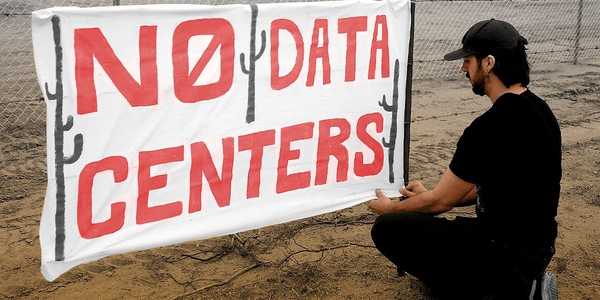
As I’ve been documenting for months here at The Fight, data center opposition is surging across the country. Our latest Heatmap Pro poll puts some very hard numbers behind that picture. More than 7 in 10 Americans oppose new data center construction near where they live, up from just over 4 in 10 last fall. Part of what’s driving that opposition: More than half of respondents hold data centers largely responsible for rising electricity prices, and nearly half are pessimistic about the effect artificial intelligence will have on their lives.
Here’s yet another data point from our poll that underscores the intensity of the opposition: A majority of Americans now say they support a nationwide halt to new data center construction.
Digging into demographics, support for a national AI data center moratorium breaks predictably based on age and gender — younger people are more likely to back the idea, as are women. Americans are just as likely to back moratoria in their own states as they are a national stop to development, indicating the public relations rot may run deep amongst its critics in the public.
The notion of an AI data center moratorium comes from the political left, specifically Senator Bernie Sanders and Representative Alexandria Ocasio-Cortez, who introduced the first bill to enact such a pause earlier this year. Yet its appeal straddles political lines. Among Democrats, 66% said they’d back a national moratorium, compared to just 19% opposed; in the Republican camp, 55% said they backed the idea, compared to 28% opposed. Independents echoed those views as well, with answers falling neatly in between the two sides (58% support, 21% oppose).
The surge in support for a country-wide stop to new data centers stands in contrast to the more hesitant attitude politicians of all stripes have shown toward the opposition movement. That includes the White House, which until this week embraced a deregulatory approach to fostering AI tech before abruptly changing course this week and seeking early access to new models.
A good example of this political distance exists in Missouri, where Republican Governor Mike Kehoe last month proudly declared that Google was investing $15 billion in a hyperscale data center project in the rural town of New Florence in Montgomery County. After Kehoe’s announcement, the White House’s rapid response media account joined in on celebrating this economic investment, touting the potential for “thousands of construction jobs and hundreds of permanent jobs” from the Google project.
Among the hoi polloi, however, discontent was rife. This was actually the second large data center project in New Florence, and locals in and around this town of fewer than 1,000 residents have been busy suing the county to halt a separate Amazon data center proposed directlyacross from Google’s project.
Montgomery County is incredibly conservative politically and “has voted red since I can’t even remember,” Sabrina Cope, an organizer with opposition group Preserve Montgomery County, told me over the phone. “They’re turning up their nose at the White House’s support for these kinds of projects. This isn’t an issue solely Democrats or Republicans are upset about.” (The White House did not respond to a request for comment.)
The political mismatch here is also bipartisan.
In New York, state legislators on Thursday passed legislation to enact a one-year pause on new data center permitting. The bill now goes to the desk of New York’s governor, Democrat Kathy Hochul, who has signaled she’s against a broad moratorium. “This is a local decision for municipalities,” Hochul told reporters last month, according to a Politico report. “It’s not a statewide approach, necessarily, but it’s something I’m looking at intensely.”
The scene in the Empire State feels eerily similar to what happened in the Pine Tree State when Maine Democrats sought to enact a moratorium, only to be stymied by a veto from Governor Janet Mills, also a Democrat. Should Hochul spurn the state legislature, it would defy what our polls say is the overwhelming political opinion.
Our poll also found rural voters are almost 10 points more likely than suburban and urban denizens to support a moratorium on new data centers. Knowing how often land use conflicts occur in upstate New York, where voters skew Republican, the yeoman’s calculus in both parties might lead more politicians to support temporarily stopping or stalling data center industry growth.
In Illinois, we’re starting to see policy start to align at least a little more closely with what Democratic voters want. On Friday, Governor J.B. Pritzker announced he would pause data center tax breaks and ask the state legislature to enact a new statute governing the industry’s water and energy use as well as deployment of non-disclosure agreements. If Illinois is a harbinger of things to come in blue states, we’ll see more action like this.