GLOBALVARS
0
After images of oil-slicked waterfowl and marching protesters, there is perhaps no visual more representative of the fossil fuel crisis than the flaming faucet in Josh Fox’s 2010 documentary GasLand. The film, which investigated how the fracking boom pollutes local communities, memorably included a scene of a man lighting his kitchen tap water on fire as methane spewed out through the contaminated water line. As one reporter wrote several years after its initial release, GasLand was the film that made “fracking” a household word in the United States.
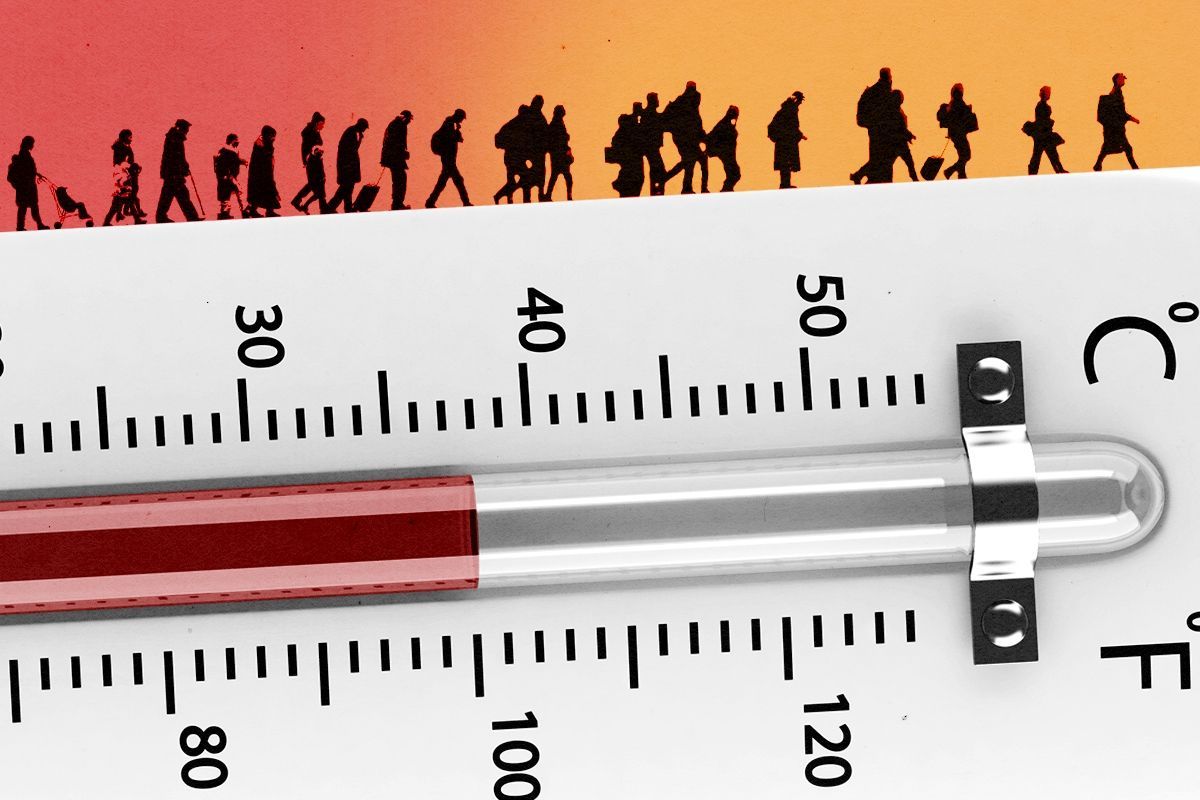
Over 16 years and about a quarter of a million more American oil and gas wells later, the climate crisis caused by human use of fossil fuels has grown ever more acute. The emissions from burning those hydrocarbons have made the weather more extreme and unpredictable, of course, but they’re also reshaping the human landscape. In 2021, a team of international scientists published a report warning that a third of the world’s population, some 3.5 billion people, may be forced to leave their homes over the next 50 years due to the increasingly hot and unstable climate.
Even as it’s become more critical to make room for these new climate refugees, anti-immigrant politics have gone mainstream around the world. Studies have shown that both Republicans and Democrats become more xenophobic after learning about climate migration, while the annual refugee admission cap is now just 7,500 in the U.S., down 85% from its peak of 50,000 during the first Trump administration.
This week, Fox returns with a new documentary, The Welcome Table. In the film, which will be released on HBO, he travels around the globe, visiting communities in decline — places where the physical catastrophes and political climates have converged to make it impossible to continue living. But as he and I discussed in our conversation below, this story is not a tragedy; rather, Fox aims to answer how we can set the table and embrace neighbors who’ve lost their homes. And here’s the good news: It involves a lot of fun.
Our conversation has been lightly edited and condensed.
Reportage on climate migration almost always focuses on the people who are migrating. What struck me about your documentary was its emphasis on the other subject in this relationship — the people and communities who either receive or exclude the refugees. Can you tell me how you arrived at that starting point?
Well, I’ll tell you a funny story. I first started working on this in 2019 because I was so outraged at the policy of child separation. I went down to El Paso — which you see in part of the movie — to investigate issues of the border. I originally thought of the movie as The Border Table, where we were going to put a table on the border for people to come to from both sides, and we were looking for a section of the border that didn’t have a wall.
I quickly realized that the issues around the border were not my wheelhouse — it is its own subject — and I wanted to focus more broadly on the climate. I was doing an event for Bernie Sanders’ 2020 campaign where I was called to go to Columbia, South Carolina, with Nina Turner, Dr. Cornel West, and Bernie to talk about water issues. My flight came in, then Dr. West’s, and it was like 10 at night. We got in a rental car with Heather Gautney, who’s also an amazing activist. There was no place to eat — everything was closed — so we’re sitting in the back of a rental car, myself and Dr. West, and eating McDonald’s, and he’s like, “What are you working on?” And I said, “Well, we’re working on this film called The Border Table.” He goes, “Oh, well, you know, James Baldwin’s last book was called The Welcome Table, but nobody’s ever read it. He never finished it.” And I thought: The Welcome Table, The Welcome Table… That’s interesting, it’s a better title.
Then I was down in New Orleans, and I went to one of my favorite clubs and saw John Boutté. John and I immediately hit it off. He knew my work. He signed one of his records, and lo and behold, I look on the record, and there’s the song: “The Welcome Table.” Immediately I thought, Well, this movie has to start with John Boutté. From the moment I met him, I felt that there was this weird destiny that was happening.
I said, “John, I want you to sing this song to an empty table on the top of the levee, and at the end of the movie, you’re going to sing the song with 1,000 people at a 1,000-foot-long table, and we’re going to show the Welcome Table as this symbol of togetherness and generosity.” Because my question was, What’s the opposite of a wall? What’s stronger than this xenophobia, this racism, this hate, this militarization? Is there anything stronger than that fascist ideology? And I realized that a wall on its side can be a table. The wall is just a metaphor.
So The Welcome Table is essentially a movie about a song. It’s a movie about imagining a future where we can sing and not get tired, where we’re in a beautiful city and have a place at the table.
In a 2023 interview, you described The Welcome Table as a Shakespearian comedy. I’m curious if you still feel that way and can explain it?
All climate movies are tragedies. They’re about the tragic flaw of this civilization, how we’re all doing ourselves in. A comedy is where everybody gets married at the end. That’s what happens at the end of As You Like It, Twelfth Night, The Two Gentlemen of Verona. At the end of Hamlet, there’s just bodies all over the floor.
To me, that table with 1,000 New Orleanians celebrating, waving handkerchiefs, second lining, having the band — it is a sort of marriage, right? I mean, at every wedding in New Orleans, you have one of those bands. To me, it’s a marriage of true minds; it’s a marriage of our communities; and it’s a question of finding our solidarity and our togetherness. The idea is that we have to be bound to each other.
It’s also a hell of a lot more fun.
You note that climate migration would be the greatest mass migration in human history, with a third of the world projected to move in the next 50 years. But the Welcome Table is already pretty crowded at the end of the movie. How do you navigate that tension in climate storytelling — saying both “this is urgent and happening now” but also “it will also get worse”?
My last film on HBO was How to Let Go of the World and Love All the Things Climate Can’t Change [in 2016], in which we trace the path to 2 degrees Celsius and how dangerously close we were at that time. Now things have gotten worse. We include a climate science update midway through The Welcome Table, which is very dire.
But I think this is probably one of the first movies to deal with climate change as it’s happening now. It’s not saying, in the future this will happen, like An Inconvenient Truth. No, this is a fire right now. We’ve never had conditions that are this hot or this dry. This is a giant mega-storm, back-to-back Category 5s flattening the Virgin Islands. This is a famine that’s been going on for seven years because it hasn’t rained in northern Kenya. This is landslides where you have a whole year’s worth of rain drop in 12 hours and the mud buries whole neighborhoods alive.
This is climate change happening to us right now. It’s not predicting a dire future; it’s showing the one that we predicted 10 years ago.
A recurring pattern in the film is that climate migration doesn’t necessarily mean leaving one’s country, but could mean moving a town or neighborhood or two over. Can you talk a little more about how this was still a traumatic upheaval for your subjects, and why you include those stories alongside the more traditional images of refugees on boats or at the southern border?
If you think about New Orleans after Katrina, they lost half their population to elsewhere. And there is no place like New Orleans anywhere on earth. So you are losing something really fundamental to who you are. And, you know, it’s not as if when Paradise, California, burns down, they’re like, “You can set up your place in Chico! We have tons of empty houses and buildings and money and love for you!” No, it’s: Go [expletive] live in your car. So the idea that you’re a climate refugee doesn’t necessarily mean that you’ve had to cross borders. It just means you’ve lost everything.
I wanted to make the point that the Convention on Refugees defines refugees as people who are oppressed because of politics or because of identity or economic hardship or political violence, but it doesn’t include climate change. And it really should. Climate change should be a reason you can declare asylum, because climate change also makes all of those problems way worse.
I was extremely moved by the fact that many of the people extending their hands to refugees in this movie have faced their own forms of rejection and exile, like the members of the queer mutual aid network that comes together organically in Brazil. But how do we get through to the people who are comfortable in their lives? Yes, there are many empathetic, good people, but I also worry there are many scared, small-minded people, too.
I don’t know how to answer that question in general, but I do know from experience that when we were working on fracking issues, it was the moms who were terrified that their children were going to be poisoned by the chemicals in the water and in the air. Those moms were the backbone of our organizing and our audience, and they were fierce in defending their children’s futures. I think what has to be gotten across is that same generational obligation.
One of the things that we cut out of the film, for time, that I’m sad about is: In Paradise, California, and in Boulder, Colorado, where we covered those fires, the rent goes up 300% after the fire. So your $800 apartment is now a $2,400 apartment. But also, nobody should move to those places. They’re going to be contaminated for decades. Everything you have in your house is basically toxic because of the oil industry, and it becomes 10 times more so if you light it on fire, then pour fire retardant sprays on top of it, which are also carcinogens. Then it rains, and all that’s in the water table. There will be cancer clusters in those fire neighborhoods if people move back into them. It’s so serious that I won’t go to one of those places for more than a couple of hours, and I’m wearing a respirator mask.
And we’re not being upfront about that. Get parents involved and understanding that the legacy of their children means that they have to stop using fossil fuels, and we have to dismantle this system of fascism to do it. They are interrelated. Oil is the blood of climate change, but it’s also the blood of this extractive capitalist system.
Do you have any final thoughts you want to leave with our readers?
I would like to see this 1,000-foot-long Welcome Table brought to cities across America and around the world. It’s not just a scene for the movie; it’s a template for our activism. We’ve got to get really good at welcoming people, because either we’re going to be on the move ourselves because we’ve lost our homes due to climate, or we’ll be welcoming those who’ve lost their homes. One way to do this is to practice singing together, hanging out together, and having a good time.
If there’s anything this week in New York City, and my beloved New York Knicks, have gone to show, it’s that collective joy is possible. We don’t need to win a basketball game to have that, though, and that’s what The Welcome Table shows: Collective joy for the sake of collective joy. Coming together to celebrate migration, to celebrate the crisis, to celebrate how, as human beings, we have this ability to sing, dance, and move — boy, that’s a fun time. Our side is more fun. A wall on its side can be a table, and it’s time to envision a different future.