GLOBALVARS
0

The data center buildout has hit a new inflection point. It has long been true that artificial intelligence is fueling climate change by driving up power demand; more recently, tech companies have started directly financing new natural gas plants in their quest for AI glory. Now one is backing the biggest fossil fuel-fired power plant ever to exist in the United States — exclusively to power an AI data center complex.
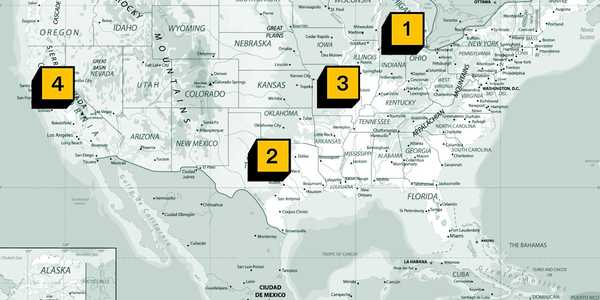
That company is Amazon, according to the market research company Cleanview, which reported on Friday that the tech giant is building an AI data center campus in Texas powered by an up to 7.65-gigawatt off-grid natural gas plant.
That’s larger than any other power plant in the country — fossil or otherwise. The next biggest plant is the Grand Coulee hydroelectric plant in Washington State, at 7 gigawatts, followed by Arizona’s 4-gigawatt Palo Verde nuclear plant, and the West Count Energy Center, a 3.7-gigawatt natural gas plant in Florida.
The new power plant’s developer, Pacifico Energy, announced in January that it had secured permits from Texas regulators for the project, dubbed “GW Ranch.” The site is also permitted for up to 750 megawatts of solar and 1.8 gigawatts of battery energy storage.
It was not clear who the customer for all this energy would be until earlier this week, when Cleanview uncovered construction permits Amazon filed showing that the company owned the GW Ranch site. The company confirmed to Cleanview that it acquired the site and planned to buy power from Pacifico’s plant.
Not only will this natural gas plant be larger than the one in Florida, it will also use far less efficient technology. Pacifico’s permit says it plans to build 35 “simple cycle” generating units, which are typically installed in rarely-used peaker power plants and waste a lot more fuel potential than the modern “combined cycle” natural gas plants that serve as baseload power for the grid today. These more efficient turbines are essentially on backorder for years, and power-hungry developers have increasingly turned to the simpler versions as a quick fix as they race to bring facilities online.
According to its permit, the GW Ranch plant is allowed to emit as much as 33 million tons of CO2 per year. That’s twice as much as the most-polluting power plant in the country, the James H. Miller Jr. coal plant in Alabama, emitted in 2023, the most recent year for which data is available.
In a statement to Cleanview, an Amazon spokesperson said the company “believes in paying the full costs of powering our operations,” and that this Texas project “does just that: it’s powered by new on-site generation that won’t raise electricity costs for Texas families and designed to transition to grid-connected service as interconnection timelines allow.”
Some researchers disagree on that point, however. In an opinion piece for Utility Dive, Energy Innovation director Jeffrey Rissman and senior fellow Eric Gimon argue that the proliferation of off-grid natural gas generation for data centers will increase costs for regular people more than if the data centers connected to the grid, because they will be competing with utility companies for gas supply. “Data centers can buy gas in bulk and sign long-term contracts (as we’ve seen in Texas, Pennsylvania and New Mexico), giving them access to cheap gas, even if this unfairly drives up prices for everyone else,” they write.
Jane Flegal, a senior fellow at the Searchlight Institute, has also argued that building off-grid natural gas plants to serve data centers locks in emissions for decades because the plants don’t face competitive pressure from other resources. When a new natural gas plant is hooked up to the grid, by contrast, there’s a far greater chance that cheaper, cleaner resources will displace its generation over time.
The Rhodium Group recently developed a scoring system to help investors differentiate between projects that are likely to accelerate the energy transition, those that will have little effect one way or the other, and those that will actively slow it down. They used it to assess options for powering data centers, and found that off grid natural gas plants scored the worst, falling at the bottom of the latter category.
Regardless, Amazon still, somehow, asserts that it is committed to achieve net zero emissions by 2040.