0

Current conditions: An historic heatwave in the Southwest could drive temperatures up to 110 degrees in parts of southeastern California and Arizona in what would mark the earliest date in recorded history that the region hit that temperature • Three major wildfires, including the largest in Nebraska’s history, have scorched more than 600,000 acres and killed at least one person so far • Days of heavy rainfall in Limpopo have washed out roads across South Africa’s northernmost province.
THE TOP FIVE
1. Trump is considering paying offshore wind developers $1 billion to kill off project
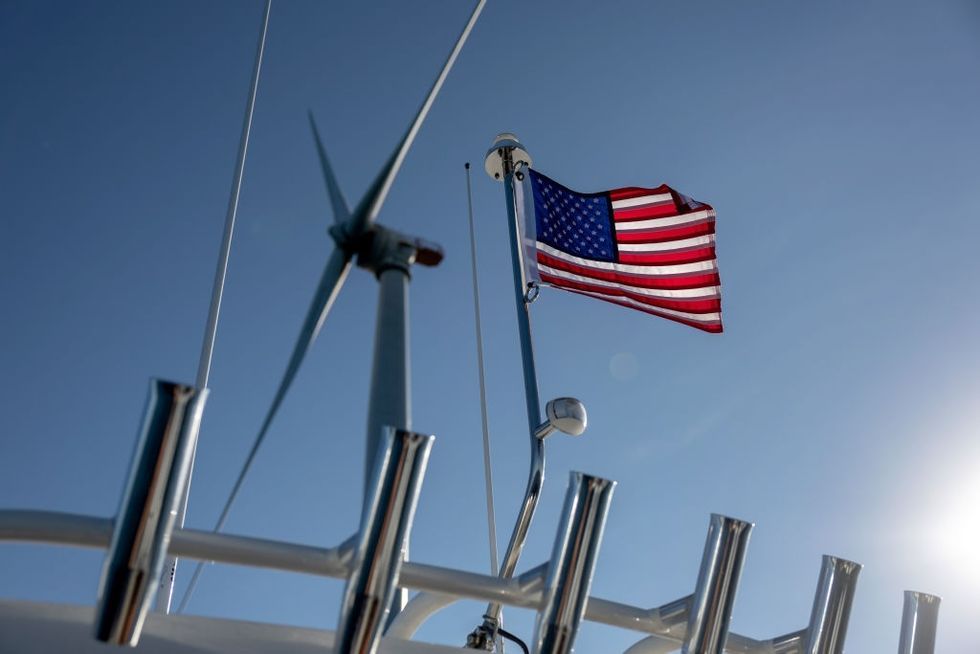
Defeated at every turn in its crusade to halt construction of offshore turbines, the Trump administration is considering a new approach to throttle the industry: Paying companies to abandon projects. Senior administration officials are drafting settlement agreements that would pay nearly $1 billion to TotalEnergies, the French company behind two wind farms off the coasts of New York and North Carolina, to abandon the projects, according to documents The New York Times obtained. The terms of the deal would allow the Department of the Interior to cancel leases in federal waters for the two projects. In exchange, the Department of Justice would pay more than $928 million to the company to reimburse its winning bid in the lease sales during the Biden administration. As part of the agreement, TotalEnergies would invest in natural gas infrastructure in Texas.
It’s a sign the White House recognizes its barrage of legal fire against the offshore wind industry isn’t landing, as Heatmap’s Jael Holzman has written. Indeed, I broke a story last month about the FREEDOM Act, a new bipartisan permitting reform bill endorsed by more Republicans than Democrats that curbed the president’s power to revoke already-granted permits..
2. New York’s metro authority sues Trump for withholding subway funding
New York’s Metropolitan Transportation Authority sued the Trump administration Tuesday for withholding federal funding for the expansion of the Second Avenue subway into northern Manhattan’s East Harlem. The lawsuit, according to Gothamist, comes five months after the White House budget director Russell Vought halted disbursements of a $3.4 billion grant for the project. The administration said it was holding up funding to weed out grants to minority- and women-owned businesses. The MTA said it complied with that probe, and the funding still hasn’t been released. The state agency accused the Department of Transportation of withholding the money illegally. “Once again, New York has been forced to sue the Trump administration to stop them from erratically shutting off billions of dollars in previously committed infrastructure funding,” Governor Kathy Hochul, a Democrat, wrote in a statement.
Sign up to receive Heatmap AM in your inbox every morning:
* indicates required
Email Address *Our Privacy Policy & Terms Apply.
3. Spain defends the EU’s carbon trading system
The European Union wants to loosen its carbon trading system to ease the energy price shock of the Iran war. But renewables-rich Spain says doing so would be a “big error.” In an interview with the Financial Times, Spanish energy minister Sara Aagesen Muñoz said using “this crisis to change a system that works is irresponsible and a big error,” adding that the trading scheme “needs to last and we can’t ignore the lessons learned about the war in Ukraine.” The fight over policy is set to intensify this week when European Commission President Ursula von der Leyen, who outlined plans to reduce energy prices Monday, meets with EU leaders on Thursday.
4. Tesla buys $4.3 billion of lithium iron phosphate batteries
Tesla has inked a $4.3 billion deal to buy lithium iron phosphate batteries from LG Energy Solution. The South Korean giant had first announced the deal back in July, but the counterparty was a mystery. On Monday, however, the Trump administration announced the partnership as part of a fact sheet listing $56 billion in deals between American companies and Indo-Pacific firms. The three-year agreement will, according to Electrek, “see LG produce LFP prismatic cells at its Lansing, Michigan, factory starting in 2027, feeding directly into Tesla’s next-generation Megapack 3 energy storage systems assembled at the Houston Megafactory.”
Google, meanwhile, unveiled a series of its own deals. On Tuesday, the tech behemoth announced a new carbon removal deal with AMP Sortation. The startup is, per a blog post from Google, “developing AI-powered sortation technology to recover organic material from municipal solid waste facilities.” Instead of allowing those food scraps and yard debris to decompose in landfills and spew carbon and methane into the atmosphere, AMP converts the material into biochar, a stable material that can keep carbon locked away for centuries. “This deal will add biochar production to the largest recycling project in the U.S., enabling AMP to transform organic waste into a stable material that locks carbon away for centuries while ensuring that all other valuable materials are put back into the circular economy,” Reilly O’Hara, the program manager in charge of carbon removal commercialization at Google, wrote in a LinkedIn post. That same day, Google announced a separate deal with the Detroit-area utility DTE Energy to develop a new data center in Michigan, promising to bring 2.7 gigawatts of new clean generation resources onto the grid.
5. The world’s biggest mining company has a new CEO
BHP Group, the world’s biggest mining company, has named Brandon Craig as its new chief executive. Starting July 1, Craig will take over from Mike Henry, whose seven-year tenure saw shareholder returns surge 17% per year, but who agreed to resign after a failed attempt to buy Anglo American last December. Craig previously led BHP’s largest division, iron ore, before becoming the president of the Americas region in 2024, according to Mining.com. During that time, BHP became the world’s top copper producer, right as prices for the metal surged to record highs.
It’s a big moment for minerals. Just last month, the Trump administration unveiled plans for a $12 billion stockpile of key metals that China controls in a bid to insulate U.S. companies from the price shocks spurred by Beijing on-again, off-again export controls.
THE KICKER
A longstanding theory on the origin of life posits that asteroids carrying fundamental elements crashed into our planet eons ago, depositing the basic ingredients that later formed into single-celled, anaerobic microorganisms believed to have been the Earth’s first living creatures. In a boon to that concept, scientists have now discovered the basic building blocks of DNA and RNA on the asteroid Ryugu. On Monday, a new study by a team of Japanese researchers in Nature Astronomy showed that the samples taken from the asteroid in 2014 contained all the “nucleobases” of both genetic materials. Still, Toshiki Koga, a biochemist at the Japan Agency for Marine-Earth Science and Technology and the study’s lead author, cautioned that this “does not mean that life existed on Ryugu.”