GLOBALVARS
0

Current conditions: Tropical Depression Five is barreling northwest from the Caribbean to Houston • In the Pacific, Hurricane Karina has strengthened into a Category 4 storm, but it’s unlikely to make landfall anywhere • The surface temperature of the Yellow Sea is nearly 85 degrees Fahrenheit, fueling storms across South Korea.
THE TOP FIVE
1. Trump says data center opponents ‘want to end up being backwards and poor’
President Donald Trump is among the few politicians in America willing to stand 10-toes-down in defense of the need to build out more data centers. In a post Monday on Truth Social, the president admonished communities that reject data centers as misguided and foolish. “The only reason that communities throughout the U.S.A. should not want data centers is if they want to end up being backwards and poor,” Trump wrote. “If they want to be successful and rich, with far lower taxes and jobs all over the place, let data reign.” Still, he said “plenty of other places” want them. “If we kill the Golden Goose, you will only have yourselves to blame,” he wrote. “China could not be happier with this anti data center movement.” It’s not a popular stance. Heatmap Pro’s latest polling shows that three-quarters of Americans now oppose data centers built in their backyards.
2. Judge strikes down New York’s climate superfund law
The U.S. District Court for the Northern District of New York struck down the state’s Climate Change Superfund Act on Monday, ruling that the 2024 law is invalid under the federal Clean Air Act. The law set up a cost recovery scheme whereby fossil fuel companies would pay into a fund used to finance climate change adaptation-related infrastructure projects. The state’s argument rested in part on the Trump administration’s decision earlier this year to rescind the Environmental Protection Agency’s endangerment finding on greenhouse gases, which gave the agency authority to regulate climate pollution. Judge Brenda K. Sannes dismissed that argument in her decision, citing the Supreme Court’s ruling in American Electric Power v. Connecticut from 2011, which, as my colleague Emily Pontecorvo put it, “established companies’ protection from federal public nuisance claims over greenhouse gas emissions. That decision sprang from the Court’s earlier 2007 decision that the Clean Air Act covers greenhouse gas emissions — which the EPA is now contesting.”
The case was one of at least four the Trump administration has pursued against states attempting to make fossil fuel companies cover the costs of adapting to climate change. Judges have already ruled against its attempts to prevent Hawaii and Michigan from suing fossil fuel companies, however a case against a similar superfund law in Vermont is still pending. “New York’s law would have expropriated $75 billion from energy companies around the world during an energy emergency and in direct defiance of American foreign policy and federal law,” Adam Gustafson, principal deputy assistant attorney general of the Justice Department’s Energy and Natural Resources Division and the administration’s lead attorney in this case, said in a statement. “We will continue to fight for affordable, reliable energy for all Americans.”
3. Exclusive: AI energy software provider Verse triples the power under its management
A sign of how much an industry is really booming is whether startups begin popping up to provide ancillary services. Here’s a prime example of the artificial intelligence buildout’s energy boom: The AI energy software provider Verse told Heatmap exclusively for this newsletter that it now has 30 gigawatts of power under its platform’s management. The company’s flagship product, Aria, is an intelligence platform for data center companies that brings utility bills, contracts, power purchase agreements, and live power usage data under one dashboard. The company also helps manage on-site assets such as batteries. “You can't solve for speed, cost, risk, and carbon while your supply contracts, your load, and your flexible assets sit in separate silos,” Seyed Madaeni, Verse’s chief executive and co-founder, said in a statement.
Sign up to receive Heatmap AM in your inbox every morning:
Email Address *Our Privacy Policy & Terms Apply.
4. The nation’s first restarted nuclear plant is loading its fuel
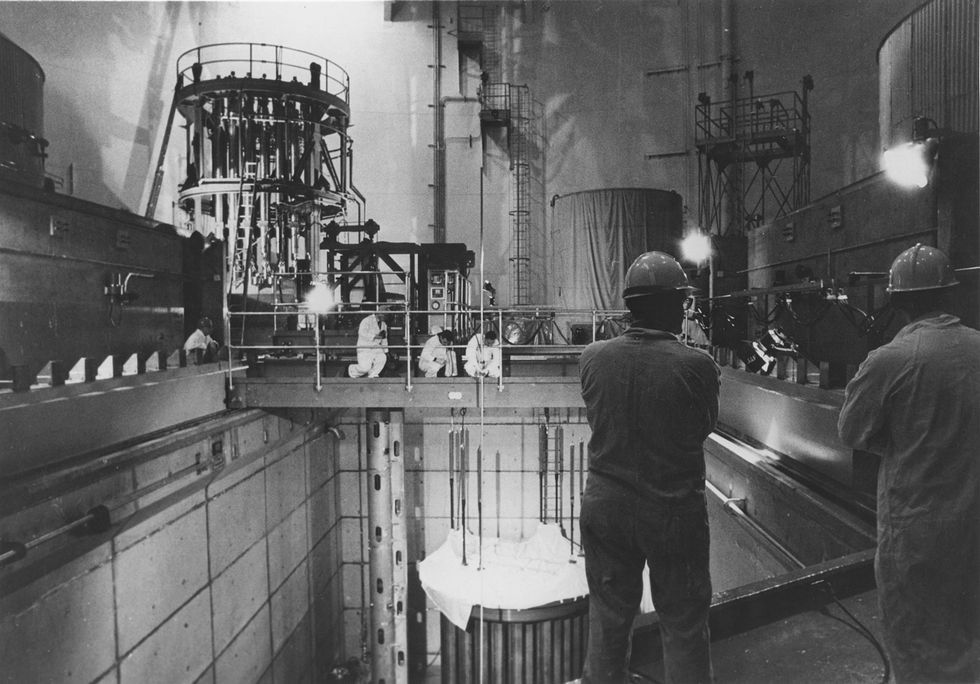
When Holtec International starts the Palisades nuclear plant back up, the facility in western Michigan will be the first in the nation to return to life after a permanent shutdown. Once complete, the Palisades restart will set off a series of other projects, including some to repower defunct nuclear plants in Pennsylvania and Iowa. That makes each milestone in the Palisades project notable — but the one it reached Monday is particularly promising. Holtec started loading fuel into the reactor, setting the stage for it to return to service potentially before the end of the year, months before the official March 2027 start date. “Loading fuel into the Palisades reactor is an important milestone and a reflection of the tremendous effort of the men and women who have brought this plant to this point,” Fadi Diya, Holtec’s chief nuclear officer, said in a statement. Palisades’ completion won’t just kick off more restarts. Holtec also plans to build its first two 300-megawatt small modular reactors at the site. Based on the industry’s standard pressurized water technology, the company has received hundreds of millions from the Department of Energy to support its construction.
5. The Taliban is offering Trump access to Afghan minerals
Commerce can, at times, be the ultimate salve. Raw materials flowed from the U.S. to British factories even after the American Revolution and the War of 1812. Japanese and German automobiles dominate American roads decades after those nations’ defeats in World War II. As memories of war fade, Americans buy nearly $200 billion in Vietnamese goods each year, helping to transform the Southeast Asian country into a top manufacturing hub. Now the Taliban is making its pitch to Washington’s wallet. The Islamist group now leading Afghanistan said it would “absolutely” welcome U.S. investments in the rural, mountainous, and underdeveloped Central Asian country’s mining, infrastructure, or agriculture industries. “Relations between Afghanistan and the United States should not be assessed through the lens of the past 20 years of war, but rather on the basis of future co-operation,” Taliban foreign minister Amir Khan Muttaqi told the Financial Times at his office in Kabul. “Our economic policy is open.”
Meanwhile, from China to the U.S., lithium producers are posting what Bloomberg called “bumper profits.” Demand for energy storage is soaring, especially as countries seek to insulate themselves from the effects of the Iran War energy shock. As a result, Chinese companies such as Tianqi Lithium and Ganfeng Lithium Group reported their strongest net income in three years during the first six months of 2026. North Carolina-based Albemarle said global lithium demand had grown 45% compared to a year earlier. Australia’s PLS Group, meanwhile, “swung a $377 million profit in the 12 months to June 30 from a loss the year before,” the newswire reported.
THE KICKER
You don’t need to be an expert in emerging markets to recognize the potential for solar. Countries that haven’t yet extended grid networks into rural areas can electrify villages using panels that are increasingly cheap and flooding into places such as sub-Saharan Africa, as I told you last week. You won’t need deep connections in those countries to start investing in that renewable energy potential, either. The startup Odyssey Energy Solutions, as my colleague Katie Brigham put it, “acts as a middleman between local installers and global capital providers that want exposure to developing markets but typically wouldn’t take the risk of financing small companies in unfamiliar environments.” This morning, the company told Katie exclusively, it’s announcing that it has raised another $74 million to fund its buildout.