GLOBALVARS
0
Earlier this year, I attempted to draw up a web diagram about energy affordability. My head was spinning from reading social media threads of experts arguing over the reasons electricity rates were so high, the best strategies to lower them, and how the data center explosion fit into the picture. I wanted to see all of the ideas laid out in one place. Here’s what I sketched out at the time:
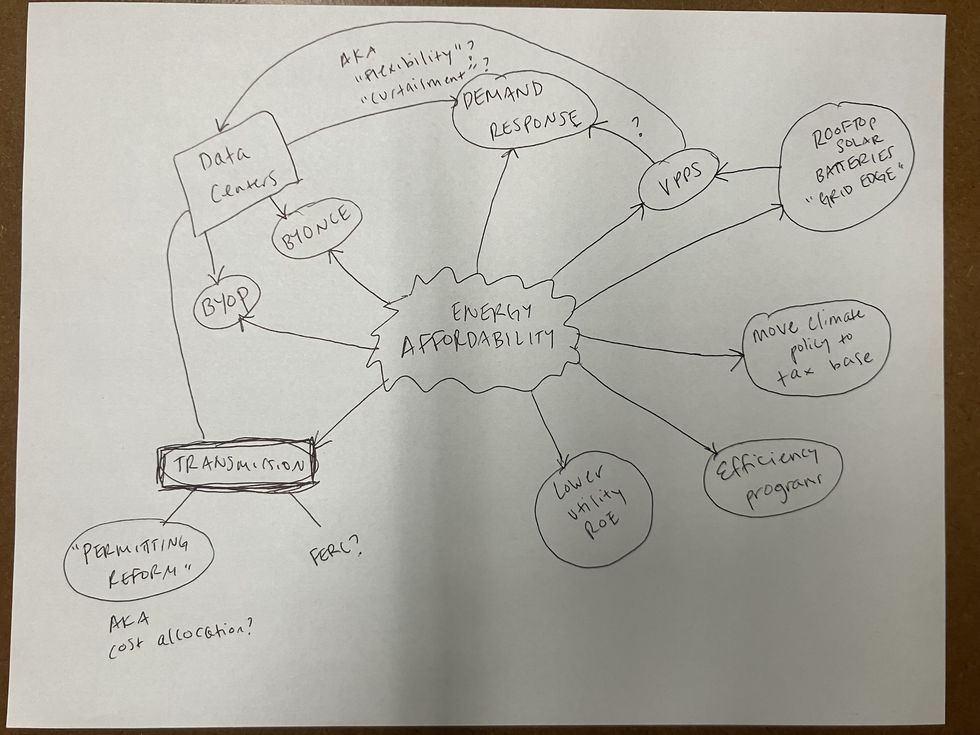
That was in March. Looking back at it now, a few things stand out. Of course, Washington hasn't gotten anywhere meaningful yet on permitting reform. Also, the BYOP, or “bring your own power,” idea has in some cases become a justification to build huge off-grid natural gas power plants. Amazon, for example, defended backing what may become the largest fossil fuel plant in the country by saying that it “believes in paying the full costs of powering our operations,” and that the Texas data center project is “powered by new on-site generation that won’t raise electricity costs for Texas families.”
On the other hand, there have been some promising developments in deploying virtual power plants and “grid edge” technologies like rooftop solar, to the benefit of both tech companies and regular folks. In July, New Jersey passed a law to incentivize data center developers to fund virtual power plants that can create more capacity on the grid. The program could ultimately help residential customers get solar panels and batteries, which would bring down their energy bills. Just today, Google announced a partnership with the California utility PG&E to offer residential customers discounts on heat pumps combined with battery energy storage in Alameda and Santa Clara counties. The first 25 homeowners to sign up will get $10,000 off; after that the discount is $5,000.
Get Heatmap Daily in your inbox.
Email Address *Our Privacy Policy & Terms Apply.
One strategy I didn’t jot down back in March was the “large load tariff.” This is when utility regulators create a new electricity rate class for large energy users that helps isolate the costs of serving these customers. A growing number of states have gone one step further and developed data center-specific tariffs, with requirements like charging data centers a minimum fee regardless of how much energy they use, and, in some cases, creating incentives for them to build new renewable energy projects.
A policy paper that came across my desk this week argues that this approach doesn’t go far enough. It says that states have an opportunity to fund the modernization of the electric grid by adding a surcharge on top of large load tariffs.
The paper is from the State Support Center, a nonprofit that provides clean energy policy recommendations and technical assistance to states. It was co-founded by Sam Ricketts, one of the founders of the climate group Evergreen Action and a significant voice in shaping the Inflation Reduction Act. Initially, the Center helped states figure out how to take advantage of all of the new federal funding that came out of that law. Now, like the rest of us, Ricketts is thinking about data centers.
“State policymakers are looking for ways to meet the load growth that is predominantly being driven by data centers,” he told me. “There hasn't been a thorough-enough discussion about capturing investments that large data center loads are making and using those revenues to drive investment into key barriers for the clean grid expansion that the electricity system in the U.S. now needs.”
Traditional large load tariffs are about cost assignment, Ricketts said: Regulators determine the cost of network and operational upgrades required to serve big customers and require utilities to pass those on directly rather than spreading them across the entire customer base. This is just the baseline of what data center developers should do to pay their “fair share,” though, Ricketts argued. Even if large load tariffs help cover the cost of new power plants, they don’t necessarily help solve the interconnection bottlenecks that are preventing generators — especially renewables — from joining the grid, for example.
By adding a simple per-megawatt surcharge to the rates data centers pay, states could raise revenue to accelerate interconnection. They could fund additional staff and invest in new software solutions to help move through the queue of projects waiting to connect faster. They could also put the money toward financing grid upgrades, such as installing grid-enhancing technologies that create more capacity on existing power lines. Alternatively, they could use the money to reward cities and towns for permitting projects more quickly, or to support siting and permitting at the state level, the paper suggests.
Ricketts told me that many state utility commissions have the power to do this today, and those that don’t would require just a simple bit of legislation to empower them. New York could become the first to adopt the idea. In June, Governor Kathy Hochul directed the state’s Department of Public Service to consider requiring data centers to invest in a “grid acceleration fund.”
Several states have already levied similar fees on data centers — they just haven’t dedicated the money toward grid upgrades. A new $0.01-per-kilowatt-hour surcharge on loads larger than 100 megawatts in Oregon will fund efficiency and distributed energy projects that reduce costs for residential customers. Virginia enacted a $0.011 per kilowatt-hour data center electricity consumption tax that will raise money for the state’s general fund. It’s expected to generate $600 million per year.
The paper doesn’t pitch the surcharge as a cure-all, nor does it touch the issue of public opposition or federal permitting obstacles. “The surcharge as envisioned and proposed here is pretty modest,” Ricketts told me. “It is trying to attend to a gap, which is like, hey, there's an opportunity here to capture reinvestment into the grid needs that are truly necessary.”