GLOBALVARS
0
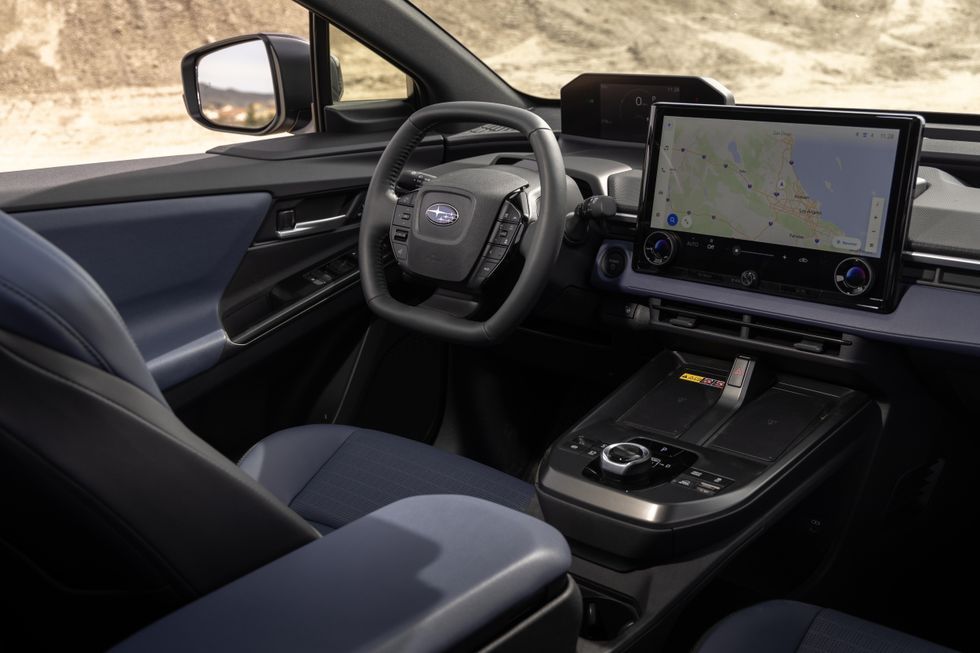
I’ve seen these cupholders before. The same goes for the pair of wireless phone charging mats in this Subaru EV, the wheel that spins to select drive or reverse, and the storage cubby between the driver and shotgun seat with its awkwardly positioned “open” button. Even the big central touchscreen and its software are fundamentally identical to the ones I remember — right down to the navigation system’s voice-activated assistant represented by a weird on-screen bubble.
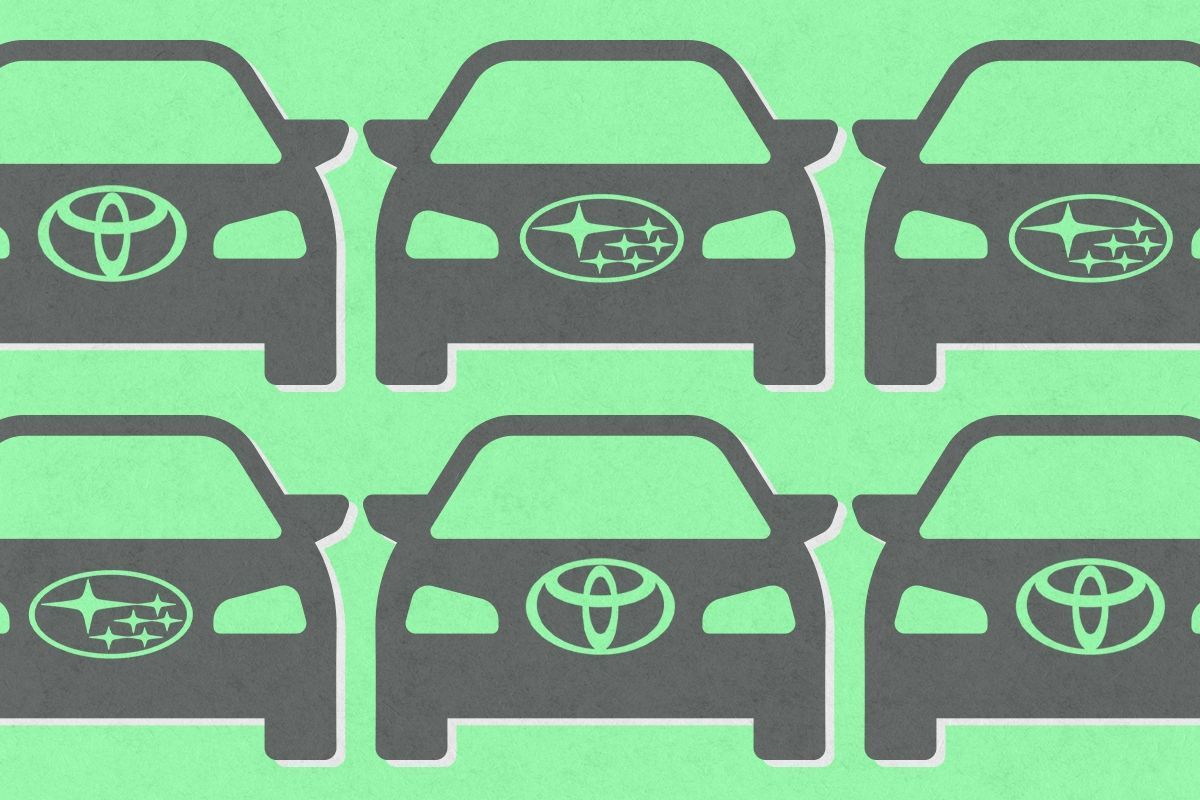
It’s no coincidence the interior of the new Subaru Trailseeker feels so familiar: I just saw it a couple of months ago while test-driving the Toyota CH-R. The two Japanese carmakers have been co-developing the bones of their electric cars together for several years now. Their dueling lineups of new models are, to a large degree, the same vehicles under the sheet metal: The Toyota CH-R and Subaru Uncharted small crossovers are effectively twins. So, too, are the Subaru Trailseeker I drove this week and the Toyota Bz Woodland, the stretched, outdoorsy version of Toyota’s EV.
Sharing parts and even platforms is nothing new. Car companies have partnered with their rivals in the past to split research and development costs. Subie and Toyota have been following this playbook since the gasoline era; in the 2010s they created a lovely small sports car badged as either the Subaru BRZ or the Scion FR-S (back when Toyota used the Scion brand to sell sportier, more “youthful” cars in America).
But sharing has become a more pressing issue in the era of electric driving, as the legacy car companies look for ways to save money as they spend billions learning how to transition their businesses toward battery power. Honda, the other Japanese auto giant, borrowed the General Motors platform to build the Prologue, its most recent attempt at an EV for America. That car sold competitively with the other non-Tesla EVs in the U.S., demonstrating there were some Honda drivers hungry for their brand to make a new EV. But that approach only got Honda so far. The company’s attempts to build a better EV from the ground up have stalled, and it has now canceled an ambitious slate of planned vehicles.
As for Toyota and Subaru, there is much to be gained from this tactic. If you’re a driver simply pondering whether to switch from the gas-powered Outback to the Trailseeker with your next Subaru purchase, you might not care that electric Subarus are just Toyotas on the inside. Still, sharing technology also raises the question: If a Subaru is just a Toyota under the skin, then is calling the car a Subaru enough for the brand’s devotees? The answer, I think, is a possibly surprising “yes.”
At the simplest level, Subaru’s electric cars do succeed in feeling like distinct vehicles. In this clip, one of Toyota’s lead engineers explains some of the philosophical differences that lead the two companies to build different products on top of the same bones. To simplify: Subaru builds with acceleration and sportiness in mind, while Toyota is more focused on braking and safety.
You can feel the difference. Toyota scales up the power depending on how much you pay, from 168 horsepower in the entry-level Bz to 375 horsepower for the outdoorsy Bz Woodland.
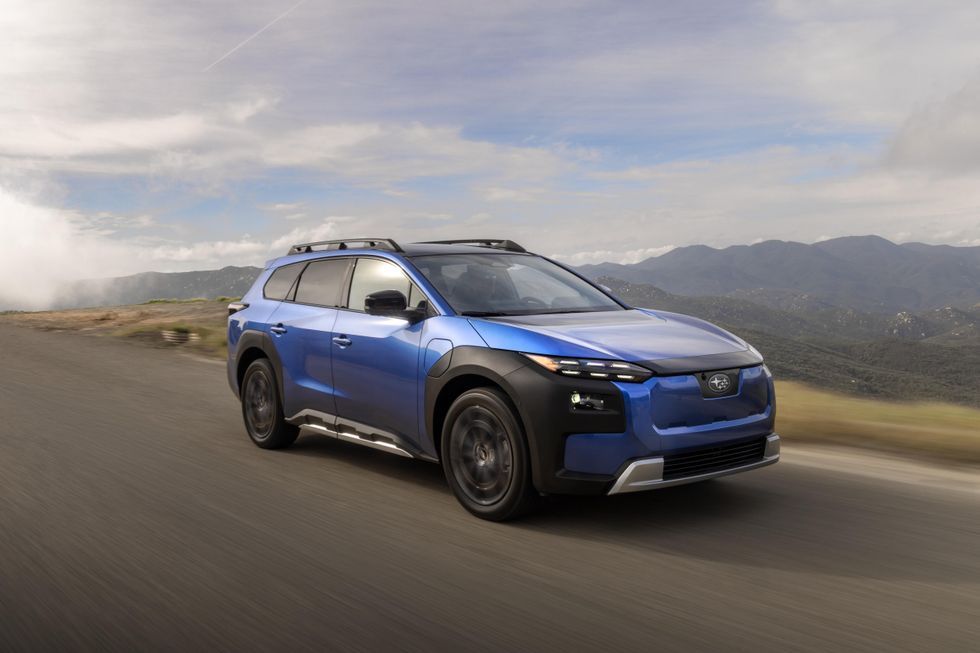
Subaru offers all-wheel-drive and 375 horsepower with every trim level of the Trailseeker, and the car is zippy and eager. The high ground clearance and road trip-ready roof rack certainly makes the EV feel appropriately Subaru. While the other vehicles that came out of this partnership were built at Toyota factories in Japan, Trailseeker (and its Toyota twin) were built at a Subaru factory.
And for a long vehicle with lots of storage space in the back, Trailseeker is pretty efficient. I made a decent 3.5 miles per kilowatt-hour on a highway drive from L.A to Santa Barbara, and the Subaru would top 4 miles per kilowatt-hour at city speeds. That efficiency is important, as it stretches the EV’s real-world range above 250 miles, giving it the legs it needs to visit the far-flung outdoorsy destinations Subaru drivers like to visit.
The trouble with co-development is that Subaru’s EVs, though they are fun and capable vehicles, are stuck with the same problems as Toyota’s. The Subaru also doesn’t feature fun or game-changing EV features like a frunk or one-pedal driving. Owners complain that there’s no way to, say, change the charging maximum to from 80% to 100% once a charging session has started, a simple task that can be accomplished with a tap on a phone app in other vehicles.
The car’s built-in navigation system, meanwhile, can list nearby EV chargers if you know where to ask, but it doesn’t incorporate them into its route planning like a Tesla, Rivian, or even Hyundai would do. This is more annoying than you might think, especially in this muddled moment in charging. Trailseeker, having adopted the Tesla NACS plug that is now becoming the industry standard, can charge at some Superchargers — but Tesla doesn’t allow other brands’ EVs at all of its stations, and you have to check their app to see which are okay. Lots of older third-party charging stations, meanwhile, still use the CCS plug that used to be common on EVs, so you’d need an adapter to plug in the Subaru there. That means that in the Trailseeker, you need either a charging strategy in advance or a co-pilot in the passenger seat checking multiple phone apps for you. (These issues can be solved somewhat by using one’s own apps through Apple CarPlay.)
What the Trailseeker is not, most fundamentally, is a Rivian. When that company teased the R2 and R3 a couple of years ago, we said it had the opportunity to dominate an outdoorsy, all-wheel-drive space in the car market that was more or less vacant because Subaru had dragged its feet on electrifying, having released only the disappointing Solterra. R2 is finally available, and compared to Trailseeker, the Rivian is much closer to the Tesla model of what an EV should be — its interface is far more sophisticated, and foundationally, it just feels so much more like a vehicle that was built from the ground up to be electric, not a car built by a legacy automaker still trying to figure out what an EV should be.
But here’s the thing: A lot of drivers, including plenty of Subaru lifers, don’t want the Tesla model. This Reddit post nicely captures the tension: EV-focused reviewers like me invariably notice what’s missing in a vehicle like Trailseeker compared to other electric cars. When you compare the Subie to gas-powered vehicles, though, you notice what’s there — the basic competencies like off-road ruggedness, roof racks, and honest-to-goodness door handles that make people love Subarus in the first place.
The price doesn’t hurt, either. Trailseeker’s key performance features — all-wheel drive, 375 horsepower, 280 miles of maximum range — are available on the simplest version that starts at $39,995, while the top-of-the-line $46,555 version gets more creature comforts. Toyota doesn’t sell an entry-level version of the Trailseeker’s twin, the Bz Woodland, only a fully-decked out edition that’s more than $45,000. Rivian’s fancier versions of R2, by contrast, cost well into the $50,000, with a $45,000 base model due in 2027.
Trailseeker, in other words, is a reasonably affordable, good EV that just works — and that you can buy at the same dealership across town that sold you your last two Outbacks. Which is all a lot of Subaru drivers ever really wanted.