GLOBALVARS
0
Welcome to Seattle! If you’re one of the 750,000 visitors in town to watch the 2026 North American FIFA World Cup, you’re going to love it here. For one thing, you’ve arrived just in time for the city to suspend its interminable construction for the games. That’s a plus! Be sure to check out our newly pedestrianized Pike Place Market and stroll along the waterfront to “Seattle Stadium” (or sound like a local and call it “Qwest”). You might even get a little chilly from the wind off the bay — you can thank our “temperate, oceanic climate” for that. It’s what makes Seattle the safest place in the United States to attend (or play in) a World Cup game, per researchers at Queen’s University Belfast — at least, from the perspective of extreme heat.
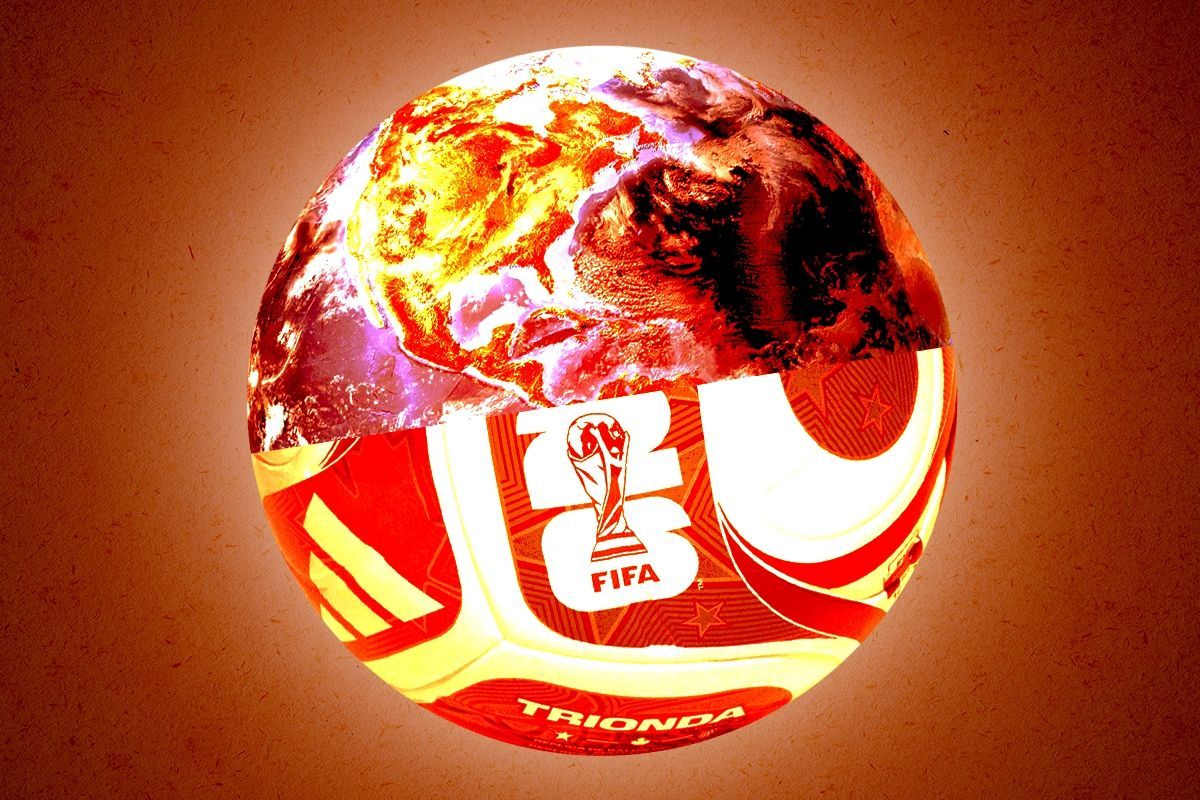
That’s worth bragging about. Extreme heat has been a concern at almost every subsequent World Cup going back to the 2014 World Cup in Brazil, including the 2022 tournament in Qatar, which FIFA had to reschedule to the winter. The 2026 World Cup could get dicey, too. Of the 104 scheduled matches in 16 host cities in the U.S., Canada, and Mexico over the next month, at least half have a 50% chance or greater of being played in temperatures of 82 degrees Fahrenheit or higher, according to research by Climate Central — that being the threshold at which player performance begins to suffer, with athletes slowing down, getting sick, and making poorer decisions because of the heat. The odds of there being impairing heat during the World Cup final in New York on July 19 are basically a coin flip, and 17% higher than they otherwise would have been due to climate change-induced warming.
All of that is just part of what makes Seattle’s host city status so appealing. There is only about a 3% chance of performance-impairing heat during its two mid-June fixtures, rising to 6% later in the month and into July.
Unless, of course, there’s another heat dome.
In 2021, temperatures in Seattle peaked at 108 degrees on June 28, which this year will fall between when the city hosts Egypt vs. Iran and a Round of 32 match. Needless to say, 108 degrees is not just perspiration-inducing; it is well beyond the 89.6-degree wet-bulb globe temperature threshold at which FIFA considers postponing matches. While the possibility of another heat dome in the next few weeks is admittedly an edge case — before 2021, Seattle had only touched 100 degrees three times in 126 years of recorded-keeping— it’s still a realistic enough possibility that last spring, the National Weather Service’s Seattle office ran a tabletop exercise with its local partners to game out just that.
“Before 2021, heat [in Seattle] was just another hazard alongside fire and smoke and those sorts of things,” Reid Wolcott, the warning coordination meteorologist with the NWS Seattle, who helped lead the two-day-long run-through, told me. The heat dome “really highlighted that heat is a powerful hazard that can cause significant loss of life.”
After more than 400 people died in Washington alone, the NWS dedicated considerable time and resources to its heat preparedness and messaging in the Pacific Northwest. Beginning in 2022, the National Integrated Heat Health Information System began offering technical support for heat tabletop exercises in communities around the country. Seattle was supposed to participate in 2024 but “due to some logistical reasons, we ended up delaying it until 2025,” Wolcott said. “And because of that, we were like, We’re well on our way into World Cup planning, here.”
The idea of the “Heat Dome Cup” exercise was to kill two birds with one stone — to test the Seattle area’s response four years after the heat dome, as well as its ability to respond to a weather crisis when thousands of visitors are in the city for the World Cup. Participants included representatives from surrounding cities such as Bellevue, Everett, and Portland, Oregon; county-level offices including from climate, emergency management, and public health; the University of Washington; and the Port Gamble S’Klallam Tribe.
The results of the exercise were both encouraging and not: For every core capability tested, from “threat/hazard identification” to “communication” and “community resilience,” the after-action report found that Seattle “performed with some challenges.” There was “limited local data” on the compounding hazards of heat, cooling center efficiency, and — particularly alarming — the local healthcare system’s ability to respond during such an event. “Prehospital triage, surge planning, and better integration with public health systems are urgently needed,” the report found. Because paramedics attempt to bring down a heat stroke patients’ temperature before transporting them to a hospital — a laborious process often involving filling a home bathtub with ice, setting the patient in it, and waiting — the emergency response during heat events is slow, and can quickly back up and overwhelm the system.
Heat Dome Cup partners directed my questions about King County’s readiness to handle extreme heat during the World Cup to the public health office, which told me no one was available for an interview.
Carlos Martinez, a senior climate scientist with the climate and energy program at the Union of Concerned Scientists who did not participate in the exercise, told me that after reading the report, he hopes that “there’s a recognition and awareness of the fact that there’s a lot of work that needs to be done.” He also flagged an observation from the exercise regarding the development of stronger workplace protections during the World Cup.
“That sometimes can be neglected,” he went on. “You have folks in construction, food service, retail, landscaping, and sanitation who work a full day outside during these events. What are the protocols that are out there to ensure that they are protected from heat-related illnesses?”
I put the question to Hollie Stark, the communications coordinator for the Office of Emergency Management in Seattle. (While Stark’s office participated in the exercise, Stark did not.) She told me that Washington’s Department of Labor & Industries offers recommendations for how employers can protect their workers from heat and smoke, including running trainings and publishing posters and pocket cards in multiple languages that promote offering adequate water, shade, and breaks. “We’re thinking about maybe bars and places that might be hosting [FIFA viewing parties] that don’t have access to AC but might have an influx of people,” she said as a hypothetical, “and we’re encouraging them to listen to those recommendations.”
In general, the people I spoke with in Seattle who were involved in the exercise acknowledged that messaging and communication were the areas the city struggled with the most. “That has definitely been the single biggest thing — trying to make sure that we’re all singing from the same sheet of music,” Wolcott told me. “Because we weren’t prior to 2021.”
One of the biggest hurdles has been figuring out exactly how to communicate potential extreme heat warnings to the thousands of visitors traveling to Seattle. During my conversations with officials involved in the Heat Dome Cup, officials pointed me to myriad preparedness websites, real-time risk tools, opt-in alert systems, and health and safety resources for out-of-town visitors, which left me — a local fluent in English — feeling even more confused.
Language itself is one thing — on that front, Stark told me her office has already pre-scripted messaging for extreme heat translated into Spanish and the eight threshold languages of King County — Vietnamese, Somali, Russian, Chinese, Korean, Amharic, Arabic, and Ukrainian — as well as seven additional World Cup spectator-specific languages — Arabic, Farsi, Dutch, French, Bosnian, Serbian, and Croatian. But one of the threats of having a heat dome during a major sporting event is that “you have a lot of visitors coming from all different parts of the world,” Wolcott said. “Some come from locations where they are probably more acclimated to heat than we are, but some may be coming from areas that are cooler climates than ours.” Proper acclimation can take weeks, if not an entire season — far longer than most spectators will be in town.
But perhaps the biggest takeaway is that a heat dome isn’t required for people to be under heat stress, even in a place as temperate as Seattle. Wolcott told me the NWS’s seasonal outlook for the summer in the region indicates above-average temperatures, and while that “does increase the risk of a heat event occurring, it has nothing to do with the actual magnitude of it. You could have a 2021-level event, or you could have 30 smaller events, and there is no way to tell exactly what’s going to happen.”
Indeed, even fairly moderate temperatures can sneak up on spectators. While FIFA is in charge of making decisions that impact their athletes’ health, Shel Winkley, the senior engagement specialist and meteorologist at Climate Central, pointed out that “fans are still sitting in the sun in the heat, and if they’re fans like me, they’re not drinking water during [the FIFA-mandated in-game] cooling breaks.” Spectators get to the stadium early, stand in long lines in the sun, sit in crowded stadiums with potentially no shade — and essentially endure an entire day of heat, even if the temperatures seemed manageable when they walked out their hotel door.
At this point, there is nothing to indicate Seattle’s worst-case scenario will come true. (Stark also mentioned that a true worst-case scenario more likely involves the Big One than extreme heat, but we won’t go there.) But “just because historically the odds are low” for a heat dome in the Seattle area “doesn’t mean that they’re zero,” Winkley said.
Martinez, the climate scientist with UCS, stressed to me that while the Heat Dome Cup was an engaging thought experiment, bringing together 30 distinct partners for two whole days, he fears that a gutted NWS and Federal Emergency Management Agency might lack the funding or personnel to act on the weaknesses the exercise exposed. “If you have this one exercise but no follow-through, that can risk eroding trust by those populations who gave time out of their day to come and speak to the federal government about the importance of this issue,” he told me. “We shouldn’t just do this for well-renowned events. This should be an evergreen thing.”
But Wolcott, the lead on the Heat Dome Cup, sounded to me like he was at the end of a long marathon when I spoke to him. “I’ve been planning for [the World Cup] for three years now. I’m ready for it to be over,” he told me, laughing.
“We are always doing this; it was just one exercise that we did last May,” he added. “I’m just looking forward to late July at this point.”