GLOBALVARS
0
About 14% of American EV drivers experienced a charging fail last year — that is, they stopped somewhere expecting to charge and just couldn’t get the electrons to flow. That number is headed in the right direction, down from 19% just a year prior. Yet it demonstrates how far we have to go. Just imagine the collective rage if it were a yearly occurrence that one in seven gas car drivers pulled into a service station — maybe the only one for miles — and couldn’t get the pumps to work.
For an electrifying nation, it’s not enough to look at the map of high-speed chargers and see enough dots to get you from place to place. Drivers, especially those considering their first try with an EV, need to believe those plugs are going to work seamlessly and without drama. That makes charger uptime the new competition for America’s high-speed charging providers and a crucial concern for carmakers trying to sell electric cars to a still-skeptical general public.
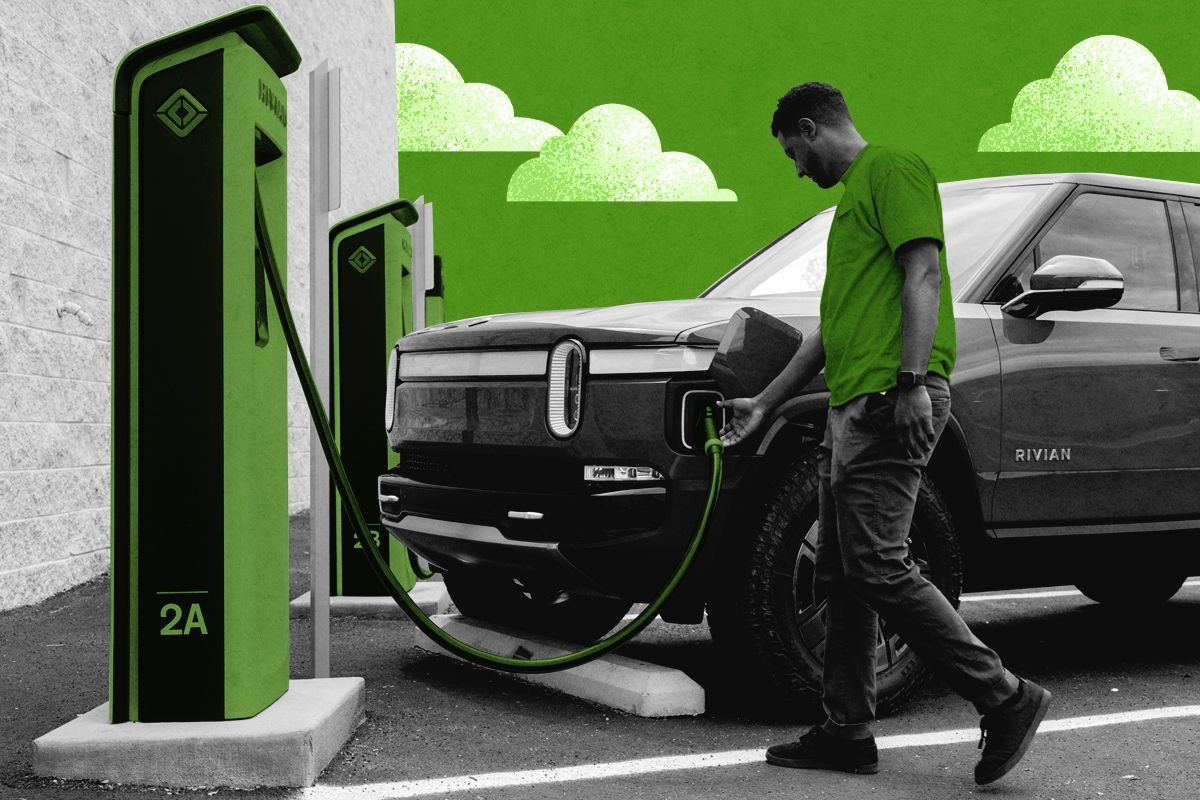
Take what’s happening at Rivian. During the brand’s ascendance, it has been slowly building out the Rivian Adventure Network. While the system is much smaller than Tesla’s Supercharger network in terms of stations and plugs, it has fast-chargers in strategic locations to ensure Rivian drivers can reach popular destinations and far-flung adventure attractions such as national parks. It also focused on making sure those plugs almost always work.
That’s crucial, because not all charger fails are created equal. Plenty of times I’ve tried to plug into a Level 2 destination charger in a parking structure or at a grocery store, only to be thwarted by a card reader that wouldn’t scan my payment method — or by the requirement to download a whole new app just to charge my car, something impossible to do with the cell service in the bowels of a garage. But those are charging sessions of convenience, times it would be nice to add a few miles during a shopping trip. The DC fast-chargers that make road trips possible have to work, no excuses.
When I asked Rivian cofounder and CEO RJ Scaringe about the network during this month’s first drive event for the R2 SUV, he noted that his and Tesla’s are the only EV fast-charging networks in America to achieve uptime north of 99%, and that he’s not stopping there. “The U.S. needs to have more than one great high-speed network,” he said, “and so we’re continuing to build it and we’re continuing to invest in the development of the hardware.”
Rivian could just outsource fast-charging, as legacy carmakers largely have done. Especially now that Rivians use the Tesla-developed NACS plug that is becoming the industry standard, they can charge easily at any of the legion of Superchargers, as well as at the stations run by third parties such as EVgo, Ionna, and Electrify America. But Scaringe says the continued expansion of Rivian’s network remains a core part of the company’s growth. The brand just opened its 1,000th plug, up from just 700 a year ago, while the network has about 150 total charging locations.
The continued investment makes sense. The more affordable R2 is the company’s do-or-die moment, and as Americans consider buying one as the various versions roll out this year and next, they’ll be greeted by a charging map that promises peace of mind — a growing list of Rivian-branded, high-reliability plugs that open up even the lonely places in America, backed up by thousands of accessible stations built by Tesla and others. (It doesn’t hurt that Rivian’s network delivers not only customer confidence, but also corporate revenue: Nearly all Rivian stations are now open to other brands’ EVs, creating a growing revenue stream as the startup finds its financial footing.)
Meanwhile, the rest of the charging industry is catching up. A report by the EV data analysis firm Paren says that while most U.S. states scored between 85% and 92% for charger reliability in the first quarter of 2025, that range of average performance rose to 90% to 95% in the first quarter of this year. In March, when I talked to Sara Rafalson of EVgo, her company was hard at work on a revised technology to make sessions more reliable and foolproof. That will involve “a completely different site layout, a completely different power sharing technology, a different dispenser, a different user interface, different hardware, firmware, software, the whole thing,” she told me.
All the parts matter. Bad interfaces with clunky software or busted hardware like physical buttons or credit card readers caused plenty of charger-fail chaos in the early days of American EVs. Tesla has created the charging gold standard — plug in your Model Y and it just works — but step outside that vertical integration and even Superchargers become a little annoying, as charging a non-Tesla still means having a Tesla account and navigating deep into their app. And too many American EV drivers know the pain of pulling up to a charger to find all the plugs either occupied or busted. Even if that doesn’t count as a failure in the statistics, it still represents a broken experience.
People have always had their reasons for picking which gas station to go to: They hit the one nearest their home, the one where they have a loyalty credit card, or the one that’s always a few cents cheaper than everywhere else in town. They don’t choose based on whose pumps are the most reliable. The gasoline delivery economy is one of those systems so mature it becomes invisible. But as EV charging comes of age, uptime and reliability might be just as important as price and amenities when it comes to planning out stops along the highway.