GLOBALVARS
0

Current conditions: The Pacific has officially entered El Niño, and the warmer-than-average weather pattern is expected to be stronger than usual • Heavy rains are deluging China’s Hunan and Guangxi provinces • While Puerto Ricans living in New York just threw the diaspora’s annual parade, thousands of Boricuas living on the island are enduring days of water shortages so severe the U.S. territory’s governor activated the National Guard.
THE TOP FIVE
1. Trump announces Iran deal to reopen the Strait of Hormuz
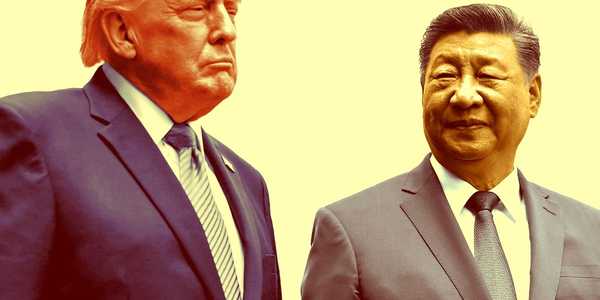
In a pair of Sunday evening posts on Truth Social, President Donald Trump said a “great deal” with Iran to end the conflict and reopen the Strait of Hormuz without any tolls was “now complete.” As part of the truce, Trump said he would “authorize the immediate removal of the United States Naval blockade” at the mouth of the Persian Gulf. The waterway through which up to a quarter of the global seaborne oil trade travels will remain closed until the deal is signed on Friday, Trump said, “for purposes of mine removal,” meaning Iran will collect the explosives its military planted around the strait to prevent vessels from passing. “Ships of the World, start your engines,” Trump wrote. “Let the oil flow!”
2. Trump gives up on defending the wind permitting ban
My colleague Emily Pontecorvo had a big scoop on Friday: The Trump administration is no longer defending the president’s moratorium on permitting wind projects. The Department of Justice filed a motion last week to dismiss its appeal of a federal court’s December decision vacating the order to halt wind energy approvals. Ending the White House’s all-of-government assault on wind and solar projects has been a key demand from Democrats seeking compromise for a permitting reform package. Experts say the procedural move in this case is a bullish sign for the various bills before Congress now. “The door to federal permitting is now unlocked again and each developer will be able to make the case for permitting their individual project based on the facts and the law,” Kit Kennedy, the managing director for power, climate, and energy at the Natural Resources Defense Council, told Emily.
The thaw in the permitting freeze comes as the SunZia Wind Project, the largest wind farm in the United States, is preparing to begin commercial operations in the coming days. The development in New Mexico, which has a total net summer generating capacity of 3,650 megawatts, is made up of 916 turbines.
3. Exclusive: New analysis shows the limits of a gas tax holiday
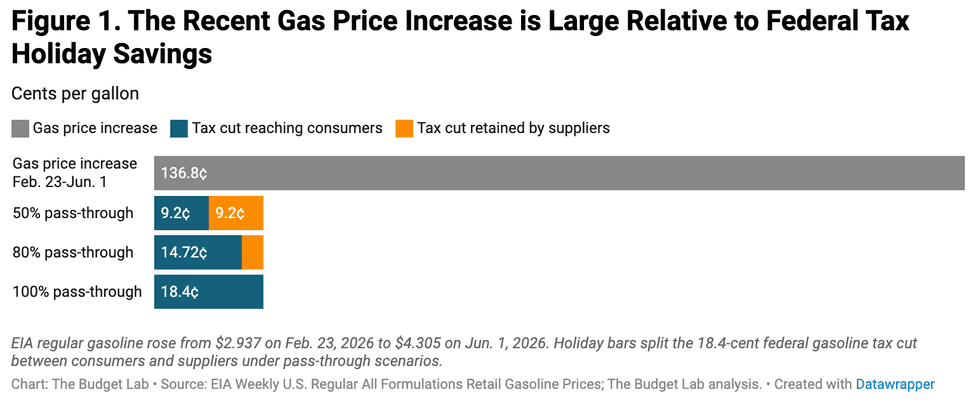
Trump wants to temporarily suspend the federal tax on gasoline to ease surging fuel prices caused by the war with Iran. His proposal would waive the tax of $0.184 per gallon, but doing so requires an act of Congress. According to a new analysis from the Budget Lab at Yale University shared exclusively with Heatmap, lifting the levy would pay Americans back about $37 of the roughly $250 in higher gasoline costs paid over the course of three months. While richer households would spend a smaller share of total income on fuel, they would accrue more per-dollar benefits than lower-income Americans. Likewise, the gas tax holiday would afford more rewards to heavy drivers.
Sign up to receive Heatmap AM in your inbox every morning:
* indicates required
Email Address *Our Privacy Policy & Terms Apply.
4. Key carbon disclosure nonprofit transforms into a for-profit business
It started out as a British nonprofit devoted to documenting, standardizing, and tracking how much carbon dioxide various partner organizations produce. Dubbed the Carbon Disclosure Project, the group, founded in 2000, had emerged as one of the central authorities on an issue increasingly baked into financial reporting rules. Now known only by its acronym, CDP said last week it would split its organization in two, segmenting a charitable, science-focused nonprofit called the CDP Foundation from a new commercial entity designed to deliver environmental data and disclosure services for a fee. The London private equity giant Permira will back the for-profit CDP’s launch. “For 25 years, CDP has been at the forefront of environmental disclosure, transforming it from the sidelines to the centre of decision-making,” the organization said in a statement. “To meet the scale and speed of today’s environmental challenges and market expectations, CDP is sharpening its focus, enabling stronger science-led disclosure and greater investment in technology to simplify the disclosure experience and deliver more decision-useful insights.”
5. Yet another Republican embraces data center NIMBYism
Tennessee Senator Marsha Blackburn, a key GOP tech policy reform voice in the Senate running for governor in her home state, just came out against a data center next to Nashville Zoo. “Tennessee should be thoughtful and considerate when deciding where data centers are located. The proposed site near the Nashville Zoo is neither,” she wrote in a post on X. “Let’s revisit this placement.” It’s yet another sign that the backlash against data centers is, as Heatmap’s Jael Holzman wrote, splintering the right.
THE KICKER
The geothermal industry is gearing up for a next-generation boom. Until Fervo Energy’s big stock market debut last month, the big publicly-traded player in the business was Ormat Technologies, a conventional geothermal giant that both builds power stations and manufactures the parts needed for plants. Now, at the industry’s big trade show in Calgary this week, Ormat is unveiling a 100-megawatt power generation system designed for unconventional wells like those Fervo or Ormat’s partner Sage Geosystems are drilling. It’s a sign, Think GeoEnergy reported, that Ormat is seeking “to accelerate the commercial deployment of next-generation geothermal projects.”