GLOBALVARS
0
Current conditions: Dolly is no longer a tropical storm, but the remnants of the system are set to drench the northern Caribbean, especially the Leeward Islands, the British and U.S. Virgin Islands, and eastern Puerto Rico • One person died and at least 14 hikers are missing in flash floods in the Grand Canyon that forced airlifts on Sunday • In the Pacific, Tropical Storm Karina is rapidly strengthening into a hurricane, but it’s unlikely to make landfall anywhere.
THE TOP FIVE
1. Trump inks ‘the biggest oil deal in world history’ with Venezuela
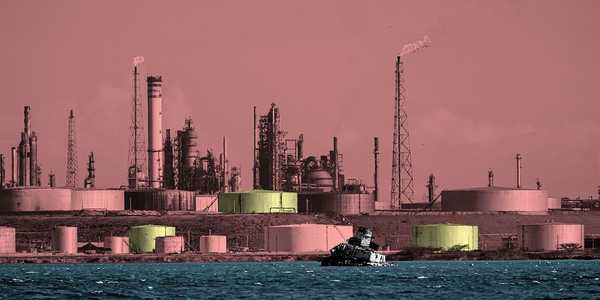
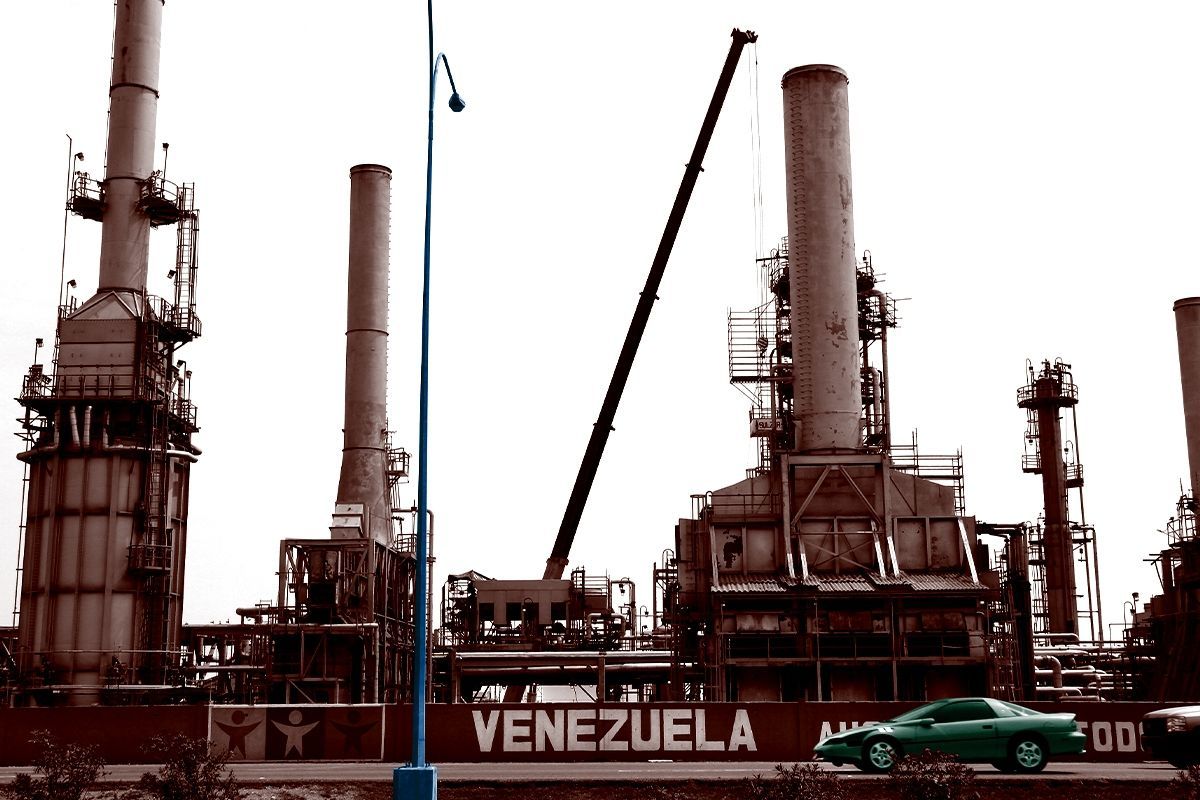
The United States has brokered what President Donald Trump called “the biggest oil deal in world history” with Venezuela, securing majority control over more than 65 million barrels of the South American nation’s proven supply of crude. In a post on his Truth Social network Friday evening, Trump said the agreement would “more than double American oil reserves” and “substantially lower gas prices for all Americans, long into the future, while helping to continue to set Venezuela on a course toward tremendous success and great prosperity.” Appearing on national television for a six-minute address, Venezuela’s interim President Delcy Rodríguez, who took power after the U.S. captured former leader Nicolás Maduro in a night-time raid nearly nine months ago, said the pact would allow Caracas to earn more than $209 billion in revenue and become “an energy powerhouse.” While “everyone knows our country has the biggest oil reserves in the world,” she said, “having resources underground isn’t enough.” She added, according to The Guardian’s translation: “It’s no use having our oil resources underground, only to appear in statistics or bookkeeping.” The deal is good news for the string of U.S. oil refineries on the Gulf coast that were designed for the heavy crude that comes out of Venezuela. As it stands, my colleague Matthew Zeitlin wrote last week, “America’s oil refineries are going all out.”
For all the fears stirred up by Central Intelligence Agency Director John Ratcliffe’s recent surprise visit to Moscow — remember, the last two times an American spy chief went to Russia, it was to try to dissuade the Kremlin from invading Ukraine or commit the first war-time nuclear bombing since World War II — the country doesn’t seem particularly ready to, as The Wall Street Journal reported, risk war with Washington by attacking a North Atlantic Treaty Organization country. Russia’s gasoline production fell to about 70% of domestic consumption levels in August following a series of Ukrainian drone attacks that forced major refineries offline, two industry sources told Reuters.
2. California sues Trump administration over deal to kill offshore wind projects
In June, New York led Northeast states in filing a lawsuit against the Trump administration, challenging the deals the Department of the Interior struck with offshore wind developers to pay out billions in taxpayer-funded “settlements” in exchange for abandoning the already-stalled turbine projects. Now California has filed its own lawsuit over what Attorney General Rob Bonta called the administration’s “blatantly unlawful” buyout of wind leases off the state’s coast. “The Trump administration’s backroom buyout with Golden State Wind to stop offshore wind development in favor of gas and oil drilling is, unfortunately, a classic playbook for them to line the pockets of their Big Oil donors,” Bonta said in a statement. “Let’s be clear: California will continue to aggressively fight back against the Trump administration’s outrageous abuse of taxpayer dollars to abandon offshore wind investments that could have delivered union-paying jobs and reliable clean energy to Californians.” The California Energy Commission, which joined the lawsuit, called the Interior Department’s efforts to curb offshore wind development “reckless” in the face of rising electricity demand. Adding to the malcontent over President Donald Trump’s most fruitful effort yet to kill off a specific clean energy sector that has drawn his ire since before he entered politics, my colleague Robinson Meyer noted earlier this month that the deals — more of which have come since the California settlement — are all for projects that were unlikely to move forward anyway.
3. U.S. uranium production tripled last year
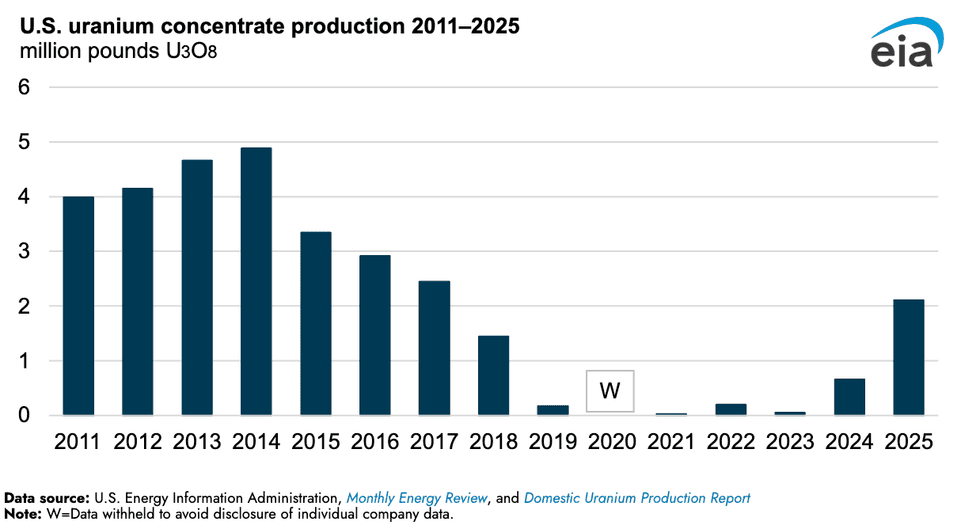
Until 1991, the United States produced the majority of the uranium its reactors (and atomic war machine) needed. Then came “megatons to megawatts.” Under the pithily named program, the U.S. took a victory lap after winning the Cold War by agreeing to import virtually any reactor fuel Russia made from disassembled weapons. American power plants received cheap fuel, a chaotically marketizing Russia found a market for some of its most coveted materials, and the world averted nuclear apocalypse. The only problem is that, contrary to the rhetoric of the time, history didn’t end. What nearly did end was domestic production of uranium and reactor fuel as Russian imports put American suppliers out of business. Nearly four decades later, the U.S. has banned Russian imports, and the exemptions to the prohibition end in 2028. The good news is that the U.S. is stepping up. In 2025, uranium concentrate production totaled 2.1 million pounds of triuranium octoxide — the base component for reactor fuel, known as yellowcake. That, according to the latest U.S. Energy Information Administration analysis, is the most since 2017 and more than triple the volume produced in 2024. But it’s still far from enough for energy independence. U.S. power plants used nearly 47 million pounds of yellowcake in 2025, down from just under 56 million pounds in 2024. Regardless of whether all the reactors currently underway move forward, that number is going up. New supply is coming. On Friday, developer Anfield Energy told The Northern Miner that it’s seeking to raise at least $50 million in financing in the coming months to refurbish and reopen Utah’s Shootaring Canyon mill, one of only three licensed, permitted, and constructed uranium mills in the U.S.
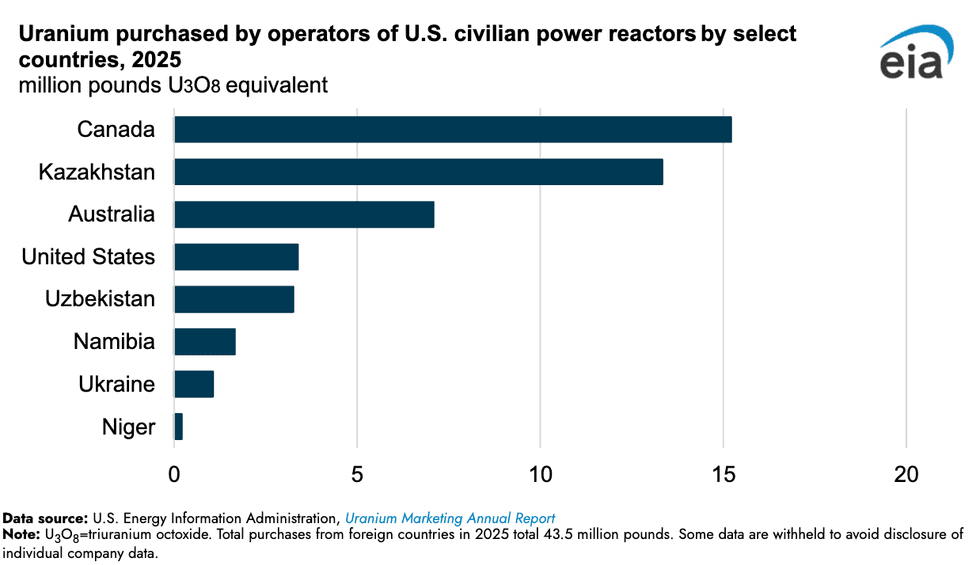
The U.S. supply boost could also benefit the United Kingdom, which is working with Washington on spurring along its own nuclear renaissance. A new YouGov poll released Friday found nuclear power to be Britain’s preferred future electricity source, with 21% of Britons saying it should be prioritized, compared to 19% for solar and 18% for offshore wind. Just over half of the voters surveyed doubted renewables alone could provide enough electricity to meet the nation’s power demand and lower costs. That’s despite nearly 50 gigawatts of onshore wind in the development pipeline across Great Britain, according to Renewables Now.
Sign up to receive Heatmap AM in your inbox every morning:
Email Address *Our Privacy Policy & Terms Apply.
4. Summer droughts test water networks from England to Puerto Rico
Britons’ doubts over renewables come as England’s water network heaves under the stress of a severe “flash drought” that Bloomberg said “is showing no signs of easing,” forcing water companies to truck supplies in and call for emergency restrictions. At least 30 million now face a temporary ban on using hoses and outdoor pipes.
Nearly 200,000 households and businesses are still without steady access to running water in Puerto Rico, where drought has collided with an aging aquifer system that leaks, by some estimates, more than half its supply of freshwater. Climate change reduced rainfall in America’s most populous non-state territory by 9% between May and July of this year, according to a new study by more than 20 scientists worldwide. The conclusion, the San Juan-based Centro de Periodismo Investigativo reported, is that drought “will persist and worsen.”
5. Two positive signs for the U.S. solar supply chain
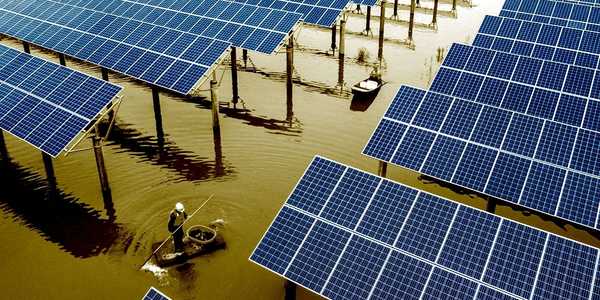
Earlier this month, as my colleague Emily Pontecorvo and I reported, the Trump administration tossed solar manufacturers a lifeline, raising tariffs on imported panel components in a bid to help factories compete with imports after Republicans’ sweeping tax law eliminated the federal incentives for developers to buy American-made photovoltaics. Since then, analysts have debated whether the minimum prices set in the Department of Commerce’s policy are sufficient to spur new investments in the production of solar cells. At least one company is announcing a project. In a post on LinkedIn last week, Oklahoma City-based Nextnova Solar unveiled plans for a 2-gigawatt solar cell factory in its home state. The company expects to bring the facility online in November and begin mass production in March 2027, according to PV Tech, which noted the possibility to expand to 5 gigawatts of annual production sometime in the future.
Meanwhile, the Minnesota-based manufacturer Heliene is preparing for a trial run of panels using American-made glass. The company has 1.3 gigawatts of crystalline silicon module capacity production, and recently formed a partnership to secure more locally sourced wafers and cells. But U.S.-made glass “has so far been a key missing element,” PV Tech reported in a separate story. Heliene’s pilot run will use glass from Ohio-based Stewart Glass. “As U.S. module manufacturing has been growing, there has been no supply of non-iron content glass,” Heliene CEO Martin Pochtaruk told the trade publication. “Being able to use glass versus importing glass is also part of de-risking the geopolitics of imports from Asia, and that’s why it’s so important.”
THE KICKER
In the U.S., we are still working our heads around building out a charging network that can comfortably keep electric cars fueled up from coast to coast with the same ease as a vehicle that can just fill up at a gas station. In China, auto giant BYD is now rolling out its ultra-fast chargers, which can restore a vehicle’s battery as quickly as you can fill up a gas tank. Just a few months ago, BYD marked its 5,000th Flash Charger deployment. Now it’s up to 10,000 across 300 different centers, InsideEVs reported last week, cribbing from the Chinese news site IT Home.