GLOBALVARS
0
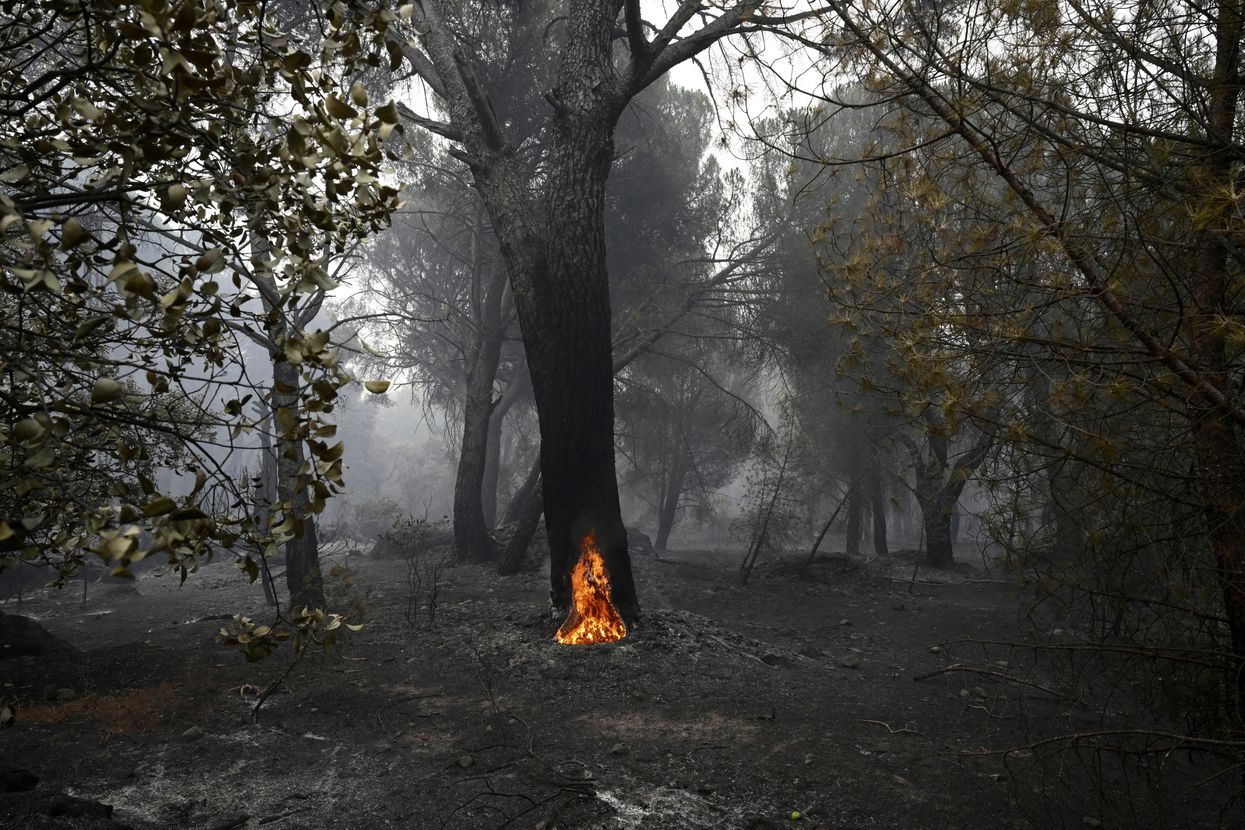
Enormous wildfires are still burning in France and Spain. “We're facing a completely unprecedented fire,” French President Emmanuel Macron said on Monday, comparing the situation to World War II. The main fire in Gironde, a southwestern department along the Atlantic coast, have consumed more than 100,000 acres and forced roughly 200,000 people to evacuate.
There’s little sign the fires are under control in either country. In France, the blazes created a pyrocumulonimbus cloud — a towering, thundering “fire storm” that sometimes forms in the western United States but is not often observed in western Europe. Some fires have come within several miles of Bordeaux, the country’s sixth-largest metropolitan area. In Spain, enormous wildfires away near Madrid, Ávila, and Toledo have killed one and displaced roughly another 79,000 people.
Firefighters are working fast, in part because a heatwave is forecast for the continent later this week. But of course it is hot — it is high summer in the Northern Hemisphere, and we are having a particularly hot year. 2026 now looks likely to be the world’s second-warmest year ever, and it has a better than one-third chance of being the warmest.
In the near term, expect more climate-addled disasters. The Pacific Ocean has slipped into its El Niño phase, which will likely spin off more extreme storms, droughts, heat waves, and wildfires. Recent modeling suggests it could be the most intense El Niño ever measured. Writing for his newsletter “The Climate Brink,” the climate researcher (and Heatmap contributor) Zeke Hausfather recently warned: “It looks like this year’s El Niño is not only very likely to be the strongest event since reliable records began — it may end up the strongest by a truly mind-blowing margin.”
How do we know this next El Niño will be bad? The most intense El Niño on record occurred from late 2015 to 2016, when sea surface temperatures in a benchmark region of the Pacific Ocean were 2.75 degrees Celsius warmer than normal. (That’s nearly 5 degrees Fahrenheit.) Those searing sea temperatures released huge amounts of heat into the atmosphere and eventually made 2016 the warmest year ever recorded. Today, a decade later, 2016 remains the fourth warmest year on record, coming in only under 2024, 2023, and 2025, per NOAA data.
But as Zeke writes, the middle 80% of modeled outcomes for this year’s El Niño are already projected to match or exceed that 2016 anomaly. The median forecast for this year’s event, in other words, would shatter the previous record. “The models are forecasting something outside the envelope of anything we have ever observed,” he writes. The National Weather Service agrees that there is an 81% chance of an event forming “that would rank among the largest El Niño events in the historical record going back to 1950,” and it says odds are better than 97% that the anomaly will stick around through spring 2027.
Scientists and activists once hoped that when global warming’s effects became unignorable, the public would take action. But disasters haven’t produced durable climate concern, and public attention has dissipated with every news cycle — and become ever more pessimistic. There are moments, however, when successive extremes can keep climate change more prominently in the public conversation. The years that followed the last mega-El Niño in 2016 made up one such period. If we are headed for another now, then experts should be ready with ideas not only for slowing and reversing the growth of heat-trapping emissions, but also for adapting our societies and infrastructure for our warming world. It’s clear we are going to need them.
The other mega-trend?
This will be a big week for understanding the U.S. energy economy’s most important trend. A handful of tech companies driving the artificial intelligence boom — namely, Microsoft, Meta and Amazon — will report their quarterly earnings on Wednesday and Thursday. These companies are behind some of the country’s largest AI data center projects and therefore some of its most sizable planned power plants — clean and otherwise.
Last week, when Alphabet boosted its capital expenditure for this year by another $15 billion, the market rebelled and sent its shares tumbling — suggesting If investors’ interest in financing mega-scale data center projects is waning, then it could affect the electricity economy for years to come. We'll know more later this week.