
GLOBALVARS
0

The Department of Energy has an enviable problem: It has more money than it can spend.
DOE disbursed just 2% of its total budgetary resources in fiscal year 2025, according to a report released earlier this year from the EFI Foundation, a nonprofit that tracks innovations in energy. That figure is far lower than the 38% of funds it distributed the year prior.
While some of that is due to political whiplash in Washington, there is another, far more mundane cause: There simply aren’t that many people left to oversee the money. Thanks to the Department of Government Efficiency’s efforts, one in five DOE staff members left the agency. On top of that, Energy Secretary Chris Wright shuffled around and combined offices in a Kafkaesque restructuring. Short on workers and clear direction, the department appears unable to churn through its sizable budget.
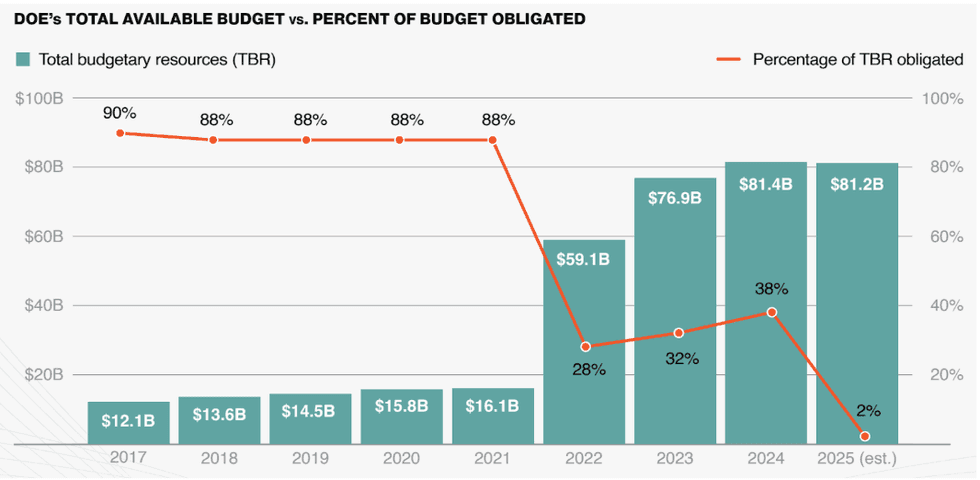
Though Congress provides budgetary authority, agencies are left to allot spending for the programs under their ambit, and then obligate payments through contracts, grants, and loans. While departments are expected to use the money they’re allocated, federal staff have to work through the gritty details of each individual transaction.
As a result of its reduced headcount, DOE’s employees are each responsible for far more budgetary resources than ever before.
“DOE is facing its largest imbalance in its history,” Alex Kizer, executive vice president of EFI Foundation, told me. In fiscal year 2017, DOE budgeted around $4.7 million per full-time employee. In the fiscal year 2026 budget request, that figure reached $35.7 million per worker — about eight times more.
Part of that increase is the result of the unprecedented injection of funding into DOE from the 2021 Infrastructure Investment and Jobs Act and the 2022 Inflation Reduction Act. The pair of laws, which gave DOE access to $97 billion, comprised the United States’ largest investment to combat climate change in the nation’s history.
The epoch of federally backed renewable energy investment proved to be short-lived, however. Once President Trump retook office last year, his administration froze funds and initiated a purge of federal workers that resulted in 3,000 staffers (about one in five) leaving DOE through the Deferred Resignation Program. The administration canceled hundreds of projects, evaporating $23 billion in federal support.
While the One Big Beautiful Bill Act passed last summer depleted some of the IRA’s coffers and sunsetted many tax credits years early, it only rescinded about $1.8 billion from DOE, according to the EFI Foundation. Much of the IRA’s spending had already gone out the door or was left intact.
This leaves DOE in a strange position: Its budget is historically high, but its staffing levels have suffered an unprecedented drop.
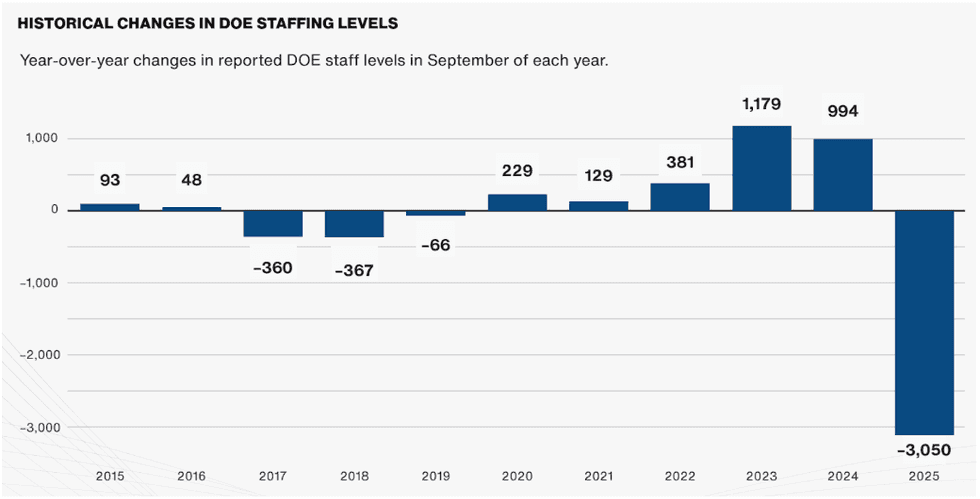
Even before the short-lived Elon Musk-run agency took a chainsaw to the federal workforce, DOE struggled to hire enough people to keep up with the pace of funding demanded by the IRA’s funding deadlines. The Loan Programs Office, for example, was criticized for moving too slowly in shelling out its hundreds of billions in loan authority. According to a report from three ex-DOE staffers that Heatmap’s Emily Pontecorvo covered, the IRA’s implementation suffered from a lack of “highly skilled, highly talented staff” to carry out its many programs.
“The last year’s uncertainty and the staff cuts, the project cancellations, those increase an already tightening bottleneck of difficulty with implementation at the department,” Sarah Frances Smith, EFI Foundation’s deputy director, told me.
One former longtime Department of Energy staffer who asked not to be named because they may want to return one day told me that as soon as Trump’s second term started, funding disbursement slowed to a halt. Employees had to get permission from leadership just to pay invoices for projects that had already been granted funding, the ex-DOE worker said.
While the Trump administration quickly moved to hamstring renewable energy resources, staff were kept busy complying with executive orders such as removing any mention of diversity equity and inclusion from government websites and responding to automated “What did you do last week?” emails.
On top of government funding drying up, Kizer told me that the confusion surrounding DOE has had a “cooling effect on the private sector’s appetite to do business with DOE,” though the size of that effect is “hard to quantify.”
Under President Biden, DOE put a lot of effort into building trust with companies doing work critical to its renewable energy priorities. Now, states and companies alike are suing DOE to restore revoked funds. In a recent report, the Government Accountability Office warned, “Private companies, which are often funding more than 50 percent of these projects, may reconsider future partnerships with the federal government.”
Clean energy firms aren’t the only ones upset by DOE’s about-face. Even the Republican-controlled Congress balked at President Trump’s proposed deep cuts to DOE’s budget in its latest round of budget negotiations. Appropriations for fiscal year 2026 will be just slightly lower than the year before — though without additional headcount to manage it, the same difficulties getting money out the door will remain.
The widespread staff exit also appears to have slowed work supporting the administration’s new priorities, namely coal and critical minerals. LPO, which was rebranded the “Office of Energy Dominance Financing,” has announced only a few new loans since President Biden left office. Southern Company, which received the Office’s largest-ever loan, was previously backed by a loan to its subsidiary Georgia Power under the first Trump administration.
Despite Trump’s frequent invocation of the importance of coal, DOE hasn’t accomplished much for the technology besides some funding to keep open a handful of struggling coal plants and a loan to restart a coal gasification plant for fertilizer production that was already in LPO’s pipeline under Biden.
Even if DOE wanted to become an oil and gas-enabling juggernaut, it may not have the labor force it needs to carry out a carbon-heavy energy mandate.
“When you cut as many people as they did, you have to figure out who’s going to do the stuff that those people were doing,” said the ex-DOE staffer. “And now they’re going to move and going, Oh crap, we fired that guy.”


