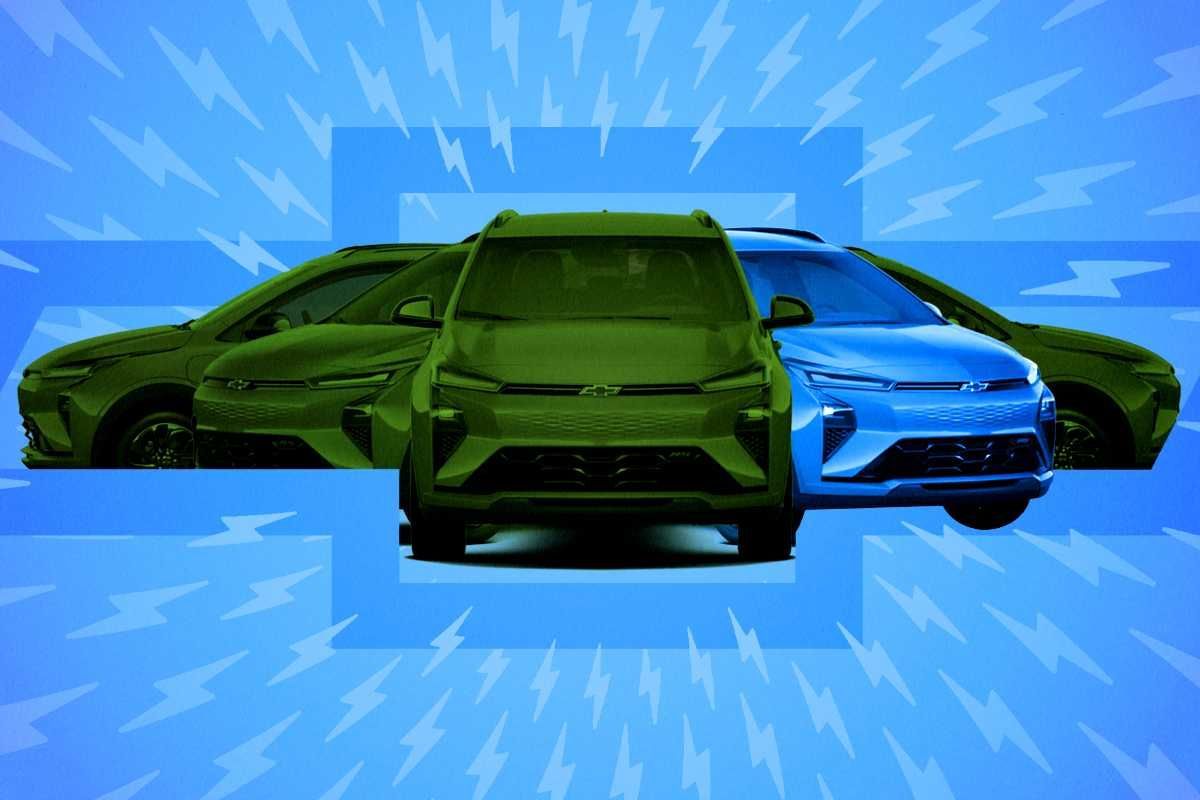
Here’s what you need to know about the rejuvenated Chevrolet Bolt: It’s back, it’s better, and it starts at under $30,000.
Although the revived 2027 Bolt doesn’t officially hit the market until January 2026, GM revealed the new version of the iconic affordable EV at a Wednesday evening event at the Universal Studios backlot in Los Angeles. The assembled Bolt owners and media members drove the new cars past Amity Island from Jaws and around the Old West and New York sets that have served as the backdrops of so many television shows and movies. It was star treatment for a car that, like its predecessor, isn’t the fanciest EV around. But given the giveaway patches that read “Chevy Bolt: Back by popular demand,” it’s clear that GM heard the cries of people who missed having the plucky electric hatchback on the market.
The Bolt died at the height of its powers. The original Bolt EV and Bolt EUV sold in big numbers in the late 2010s and early 2020s, powered by a surprisingly affordable price compared to competitor EVs and an interior that didn’t feel cramped despite its size as a smallish hatchback. In 2023, the year Chevy stopped selling it, the Bolt was the third-best-selling EV in America after Tesla’s top two models.
Yet the original had a few major deficiencies that reflected the previous era of EVs. The most egregious of which was its charging speed that topped out at around 50 kilowatts. Given that today’s high-speed chargers can reach 250 to 350 kilowatts — and an even faster future could be on the way — the Bolt’s pit stops on a road trip were a slog that didn’t live up to its peppy name.
Thankfully, Chevy fixed it. Charging speed now reaches 150 kilowatts. While that figure isn’t anywhere near the 350 kilowatts that’s possible in something like the Hyundai Ioniq 9, it’s a threefold improvement for the Bolt that lets it go from 10% to 80% charged in a respectable 26 minutes. The engineers said they drove a quartet of the new cars down old Route 66 from the Kansas City area, where the Bolt is made, to Los Angeles to demonstrate that the EV was finally ready for such an adventure.
From the outside, the 2027 Bolt is virtually indistinguishable from the old car, but what’s inside is a welcome leap forward. New Bolt has a lithium-ion-phosphate, or LFP battery that holds 65 kilowatt-hours of energy, but still delivers 255 miles of max range because of the EV’s relatively light weight. Whereas older EVs encourage drivers to stop refueling at around 80%, the LFP battery can be charged to 100% regularly without the worry of long-term damage to the battery.
The Bolt is GM’s first EV with the NACS charging standard, the former Tesla proprietary plug, which would allow the little Chevy to visit Tesla Superchargers without an adapter (though its port placement on the front of the driver’s side is backwards from the way older Supercharger stations are built). Now built on GM’s Ultium platform, the Bolt shares its 210-horsepower electric motor with the Chevy Equinox EV and gets vehicle-to-load capability, meaning you’ll be able to tap into its battery energy for other uses such as powering your home.
But it’s the price that’s the real wow factor. Bolt will launch with an RS version that gets the fancier visual accents and starts at $32,000. The Bolt LT that will be available a little later will eventually start as low as $28,995, a figure that includes the destination charge that’s typically slapped on top of a car’s price, to the tune of an extra $1,000 to $2,000 on delivery. Perhaps it’s no surprise that GM revealed this car just a week after the end of the $7,500 federal tax credit for EV purchases (and just a day after Tesla announced its budget versions of the Model Y and Model 3). Bringing in a pretty decent EV at under $30,000 without the help of a big tax break is a pretty big deal.
The car is not without compromises. Plenty of Bolt fans are aghast that Chevy abandoned the Apple CarPlay and Android Auto integrations that worked with the first Bolt in favor of GM’s own built-in infotainment system as the only option. Although the new Bolt was based on the longer, “EUV” version of the original, this is still a pretty compact car without a ton of storage space behind the back seats. Still, for those who truly need a bigger vehicle, there’s the Chevy Equinox EV.
For as much time as I’ve spent clamoring for truly affordable EVs that could compete with entry-level gas cars on prices, the Bolt’s faults are minor. At $29,000 for an electric vehicle in the U.S., there is practically zero competition until the new Nissan Leaf arrives. The biggest threats to the Bolt are America’s aversion to small cars and the rapid rates of depreciation that could allow someone to buy a much larger, gently used EV for the price of the new Chevy. But the original Bolt found a steady footing among drivers who wanted that somewhat counter-cultural car — and this one is a lot better.