
Current conditions: Hurricane Melissa passed by Bermuda on its way northward, leaving at least 30 dead in its wake across the Caribbean • Tropical Storm Kalmaegi is strengthening as it approaches the eastern shore of the Philippines • Colombia and Venezuela are bracing for flooding from heavy rainfall up to 2 inches above average.
THE TOP FIVE
1. EPA backs off plans to kill Energy Star
The Environmental Protection Agency has quietly walked back its plans to eliminate Energy Star, the popular program that costs just $32 million in annual budget but saves Americans more than $40 billion each year. In May, EPA Administrator Lee Zeldin announced that his agency would end the program. The proposal drew swift backlash from industry groups and Republicans in Congress, as I wrote in a July newsletter. Now Zeldin is reconsidering the move, four unnamed sources with direct knowledge of the agency’s plans told The New York Times. Federal records show the agency renewed four contracts with ICF, the consulting firm that helps oversee the program, including one deal that stretches through September 2030.
Calling the initial plan to eliminate Energy Star “vexing,” RE Tech Advisors’ Deb Cloutier, one of Energy Star’s original architects, told Heatmap’s Jeva Lange, “There are a lot of lobbying efforts that I’m personally aware of within the commercial real estate industry and the manufacturing industry, where folks are reaching out and doing calls to action for the House and Senate Appropriations majority members — similar activities to what we did eight years ago when Energy Star was directly under fire.” She added, “I know that there are many, many representatives, both Republican and Democrats, who support Energy Star. We’ve had 35 years of bipartisan support, and it has been earmarked in congressional law many times, through multiple George H.W. and George W. Bush administrations.”
2. The world is on track for about 2.8 degrees of warming
The world is on track to warm by an average of 2.8 degrees Celsius by the end of the century, the Rhodium Group predicted in its latest forecast. The consultancy said its modeling showed a 67% likelihood that global temperatures will rise between 2.3 degrees and 3.4 degrees thanks to the current trajectory of planet-heating pollution. That’s a significant improvement on the dire predictions issued a decade ago. But if decarbonization doesn’t pick up pace, the probability of limiting warming to 2 degrees — the more modest target set in the Paris Agreement — is below 5%. Still, the findings don’t deviate much from Rhodium’s projections before Trump returned to office. As Heatmap’s Emily Pontecorvo wrote this morning, “in the long run, Trump might not mean much for the climate’s trajectory.”
Nevertheless, the overshoot beyond 2 degrees is partly why Bill Gates took a more moderate stance on climate change in his latest memo, as Heatmap’s Robinson Meyer wrote last week. It’s also why, as Rob explained in a big story, private companies promising to commercialize technology to geoengineer the world’s temperature are raising large sums of money.
3. Energy Department makes $100 million available to help modernize coal plants
The Department of Energy is stepping up its efforts to keep aging coal plants online. The agency on Friday announced plans to offer up to $100 million to owners of coal-fired power stations that plan to modernize the stations with upgrades that “improve efficiency, plant lifetimes, and performance of coal and natural gas use.” In a press release, Secretary of Energy Chris Wright praised President Donald Trump for having “ended the war on American coal” and “restoring common sense energy policies that put Americans first.”
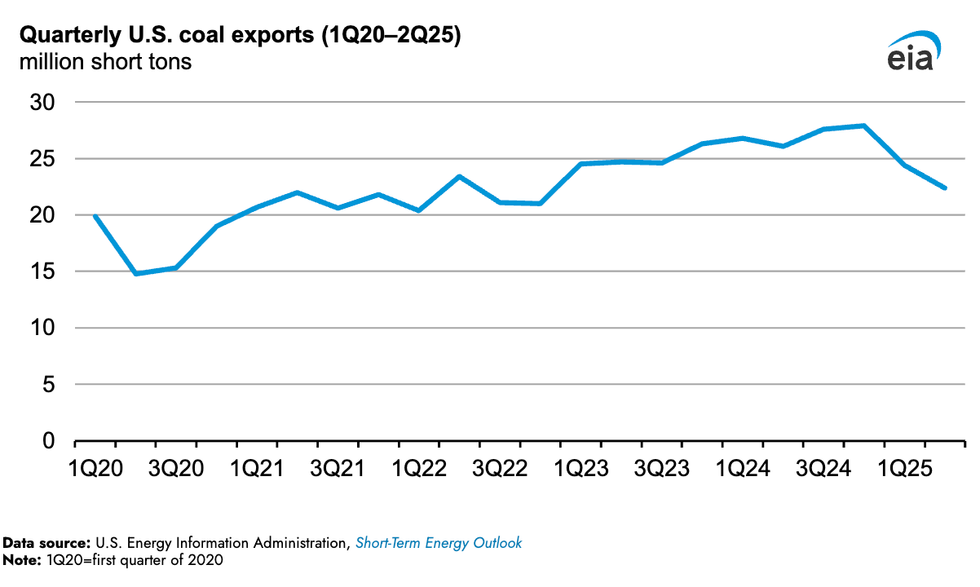
Despite Trump’s promises to revive American coal production and use, exports fell 11% in the first half of this year due to China buying less of the fuel amid ongoing trade negotiations, according to an analysis published Friday by the Energy Information Administration.
4. State Street quits climate group
In the latest sign that Wall Street is heeding Trump’s calls to veer away from investment initiatives that cut out fossil fuels, lending giant State Street’s asset management arm withdrew its U.S. operations from what was once a leading climate action group for the industry. The company said “it had decided that only its units serving UK and European clients would remain part of the Net Zero Asset Managers” group, the Financial Timesreported. BlackRock, Vanguard, and JP Morgan Asset Management had already left the group known as NZAM in the U.S. JP Morgan and State Street had already also quit another green investor group, Climate Action 100+, last year.
5. Spain is officially reconsidering the world’s last national nuclear phaseout
Months after Taiwan shut down its final reactors earlier this year, a plurality of voters approved a referendum calling for the last atomic plant to be turned back on. Years after Germany completely exited nuclear power, the new government has reversed Berlin’s position and has now joined France in supporting atomic energy again as it considers ways to restore its fleet. Switzerland and Belgium, meanwhile, reversed plans to shut down nuclear plants, and Italy — the first country in the world to end its nuclear power production years ago — is working on reviving its industry. That leaves only Spain still stubbornly planning to close its nuclear plants starting in 2027.
The tides may be turning. In February, a majority of lawmakers in Spain’s parliament approved a resolution condemning Socialist Prime Minister Pedro Sanchez’s phaseout plans. Now the board of Spain’s Centrales Nucleares Almaraz-Trillo has officially requested a three-year extension on the operating license for units one and two of the Almaraz Nuclear Power Plant. If granted, the extension would allow the reactors to stay online through 2030. The station currently supplies 7% of Spain’s electricity.
THE KICKER
Fusion energy, the joke goes, is the energy source of tomorrow — and always will be. But recent laboratory breakthroughs have unleashed billions of dollars in private financing to commercialize fusion energy for real, with companies promising to open power plants in the next decade. There’s a big bottleneck, however: Many of the materials needed for fusion reactors are scarcely produced right now. New bipartisan legislation aims to change that by extending the 45X tax credit for clean manufacturing — one of the few parts of the Inflation Reduction Act retained in Trump’s One Big Beautiful Bill Act — to producers of vanadium, deuterium, helium-3, and other materials needed for fusion power to take off.