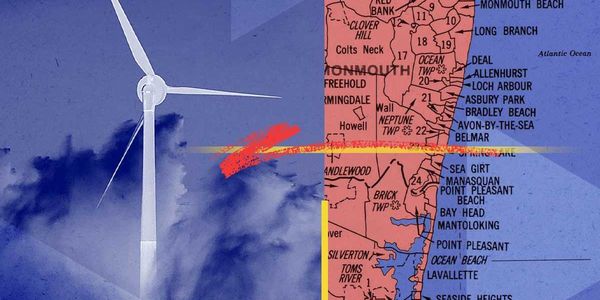
This week’s conversation is with Johanna Bozuwa, executive director of the Climate and Community Institute, a progressive think tank that handles energy issues. This week, the Institute released a report calling for a “public option” to solve the offshore wind industry’s woes – literally. As in, the group believes an ombudsman agency akin to the Tennessee Valley Authority that takes equity stakes or at least partial ownership of offshore wind projects would mitigate investment risk, should a future Democratic president open the oceans back up for wind farms.
While I certainly found the idea novel and interesting, I had some questions about how a public office standing up wind farms would function, and how to get federal support for such an effort post-Trump. So I phoned up Johanna, who cowrote the document, to talk about it.
The following conversation has been lightly edited for clarity.
How did we get here? What’s the impetus for this specific idea – an authority to handle building out offshore wind?
As you have covered very closely, [the Trump administration is] stymying huge manufacturing opportunities for union workers, and obviously putting [decarbonization] way off course. Even though it’s an odd time to talk about a federally-focused offshore wind agenda, I think because the administration is scaring off investment in this sector, increasingly our only option in a more amenable administration may be to just do it ourselves.
From my perspective, we can’t just abdicate this critical decarb sector. It’s so close to coastal population centers, so close to where people live in high-density urban areas that need electricity. So we need to be preparing for how we make up for this massive amount of lost time. We’re also trying to break through some of the longer term coordination problems the offshore wind sector has run into.
Your report outlines past examples of authorities like the Tennessee Valley Authority – help me understand what this would look like for offshore wind.
There are definitely examples of what we’re discussing here, and we evoke the moonshot as one of these examples where the government got behind a major technological jump and used industrial policy to make that happen — doing some of the planning, investing in companies directly via equity stakes, developing its own public enterprises or departments within the government to drive towards a common goal.
Then, of course, there was the rural electrification administration and the TVA development. The federal government has used more of its planning muscle to drive toward a critical goal, and from our perspective, a critical goal is decarbonizing the electricity sector. Yet at the same time, we’re seeing massive electricity cost spikes, so we’re trying to ponder how an authority like this could actually do that.
There are three areas where we’d imagine this authority to be involved. The first is actual development of offshore wind projects – a stable baseline for offshore wind by always being the bidder of last resort, actively bidding on projects along the coast. This also creates a baseline for the supply chain generally.
We also see an opportunity here in offshore transmission grids, because I’m sure you’re well aware how mired those grids have become. There are opportunities for increased planning around the grid to ensure a higher level of coordination. And by having a federal authority, it will lower the cost to other offshore wind developers.
The third piece is the supply chain manufacturing — more so a coordination role, sure, but also an opportunity for the federal government to leverage its large-scale procurement power. It would help provide security for a lot of the components in this moment of uncertainty.
On one hand, the benefit of the public option is a birch rod for the private sector. If the public entity is providing things at lower cost and with potentially higher commitments to higher wages, with more people wanting to work for the public entity, it can bring the entirety of the industry up because they’d have to compete with the agency.
On the other hand, I think there’s pieces of this that actually draw down costs, like the transmission and supply chain pieces.
What do you say to the percentage of the public that is opposed to offshore wind development?
I think there has been a very effective disinformation campaign. We also see a benefit in planning because we can limit overbuild and be strategic about where it’s deployed to limit permitting snags and other turmoil.
Okay, but the big question hovering over this is how it gets done. You’re going to need to convince the public to create this authority. And this is such an ambitious idea. How do you reckon with that?
Because so much has been lost during this administration, in terms of public planning and the DOGE cuts, there will be this need on a grand scale to supercharge and re-double efforts in a wide range of areas. My feeling is that we have to build toward a political appetite.
We have to think about big, ambitious solutions like this. Is this actually an opportunity to lower costs, not just decarb? Are there ways to think about that to build an enduring political coalition?
We’re seeing the Trump administration use some of these policy levers much more stridently than former Democratic presidents have used — like with equity stakes. We could do that kind of thing, too.
The truth is we have three years to build the political opportunities and coalition to do this.