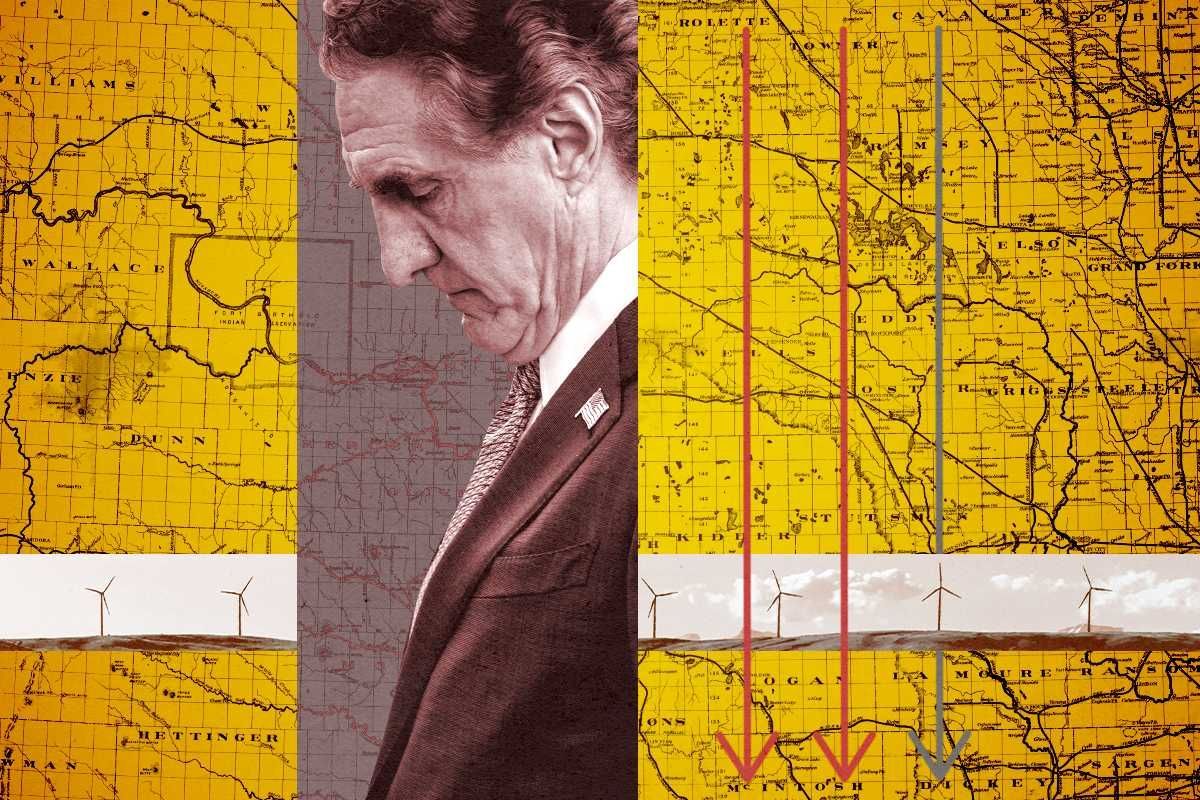
A wind farm in North Dakota – the former home of Interior Secretary Doug Burgum – is becoming a bellwether for the future of the sector in one of the most popular states for wind development.
At issue is Allete’s Longspur project, which would see 45 turbines span hundreds of acres in Morton County, west of Bismarck, the rural state’s most populous city.
Sited amid two already operating wind farms, the project will feed power not only to North Dakotans but also to Minnesotans, who, in the view of Allete, lack the style of open plains perfect for wind farms found in the Dakotas. Allete subsidiary Minnesota Power announced Longspur in August and is aiming to build and operate it by 2027, in time to qualify for clean electricity tax benefits under a hastened phase-out of the Inflation Reduction Act.
On paper, this sounds achievable. North Dakota is one of the nation’s largest producers of wind-generated power and not uncoincidentally boasts some of cheapest electricity in the country at a time when energy prices have become a potent political issue. Wind project rejections have happened, but they’ve been rare.
Yet last week, zoning officials in Morton County bucked the state’s wind-friendly reputation and voted to reject Longspur after more than an hour of testimony from rural residents who said they’d had enough wind development – and that officials should finish the job Donald Trump and Doug Burgum started.
Across the board, people who spoke were neighbors of existing wind projects and, if built, Longspur. It wasn’t that they didn’t want any wind turbines – or “windmills,” as they called them, echoing Trump’s nomenclature. But they didn’t want more of them. After hearing from the residents, zoning commission chair Jesse Kist came out against the project and suggested the county may have had enough wind development for now.
“I look at the area on this map and it is plum full of wind turbines, at this point,” Kist said, referencing a map where the project would be situated. “And we have a room full of people and we heard only from landowners, homeowners in opposition. Nobody in favor.”
This was a first for the county, zoning staff said, as public comment periods weren’t previously even considered necessary for a wind project. Opposition had never shown up like this before. This wasn’t lost on Andy Zachmeier, a county commissioner who also sits on the zoning panel, who confessed during the hearing that the county was approaching the point of overcrowding. “Sooner or later, when is too many enough?” he asked.
Zachmeier was ultimately one of the two officials on the commission to vote against rejecting Longspur. He told me he was looking to Burgum for a signal.
“The Green New Deal – I don’t have to like it but it’s there,” he said. “Governor Burgum is now our interior secretary. There’s been no press conferences by him telling the president to change the Green New Deal.” Zachmeier said it was not the county’s place to stop the project, but rather that it was up to the state government, a body Burgum once led. “That’s probably going to have to be a legislative question. There’s been nothing brought forward where the county can say, We’ve been inundated and we’ve had enough,” he told me.
The county commission oversees the zoning body, and on Wednesday, Zachmeier and his colleagues voted to deny Longspur’s rejection and requested that zoning officials reconsider whether the denial was a good idea, or even legally possible. Unlike at the hearing last week, landowners whose property includes the wind project area called for it to proceed, pointing to the monetary benefits its construction would provide them.
“We appreciate the strong support demonstrated by landowners at the recent Commission meeting,” Allete’s corporate communications director Amy Rutledge told me in an email. “This region of North Dakota combines exceptional wind resources, reliable electric transmission infrastructure, and a strong tradition of coexisting seamlessly with farming and ranching activities.”
I personally doubt that will be the end of Longspur’s problems before the zoning board, and I suspect this county will eventually restrict or even ban future wind projects. Morton County’s profile for renewables development is difficult, to say the least; Heatmap Pro’s modeling gives the county an opposition risk score of 92 because it’s a relatively affluent agricultural community with a proclivity for cultural conservatism – precisely the kind of bent that can be easily swayed by rhetoric from Trump and his appointees.
Morton County also has a proclivity for targeting advanced tech-focused industrial development. Not only have county officials instituted a moratorium on direct air capture facilities, they’ve also banned future data center and cryptocurrency mining projects.
Neighboring counties have also restricted some forms of wind energy infrastructure. McClean County to the north, for example, has instituted a mandatory wind turbine setback from the Missouri River, and Stark County to the west has a 2,000-foot property setback from homes and public buildings.
In other words, so goes Burgum, may go North Dakota? I suppose we’ll find out.