GLOBALVARS
0
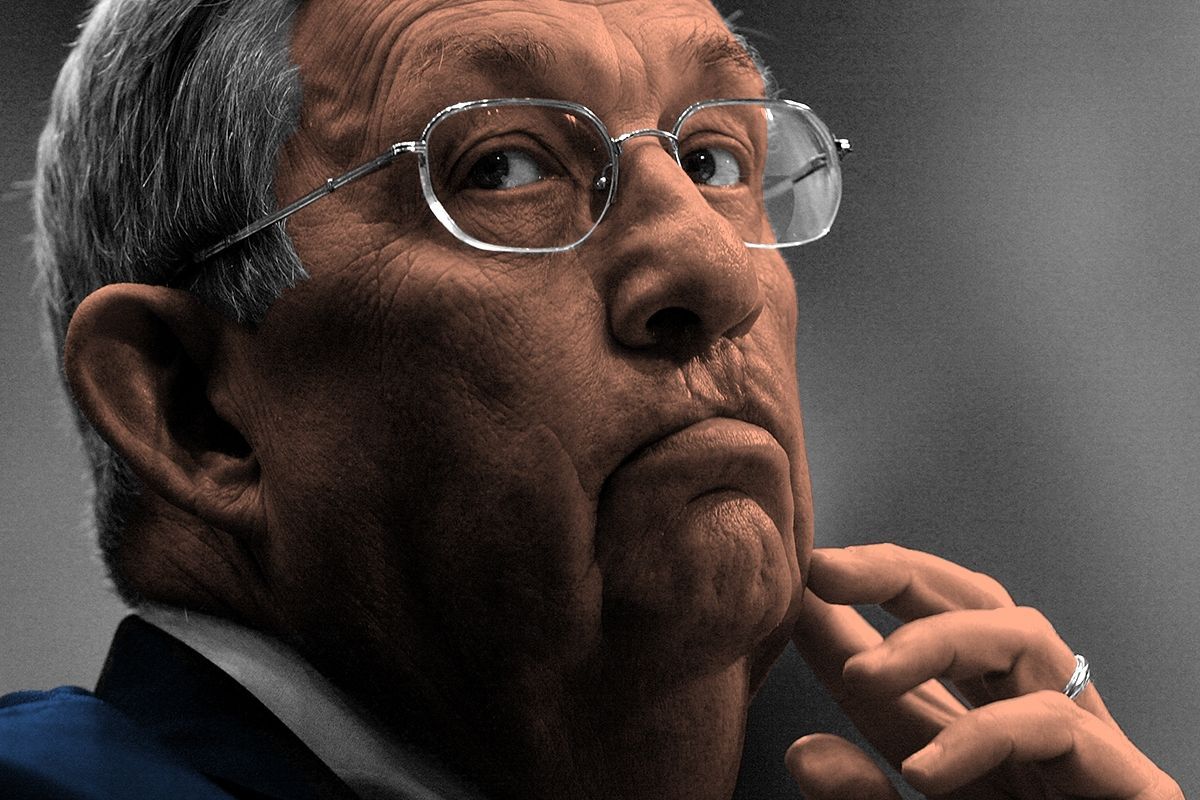
Lee Raymond, the former ExxonMobil chief executive who became one of the country’s most important and influential climate science deniers, died in Dallas on Saturday. His death was announced today.
Raymond would probably count as a world-historic figure even if viewed only through the lens of the fossil fuel business. As Exxon’s chief executive, he personally negotiated the company’s merger with Mobil, creating the modern oil and gas juggernaut ExxonMobil in 2000 — and uniting two major pieces of the old Standard Oil monopoly. He ran Exxon from 1993 to 1999, and then ExxonMobil until 2005, at a crucial period in the history of that company, turning it from a diversified conglomerate that sold office furniture, real estate, and uranium fuel into a streamlined and exorbitantly profitable oil and gas business. Even before taking over the company, he managed its response to the disastrous Exxon Valdez oil spill; he later oversaw a worker safety push that would be widely copied by the industry.
In a way, he transformed Exxon from a company that was itself a portfolio — that distinguished itself via managerial competence across business lines — into a ruthlessly focused oil and gas supermajor meant to sit inside other people’s portfolios and churn out cash. Under his leadership, ExxonMobil became the world’s most profitable publicly traded company; it later lost that title to Apple.
Yet even if Raymond had merely played a bit part in the history of oil and gas, he would remain essential to the modern ordeal of climate change. Today, people throw around the “climate change denier” label often enough that it has lost some of its charge. But Raymond was the genuine article, a true villain. It was Raymond who turned ExxonMobil into one of the world’s most important funders of falsehood and denial about fundamental climate science research.
Raymond, an engineer by training, straightforwardly rejected the mainstream scientific consensus that carbon dioxide emissions from fossil fuels cause climate change. Even though Exxon’s in-house climate research arm knew by the late 1970s that “there is no doubt” fossil fuels worsened the “potential problem of CO2 in the atmosphere,” Raymond did everything he could to elevate more industry-friendly perspectives. And he was willing to muddy the truth to win.
Under Raymond’s leadership, Exxon spent millions of dollars funding a shadowy network of think tanks and pseudo-scientific groups who published memos, briefings, and advertisements meant to cast doubt on climate change. As the journalist Steve Coll wrote in his book Private Empire,
> Under Lee Raymond, ExxonMobil had persistently funded a public policy campaign in Washington and elsewhere that was transparently designed to raise public skepticism about the science that identified fossil fuels as a cause of global warming. ExxonMobil ran some aspects of its campaign clandestinely; that is, it did not initially disclose the full scope and purpose of contributions it made. […] What distinguished the corporation's activity during the late 1990s and the first Bush term was the way it crossed into disinformation.
In his capacity as CEO, Raymond made it clear that he personally rejected bedrock science. “Is the Earth really warming? Does burning fossil fuels cause global warming? And do we now have a reasonable scientific basis for predicting future temperature?,” he asked rhetorically during a 1997 meeting of the World Petroleum Congress in Beijing.
He answered all three questions in the negative, concluding, “Let’s agree there’s a lot we really don't know about how climate will change in the 21st century and beyond.” (In fact, we now know that even ExxonMobil’s primitive in-house climate models, then 20 years old, basically got global warming right.) He also claimed — we now know incorrectly — that any policy passed in the 1990s would be “very unlikely” to affect the future trajectory of mid-21st-century emissions declines.”
The campaign worked. Exxon’s activism during this period, conducted sub and supra rosa, helped prevent the passage of major global and domestic climate policy in the 1990s; it also kept the United States from developing expertise in the solar, wind, and battery industries that other countries now dominate.
One of the ironies of this era is that much of modern climate science is derived from oil geology. You cannot grasp the all-important role that carbon plays in the Earth system — the way it has functioned as the thermostat for Earth’s climate over the long run — without a rich understanding of what the fossil record tells us about the Permian, Carboniferous, or the Upper Jurassic periods.
Take the Permian, for instance: When it began 299 million years ago, the Earth was relatively cool, with atmospheric CO2 levels somewhere around 200 to 400 parts per million. But soon enormous volcanoes ignited subterranean stores of fossil fuels, dumping thousands of gigatons of carbon into the atmosphere and initiating an era of rapid global warming and ocean acidification. When the Permian ended 252 million years ago in the largest mass extinction in Earth’s history — an annihilation that climate scientists call “the Great Dying” — atmospheric CO2 was closer to 2,500 parts per million.
When Lee Raymond was born in South Dakota in 1938, the atmosphere’s CO2 concentration sat at about 311 parts per million. When he died last week, it read 421 parts per million. Look at it this way, I suppose: Many people would feel captive to a change of that magnitude. But Raymond did something about it.