GLOBALVARS
TEST TEST TEST
0
Products
Current conditions: A sleepy Atlantic hurricane season just snapped to attention as two tropical storms started forming near the Caribbean and off Africa’s coast • Southern California is bracing for a week of triple-digit temperatures • The Hawk Fire has forced 42,000 people to evacuate an area near Reno, Nevada.
THE TOP FIVE
1. U.S. pipeline of gas plants nearly doubles
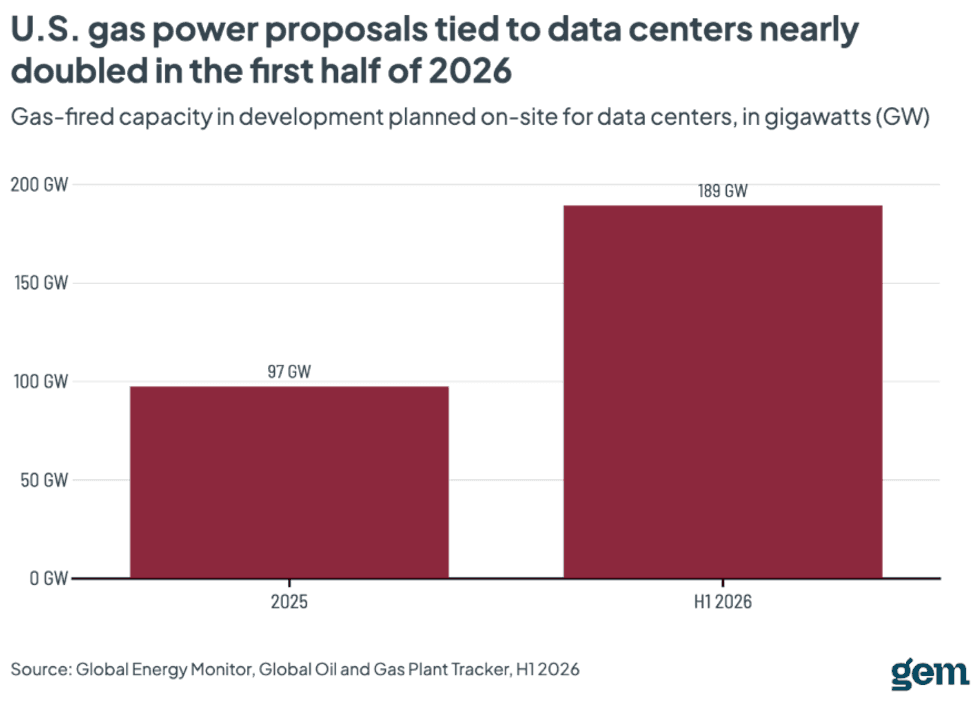
The United States nearly doubled its pipeline of gas-fired power plant projects in the first half of this year, “but uncertainty persists about how and when this capacity gets built,” the watchdog Global Energy Monitor concluded in a new analysis. The country now has 189 gigawatts of planned gas projects, accounting for one-third of the global total. Completing all the plants would cost more than $647 billion. The U.S. is taking unique approaches to expanding its gas fleet, including building what would be the largest power station in the country as a federally-owned gas plant.
As my colleague Emily Pontecorvo points out, however, there’s a big asterisk on these numbers: Many of the projects are still in nascent stages of development and may never be built. “When I went through the group’s data to try to identify the 10 biggest gas projects under development that are tied to data centers, it became clear how slippery the whole picture really is,” she says in her write-up of the report, which I highly recommend checking out.Electric cooperatives, meanwhile, are lobbying to make building more gas plants even easier. Last week, Utility Dive reported, the National Rural Electric Cooperative Association urged the Environmental Protection Agency to exempt more gas plants from emissions rules.
2. New NRDC analysis gives the bear case on clean energy in the Trump era
Last month, a report by the Massachusetts Institute of Technology’s Center for Energy and Environmental Policy Research made the case that “the glass is half full” on federal green spending, finding that President Donald Trump’s landmark tax law, the One Big Beautiful Bill Act, preserved 74% of the clean energy gains from the Biden-era Inflation Reduction Act. (You should listen to my colleague Robinson Meyer’s podcast conversation with the author, Lily Bermel, from last month.) Now the Natural Resources Defense Council has come out with the bearish counterargument. The environmental group’s new analysis, out this morning, found that the U.S. will lose between 390 gigawatts and 540 gigawatts of new solar, wind, and battery projects that would have been built before OBBBA’s passage.
“I see a glass much more than half empty,” Amanda Levin, the director of policy analysis at the NRDC, wrote in an op-ed for Heatmap. “The repeal of the key IRA tax credits and other Trump administration policies will result in 637 fewer gigawatts in added clean energy over the next 15 years and cost the average American household $4,500.”
3. China’s oil demand probably peaked last year, Sinopec says
One popular theory of Trump’s motivation for joining Israel in launching a war against Iran is that halting the flow of oil through the Strait of Hormuz would demonstrate China’s vulnerability as a top importer of foreign fossil fuels and America’s strength as the world’s No. 1 producer of oil and natural gas. But China’s actual response proved to be robust. In addition to ramping up domestic production of its own limited reserves of fossil fuels, Beijing deployed more renewables and nuclear reactors, electrified things that once ran on oil or gas, and made real progress on fuels such as hydrogen and its derivatives. Between that and China’s own carbon-cutting goals, last year was likely the peak of the country’s demand for oil, according to the state oil company Sinopec. In an earnings call Monday in Hong Kong, Sinopec Chairman Hou Qijun said demand had already crested, two years earlier than the 2027 peak the company had previously forecast, according to Bloomberg. Keep in mind that only means oil demand is no longer growing. The Chinese economy isn’t exactly on a GLP-1 treatment for crude just yet. In fact, Reuters noted that, on the call, Sinopec said it was now eyeing Brazil and Africa as new sources of oil imports. That’s probably partly why, as I told you last week, American oil giants are setting sights on Africa.
In the meantime, the People’s Republic may finally be sorting out carbon capture and storage. Last week, GD Power’s Jinjie Company issued a tender for engineering design of its 4 million tons per year full-sized CCS project for coal power stations. The project, according to the China Hydrogen Bullet, “is described as the world’s first full-flue-gas carbon capture facility at a coal-fired power plant.”
Sign up to receive Heatmap AM in your inbox every morning:
* indicates required
Email Address *Our Privacy Policy & Terms Apply.
4. Thousands still without electricity in Indiana nearly two weeks after storms
Nearly two weeks after a powerful storm took out power for roughly 800,000 households in one of America’s most important industrial clusters, as many as 30,000 in northwest Indiana remained without electricity this past weekend. “My people are being overlooked,” Myles Tolliver, a Gary councilman whose family decamped to Chicago while the power was out, told The New York Times. “Our families are sitting in the dark. We don’t need any more excuses. We need the lights on.” By Monday evening, more than 8,300 households and businesses remained disconnected from the grid, according to data on PowerOutage.us, a tracker website.
The worst outage in the U.S. as of Monday night was in Shelby County, in the southwesternmost corner of Tennessee, where storms knocked out the power for nearly 32,000 households and businesses. Behind that was Washoe County, on the western flank of Nevada, where the aforementioned Hawk Fire damaged power lines.
5. Trump gets behind nuclear-powered merchant vessels to counter China’s shipbuilding dominance
The Trump administration is working with the British startup Core Power to help build a fleet of nuclear-powered merchant vessels to loosen China’s tightening grip over commercial shipbuilding. In an interview Monday with the Financial Times, U.S. Maritime Administration chief Stephen Carmel announced a public-private partnership agreement with Core Power in a bid to speed up commercialization of nuclear propulsion for ships. “We are not going to beat China by being a cheaper version of China. They have mastered the art of being cheap,” Carmel said. “The way we win in all this is to change the terms of the competition to something that is more favourable to us. So, we don’t compete on trying to be cheap. We compete on technology … and nuclear technology is something we are really good at.”
Vietnam just took a big step toward building its nuclear power station. On Monday, NucNet reported that the fast-growing Southeast Asian nation’s parliament had approved plans for its first commercial nuclear plant, a two-reactor, 2.4-gigawatt plant built by Russia. Hanoi is looking beyond just atomic energy to supplement its surging demand for power. The municipal government in Ho Chi Minh City, the nation’s largest metropolis, is reviewing a feasibility study into developing up to 6 gigawatts of offshore wind, according to offshoreWIND.biz.
THE KICKER
The Trump administration fast-tracked a Rare Earth Resources’ plan for an open-pit mine in Wyoming to extract rare earth minerals. Even in a deep-red state that mines more coal than any other in the U.S., the project is getting pushback. “It was kind of hush-hush, in my opinion, as far as not much word about it around Sundance,” Sundance resident Justin Johnson told WyoFile. “All of a sudden, in July when it came to our attention, it’s like, ‘Holy cow. We got little time before the federal deadline to get our comments and concerns to the Forest Service … You would think there’d be a lot more time for the actual owners of public land — the citizens of the U.S. — to have a response to what’s going on.”