GLOBALVARS
0
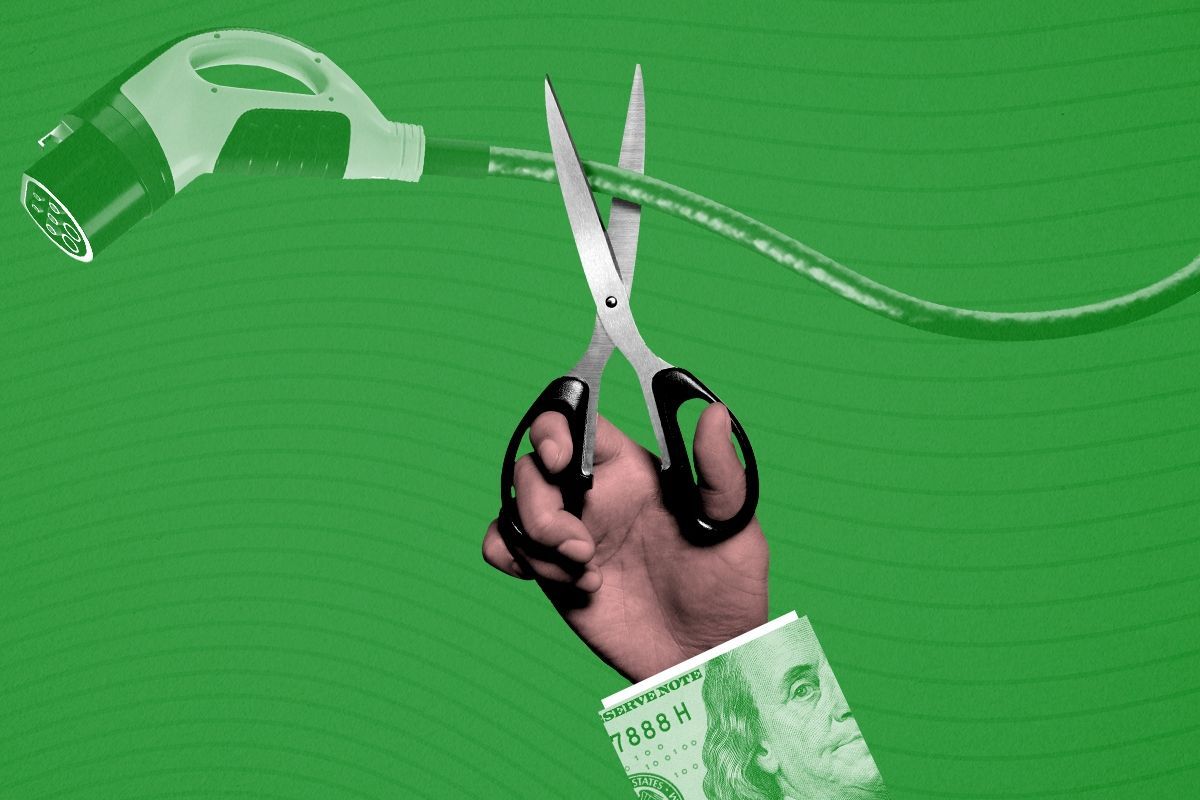
Investment in the clean economy is flagging — and the electric vehicle supply chain is taking the biggest hit.
The Clean Investment Monitor, a project by the Rhodium Group and the Massachusetts Institute of Technology’s Center for Energy and Environmental Policy Research that tracks spending on the energy transition, found that total investment in clean technology in the last three months of 2025 was $60 billion. That compares to $68 billion in the fourth quarter of 2024 and $79 billion in the third quarter of last year. While total clean investment in 2025 was $277 billion — the highest the group has ever recorded — the fourth quarter of 2025 was the first time since the Clean Investment Monitor began tracking that the numbers fell compared to the same quarter the year before.
“Since 2019, quarterly investment has surpassed the level observed in the same period of the previous year — even when quarter-on-quarter declines occurred,” the report says. “That trend ended in Q4 2025, when investment declined 11% from the level observed in Q4 2024.”
It starts downstream, with consumer purchases of clean energy technology once favored by federal tax policy: electric vehicles, heat pumps, and home electricity generation. Consumer purchases fell 36% from the third quarter to the fourth quarter, after the $7,500 federal EV credit expired on September 30.
With a consumer market for EVs being undercut, car companies responded by canceling projects and redirecting investment.
“There were a lot of big, multi-billion dollar cancellations coming from Ford specifically,” Harold Tavarez, a research analyst at Rhodium, told me. There’s been a lot of pivots from having fully electric vehicles to doing more hybrids, more internal combustion, and even extended range EVs.”
Ford alone took an almost $20 billion hit on its EV investments in 2025. The company suspended production of its all-electric F-150 Lightning late last year, despite its status as the best-selling electric pickup in the country for 2025, and announced a pivot into hybrids and extended-range EVs (which have gasoline-powered boosters onboard), including a revamped Lightning. It has also announced plans to convert some manufacturing facilities designed to produce EVs back into internal combustion plants, but it hasn’t abandoned electricity entirely. Other decommissioned EV factories will instead produce battery electric storage systems, and the company has announced a pivot to smaller, cheaper EVs.
Ford is far from alone in its EV-related pain, however. Rival Big Three automaker GM also booked $6 billion in losses for 2025, while Stellantis, the European parent company of the Chrysler, Dodge, and Jeep brands, will take as much as $26 billion in charges. EV sales fell some 46% in the fourth quarter of last year compared to the third quarter, and 36% compared to the fourth quarter of 2024, according to Cox Automotive.
Looking at the investment data holistically, the true dramatic decline was in forward-looking announcements, again heavily concentrated in the EV supply chain. The $3 billion in clean manufacturing announced in the fourth quarter of last year was an almost 50% drop from the previous quarter, “marking this quarter as the lowest period of announcements since Q4 2020,” the report says. Announcements were down about 25% for the year as a whole compared to 2024. Of the $29 billion of canceled projects Clean Investment Monitor tracked from 2018 through the end of last year, almost three quarters — some $23 billion — happened in 2025.
“Collectively, we estimate around 27,000 operational jobs in the manufacturing segment were affected by cancellations,” the report says, “two-thirds (68%) of which were tied to projects canceled in 2025.”
“One of the most frustrating parts of watching Trump wage war on all things clean energy is the apparent lack of understanding — or care — of how it impacts his stated goals,” Alex Jacquez, a former Biden economic policy official who is chief of policy and advocacy at the Groundwork Collective, told me. “The IRA built a real, competitive manufacturing base in the U.S. in a new sector for the first time in decades. Administration priorities are being hampered by blind opposition to anything Biden, IRA, or clean energy.”