GLOBALVARS
0

Current conditions: A series of tornadoes has flattened entire neighborhoods in central and southern Mississippi, causing what one pastor called “just total devastation” • The heat index across the northern half of the Philippines’ main island of Luzon could feel as high as 122 degrees Fahrenheit, raising the risk of heat stroke • There will be some hot moms in Phoenix this weekend when temperatures in Arizona’s sprawling capital top 108 degrees on Mother’s Day.
THE TOP FIVE
1. Trump is sentencing the wind industry to death by a thousand cuts
President Donald Trump’s attempts to kill the offshore wind industry through regulatory fiat have largely failed to hold up in court. But as the administration finds new success in paying off developers to abandon ocean leases for seaward turbines, it’s attempting the original playbook now on the onshore wind sector, holding up more than 150 projects by refusing to give out once-routine approvals from the Department of Defense. That includes projects that are nowhere near military bases or defense-related infrastructure, and comes despite the fact that U.S. policymakers across the political spectrum agree we need to bring as much new power online as quickly as we can to meet booming demand from data centers and electrification. “This is the strategy for how you kill an industry while losing every case: just keep coming at the industry,” an energy lawyer told Heatmap’s Jael Holzman. “Create an uninvestable climate and let the chips fall where they may.” In other words: The bombardments may fail, but the siege can win..
2. Blowback is building against Trump’s cash-for-quitting offshore wind scheme
When French energy giant TotalEnergies became the first offshore wind developer to take up Trump on his offer of $1 billion to abandon two projects back in March, the administration’s effort to kill off an industry Trump has personally opposed since long before he gained political power seemed to finally be catching a foothold following a series of legal retreats. By April, however, blowback to the deal had started building. Reporting from Heatmap’s Emily Pontecorvo found that the U.S. government’s agreement with Total didn’t actually mandate any new investments in fossil fuels, as the administration strongly implied, and that and that the payment may not have actually met the requirements to be drawn from a federal coffer designed to fund legal settlements. Shortly afterward, House Democrats announced plans to investigate Total’s contract with the government. This week, California regulators launched their own probe into one of two new developments that took up Trump’s offer, a floating offshore wind project that was set to be the first such project on the West Coast. Now one of the largest U.S. pension funds is reconsidering its stake in Total. Citing “significant concerns” over Total’s decision to cancel its two offshore wind leases and double down on fossil fuels, the New York State Common Retirement Fund said it would evaluate selling the $1.6 million stake in the company.
In a letter to Total CEO Patrick Pouyanné that the Financial Times reviewed, Thomas DiNapoli, the New York State comptroller and trustee of the retirement fund, said: “As the fund continually evaluates companies based on credible transition plans, portfolio companies’ backtracking may impact the fund’s risk assessment results and proxy voting decisions.” While “TotalEnergies had sought to be a leader in [the] energy transition,” he added, “now investors are left scratching their heads over how the board came to this decision to abandon that strategy and what it means for the future of the company and our stake in it.” In Total’s home country, the picture for offshore wind looks quite different. While Paris remains committed to expanding its world-leading nuclear fleet, a new floating offshore wind farm off France just started pumping electricity onto the grid.
3. The world’s largest carbon removal plant hits a snag
Occidental Petroleum has once again pushed back the opening of the world’s largest carbon removal facility, with executives warning that they’re uncertain how quickly the delay can be resolved. Construction on the direct air capture megaproject in West Texas, known as Stratos, has been mostly complete for months. Last August, the company revised the start date to the end of the year. In February, Occidental said the operations would begin by the second quarter of this year. But in its first-quarter earnings call Wednesday, Richard Jackson, Occidental’s chief operating officer, who will take over for CEO Vicki Hollub when she retires at the end of this month, told analysts “the technology and process unit operations performed as expected.” He said the company had “identified an issue related to non-process components of the facility, unrelated to the technology” and was “currently evaluating the repair timeline and assessing the impact on the operations schedule,” according to Occidental’s official transcript of his remarks. When I emailed the company to ask for more details on what issues and specific components are holding up the project, a spokesperson responded: “We have nothing to offer beyond what Richard said that it’s non-process and we’ll provide an update next quarter.”
Make no mistake, it’s not all doom and gloom for DAC. Colorado and Wyoming this week signed an agreement to work together on carbon storage infrastructure. And a major breakthrough in Kenya “signals a new era” for geological storage of carbon dioxide, so heralded the Carbon Herald.
Sign up to receive Heatmap AM in your inbox every morning:
* indicates required
Email Address *Our Privacy Policy & Terms Apply.
4. Trump’s new mineral sanctions on Cuba torpedo a Canadian miner
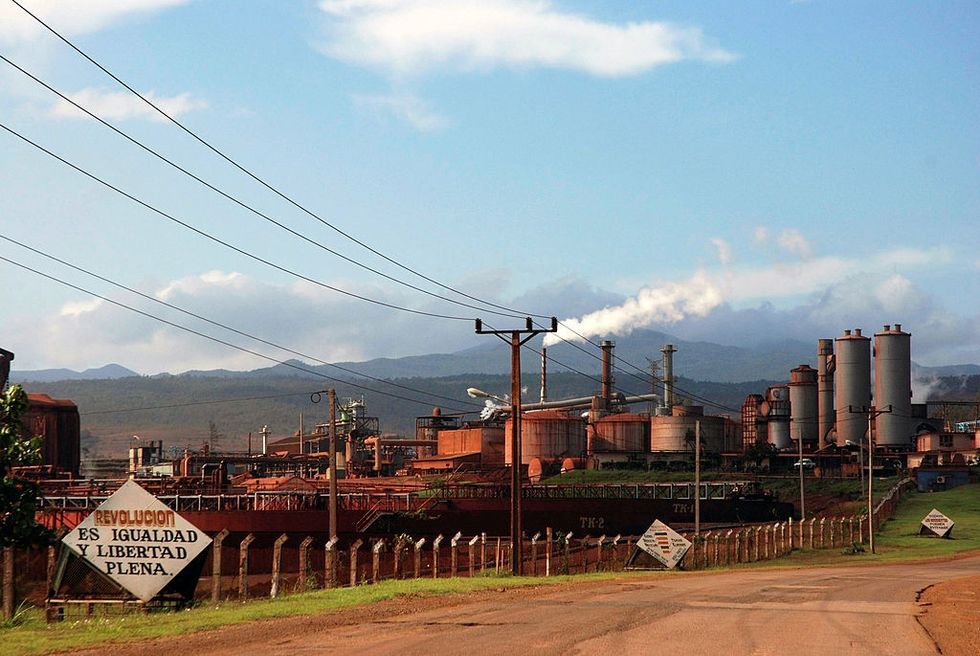
The United States has expanded its sanctions on Cuba, forcing the Canadian miner that had been the Caribbean nation’s biggest foreign investor to flee as the Trump administration ramps up its effort to topple the 67-year-old communist regime and reassert Washington’s suzerainty over the island just 90 miles south of Florida. The new sanctions on Thursday, which came days after Trump broadened the U.S. embargo on Cuba, sent the price of shares in Canada’s Sherritt International Corporation tumbling 41% by the time the market closed in North America. For the past 32 years, the company has operated a nickel and cobalt mining operation on the island, providing one of Cuba’s few commercial lifelines into the global economy. While Sherritt said it had not yet been designated for sanctions, a listing “could occur at any time,” the company warned, and banks and other vendors might be “unable or unwilling” to keep supplying the firm. “In any event, the mere issuance of the executive order itself creates conditions that materially alter the corporation’s ability to operate in the ordinary course, including activities related to Sherritt’s Cuban joint venture operations,” Sherritt said in a statement on its website. “This is a massive blow to an already sinking economy,” Ricardo Torres, a leading Cuban-born economist at the American University in Washington, told the Financial Times.
5. Volkswagen says its latest EVs are up to 80% as profitable as gas cars
The internal combustion engine is still the profit motor for Volkswagen. But when the world’s second-largest automaker reported its first-quarter earnings last week, the company said its latest electric vehicles are up to 80% as profitable as gasoline-powered alternatives. That’s according to a nugget InsideEVs highlighted this week from the investor update. Once Volkswagen launches its newest modular blueprint for its electric vehicle offerings — known internally as the Scalable Systems Platform, or SSP — the margins are expected to align more closely, said Arno Antlitz, the German auto giant’s chief financial officer. “We expect the margin to be fully comparable only with our future SSP platform,” he said.
THE KICKER
Things are looking sunnier for what has long been the weakest sector of the American solar industry. SEG Solar, a Houston-based manufacturer, has announced plans to add 4 gigawatts of module production capacity to its factory in Texas’ largest city, creating a 6-gigawatt facility. The move comes as Elon Musk has vowed to dramatically scale up Tesla’s solar manufacturing capacity and First Solar builds its own 4-gigawatt facility.