GLOBALVARS
0
We’ve already talked this week about Pennsylvania asking whether the modern “regulatory compact,” which grants utilities monopoly geographical franchises and regulated returns from their capital investments, is still suitable in this era of rising prices and data-center-driven load growth.
Now America’s biggest electricity market and another one of that market’s biggest states are considering far-reaching, fundamental reforms that could alter how electricity infrastructure is planned and paid for over 65 million Americans.
New Jersey Governor Mikie Sherrill anchored her 2025 campaign on electricity prices, and for good reason — in the past four years, electricity prices in the state have gone up 48%, according to Heatmap and MIT’s Electricity Price Hub, while average bills have risen from $83 per month to $130. On her first day in office, Sherrill issued two executive orders acting on that promise, directing the state to make funds available to freeze rates and declaring a state of emergency to ease the way to building more generation.
Included in that first order was a review of utility business models to be carried out by state regulators. What that review will entail is now coming into focus.
On Wednesday, the New Jersey Board of Public Utilities issued a statement announcing that it will look specifically at “whether New Jersey’s century-old utility business model — one that rewards electric distribution companies (EDCs) for capital spending even when cheaper alternatives exist — should be replaced with a framework tied to performance, affordability, and long-term cost stability.” In case anyone was still ambiguous as to what the outcome of said study might be, the board added that it is “expected to drive the most significant restructuring of utility regulation in New Jersey in decades.”
The current system, the board’s president Christine Guhl-Savoy said at a hearing Thursday, “creates a structural incentive to favor capital intensive solutions, even when lower costs, non-wires or demand side alternatives may be available.”
This structure, she said, could help explain why “over the past decade, electric delivery charges in New Jersey have risen steadily.” Within the service territory of PSEG, one of the four major New Jersey utilities, distribution charges alone have risen from $19.24 per month in January 2020 (as far back as the Heatmap-MIT data goes) to $21.84 as of April, while transmission charges have risen from around $20 to just over $29 per month. Many critics of the utility business model point to high levels of local grid spending on distribution as a way that utilities pad their earnings with returns harvested from ratepayers.
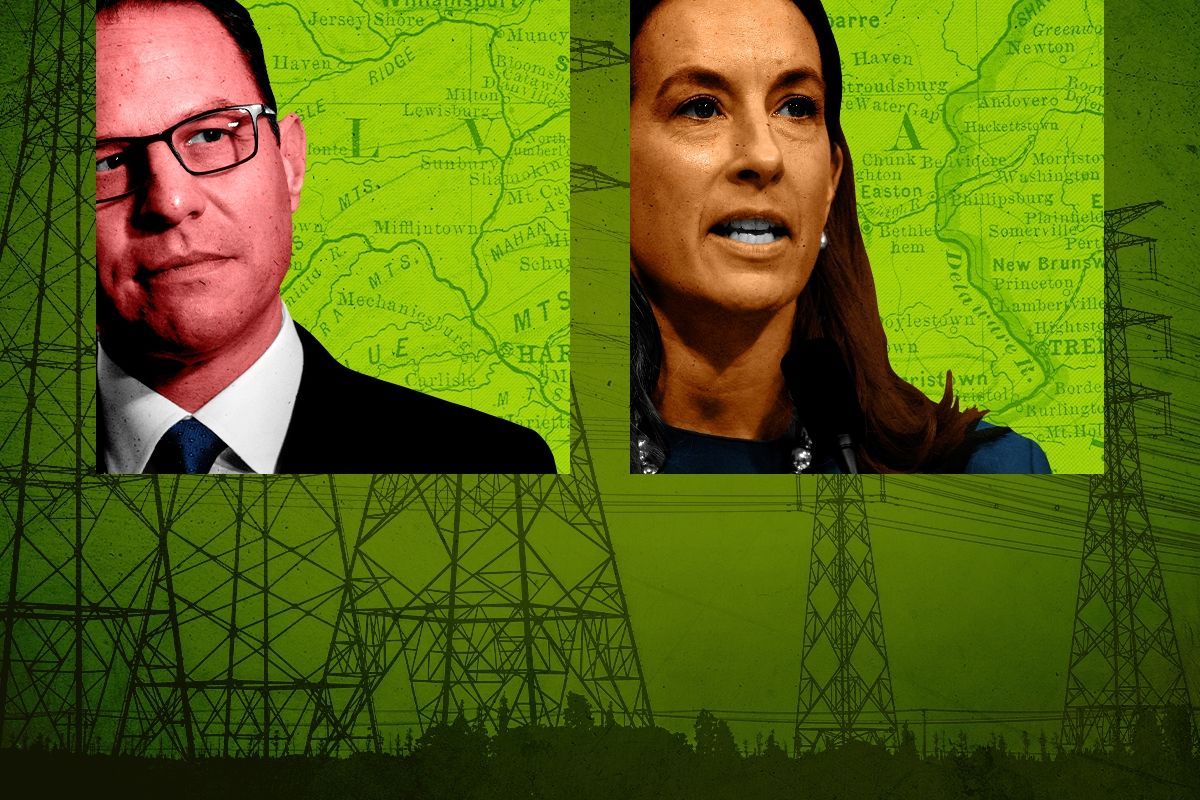
In the system regulators explored at the hearing, new projects would get a more skeptical look and ratepayers payouts would be partially determined by utilities hitting pre-defined service goals. NJBPU executive director Bob Brabston also indicated that the review process would take a close look at utilities’ regulated returns on equity — echoing his neighbor across the Delaware River, Pennsylvania Governor Josh Shapiro, who wrote in a letter to his state’s utilities earlier this week that these returns must be “transparent” and “justifiable,” and no longer be based on “educated guesses.”
“We want to make sure that the actual cost of equity and the returns on equity are close,” Brabston said Thursday. “We don’t want there to be a significant gap between the cost of equity that you all experience and the returns that the agencies that the agency awards.”
Meanwhile, in Valley Forge, Pennsylvania, the framework within which New Jersey’s utilities exist is coming in for its own examination.
PJM Interconnection — the nation’s largest electricity market, which covers not just Pennsylvania and New Jersey but also part or all of 11 other states — released an almost 70-page paper Wednesday, in which the organization’s president David Mills wrote that “the current situation is not tenable.”
PJM has been the poster child for a host of issues plaguing the electricity markets across the country, including fast-rising prices, a failure to quickly bring on new generation, and an inability to assure the market’s preferred level of reserve reliability. This set of challenges, Mills said in the paper’s introduction, “reflects something more fundamental than a design that needs recalibration.” Instead, PJM must consider “whether the foundational assumptions of the market remain valid – and if not, what a valid set of assumptions would require.”
The problem with the electricity market, he argued, can be solved by more markets. Right now, when prices shoot up, governments intervene with price caps, suppressing the market signal necessary to bring on sufficient generation that would bring down prices.
To replace that system, the paper proposes three possible models. The first, which it calls “Stabilized Markets,” would allow capacity to be procured for several years at a time outside of the current auction system, so that utilities could make sure their basic needs were covered before they go into the annual auctions. This would provide long term security for new investment.
The second path would be a more fundamental reform. This “Differential Reliability” approach would do away with the “shared reliability compact,” under which all loads must be served by the system at all times. Instead, PJM would “develop the operational and commercial framework to explicitly differentiate reliability,” incentivizing approaches like bring your own generation or curtailing power for new large sources of demand.
The third path is an “Energy Market Transition,” which might also be called the “Texas option.” Following this path, the capacity market would shrink as a portion of revenues earned by generators, and more revenue would come from real-time or near-real-time electricity sales.
While this path isn’t “full Texas” (ERCOT doesn’t have a capacity market at all), it would mean allowing for higher prices for energy in real-time, a.k.a. “scarcity pricing” which is arguably the defining feature of the ERCOT system (though even that was scaled back when prices got too high).
“The choices embedded in these paths involve genuine trade-offs, and those trade-offs affect different stakeholders uniquely,” the paper says.If PJM has learned anything in the past few years, it’s that it doesn’t get to make decisions on its own. Those stakeholders will get their say, one way or another.