GLOBALVARS
0
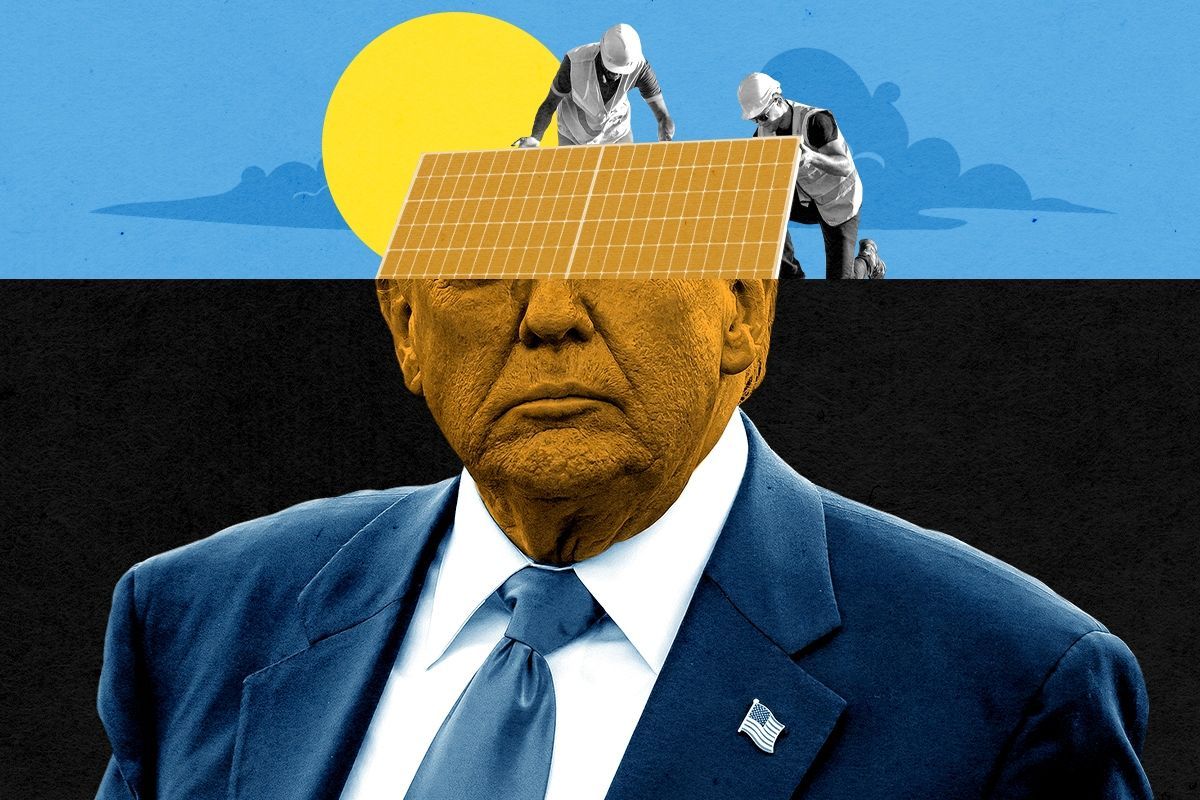
Almost exactly a month after President Donald Trump’s landmark tax law effectively eliminated a key incentive for solar developers to buy panels made in America, his administration is throwing a lifeline to manufacturers behind the nation’s fastest-growing and quickest-to-deploy source of electricity.
On Thursday afternoon, after the markets closed, the White House announced new tariffs and minimum import prices for imported polysilicon as part of an effort to prop up the domestic supply chain for the primary ingredient in semiconductors and solar panels.
The levies come in response to complaints from polysilicon makers that the dearth of U.S. factories demanding solar-grade polysilicon made it difficult to compete with Chinese giants who benefit from selling both the solar- and microchip-grade versions of the ultra-pure industrial material derived from quartz and sand. The companies made the petition under Section 232 of the Trade Expansion Act of 1962, which gives the White House the power to restrict imports and charge tariffs on imports that demonstrably impair national security.
The Trump administration will impose a 15% tariff on all imports and set baseline prices at which the levies would apply for each component in the solar supply chain. Polysilicon will have a minimum import price of $20 per kilogram. Wafers, the ultra-thin slice of crystalline silicon that acts as the foundation of a photovoltaic cell, and ingots, the silicon material before it’s sliced, will start at $100 per kilogram. Cells, the tiny silicon-based devices that absorb photons from sunlight and break away electrons that generate electrical currents, will have a minimum price of $0.22 per watt. Modules, the completed panels, are $0.38 a watt.
The majority of U.S. solar factories simply assemble wafers and cells into modules, leaving them reliant on imports. But the policy won’t hit all at once. The Commerce Department is giving companies 120 days before the restrictions kick in.
The agency will also set up an incentive program that allows manufacturers that make large capital investments in the U.S. to avoid the worst of the levies. Jeffrey Kessler, the Under Secretary of Commerce in charge of executing on 232 cases, pushed for the provision as a bid to avoid what happened when Europe attempted to protect its own solar manufacturers by setting a minimum import price meant to keep Chinese companies from flooding the market. That policy ended up subsidizing the very Chinese parent companies putting market domination ahead of profits back home.
Avoiding that outcome is tricky under any circumstances. China and the U.S. don’t have a tax treaty, which makes it difficult for American authorities to confirm a company’s ownership structure. The surest way to seal off the U.S. market is with 100% tariffs such as those imposed on Chinese electric vehicles.
In this case, the Commerce Department decided to allow companies with active plans to onshore the solar supply chain to apply for an exemption from the new trade rules. Ahead of the announcement, sources familiar with the talks listed South Korean giant Qcells, which just opened the nation’s largest integrated solar factory in Georgia, as one obvious example of a company that would pass muster.
Solar manufacturers applauded the move. “Today’s decision from the White House balances the reality of where America’'s solar energy manufacturing is today while advancing our collective ambition to onshore the entire supply chain from polysilicon to finished panels in the U.S.,” Andy Park, the global CEO of Qcells, said in an emailed statement. “American solar manufacturers are ready to rise to the occasion.”
The trade action “creates a market where wafer and cell manufacturing can happen in the United States, and companies can go fully vertically integrated,” Nick Iacovella, the executive vice president of the Coalition for a Prosperous America, a bipartisan trade association that represents manufacturing companies at every stage of the polysilicon supply chain, told Heatmap.
“What this does is cement a key input in the supply chain that’s critical not just for chips, but for the most efficient, best-performing solar modules,” he said. “We shore up our chip supply chain at a time when there is a greater urgency to derisk from China invading Taiwan — and also during a time when the AI data center boom is driving massive demand for new energy generation, with solar driving a lot of the new capacity coming onto the grid.”
The levies come a week after the Federal Communications Commission banned the use of new types of foreign-made inverters, the equipment needed to patch solar panels onto the grid. Analysts said the ban would have a limited effect on the solar industry, since it allows for the current models on the market to be sold. The purpose of that policy is to prop up domestic factories at a moment when Europe, despite its struggle to reindustrialize, is experiencing an inverter manufacturing boom.
Despite those intentions, multiple industry sources who spoke on condition of anonymity told Heatmap that trade restrictions alone would likely prove insufficient to prop up a domestic solar supply chain at the scale needed to minimize imports.
The latest data from the Rhodium Group found that new U.S. investments in solar factories peaked from the second half of 2022 through the first quarter of 2025. During that time, as Emily reported in May, the announced projects averaged more than $2 billion per quarter. At least 30 new utility-scale solar factories opened across the U.S. just last year.
Since then, development has plummeted. Investment in new solar factories announced fell to about $350 million in the first quarter of 2026, a drop of more than 80%.
By raising the price of panels overall, the Commerce Department is providing a particular boon to America’s leading solar manufacturer, First Solar. While the Phoenix-based panel-maker’s thin-film cell technology doesn’t use polysilicon, the price hike from the tariffs will give the company an edge by allowing the company to either raise its prices to match new industry-wide benefits or undercut its competitors. Investors in the company told Heatmap its recent bookings average sales of about $0.36 per watt.
Another clear winner is T1 Energy, which Roth analysts say “would eventually be a beneficiary once it ramps up its U.S. cell manufacturing, which is now expected to come online” next year. The company’s share price spiked more than 10% in after-hours trading, while First Solar was up more than 8%.
“There are a lot of people in the administration who support solar,” Iacovella said. “They just don’t want a bunch of Chinese solar panels.”
Still, he added, “this is all about the chip supply chain.” While the benefits to solar are welcome, “this is a two-for-one.”