
GLOBALVARS
TEST TEST TEST
0
Products

Beyond the repudiation of Donald Trump, if there was one message voters sent on election night, it was that they really don’t like data centers.
Democrats who ran against rampant data center development won at both the gubernatorial level (Amy Acton in Ohio, Gina Hinojosa in Texas) and the senatorial level (Abdul El-Sayed in Michigan, Annie Andrews in South Carolina). The Wall Street Journal counted 125 Democrats nationwide who “targeted their opponents over data centers.”
“Data centers are the midterms’ other big loser,” according to Politico. “The Results Are In: Voters Hate Data Centers,” from Wired.
Commentators didn’t just notice that many anti-data-center candidates won, but that a number of local data center moratoria passed as well. “In nearly every case, it’'s about 67-80% opposing data centers. True in California, Ohio, everywhere,” Brad Carson, head of the artificial intelligence policy group Americans for Responsible Innovation tweeted. Added Democratic strategist David Shor on X, “Voters sided against data centers in 40 of 41 ballot measures, with basically no correlation to how red a county was.”
But as far as new legislation and ordinances go, November 3 was just another Tuesday in the long-running local campaign against data center development, Heatmap Pro data shows.
“Forty is a lot in one day,” Owen Curtin, a data analyst with our intelligence platform Heatmap Pro, admitted, but “in terms of the rate at which county governments are enacting legislation and the overwhelming public support for them, it’s not new.”
There have been over 830 restrictive measures passed this year, according to analysis from Heatmap Pro, which breaks down to just over 80 per month. The numbers picked up substantially in the summer and fall.
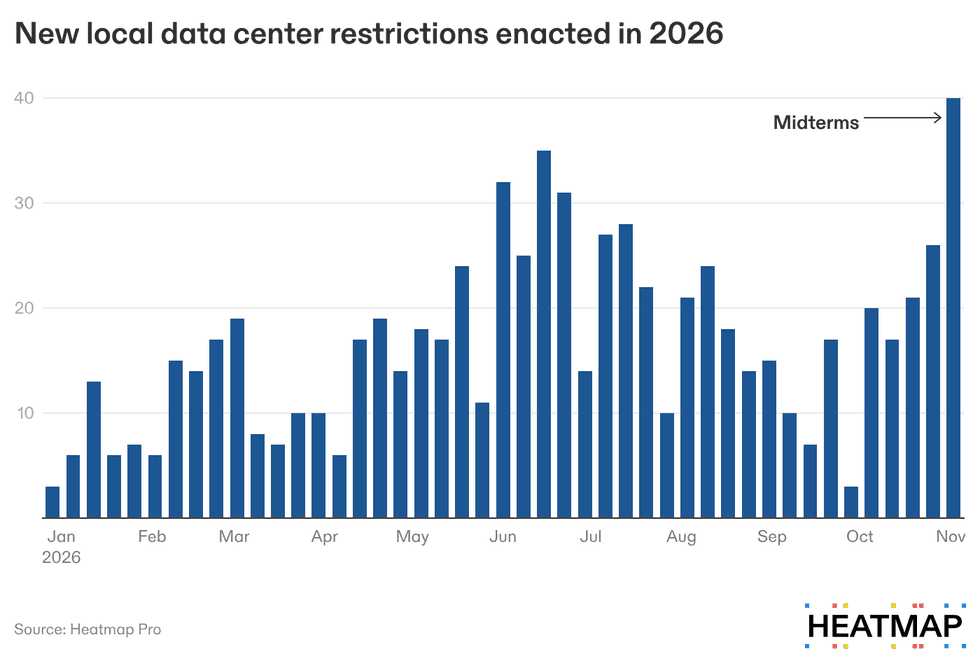
June 15 to 21 was the busiest week of the year for passing data center laws, at 35, and June the month with the most laws passed overall, with 133. Another95 restrictive laws were passed in July, followed by 86 in October.
Of the 40 ballot measures passed this week, only one applied at the county level (Morgan County, Illinois), where a great deal of data center permitting occurs. “While many municipalities permit data centers, a significant portion are permitted by county governments. Not all counties have the legal authority to pursue ballot measures, which is why most November 2 measures were at the municipal level,” Curtin explained.
“While the overwhelming support for local data center ballot measures is indicative of public sentiment (largely anti-data center), it doesn’t necessarily correlate with the regulatory landscape,” he went on. And here’s a fun fact: “There are over 19,000 municipalities in the U.S., so 40 bans are only 0.2% of all municipalities,” Curtain added. “If 40 municipalities banned data centers every day, it would take 475 days to ban data centers across the entire U.S.”