GLOBALVARS
0

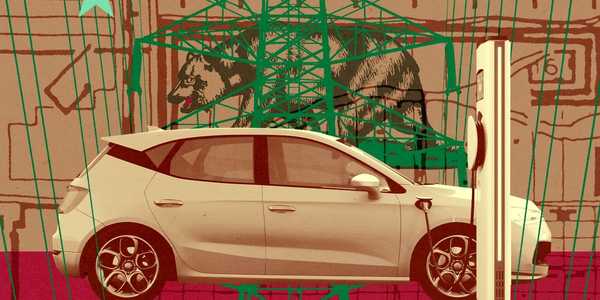
California now has the most expensive electricity in the continental United States. It also has expensive housing … and an increasingly broken home insurance market.
Are the three phenomena linked? They might be. Due to a peculiarity in the state’s constitution, electricity utilities are incentivized to pay for a huge amount of wildfire prevention, above and beyond what would be seen as economically reasonable in another state. Fixing that constitutional peculiarity could help bring down energy costs and heal the home insurance market, but it will be complicated — and a number of policies will need to get passed at the same time.
That’s what Lauren Teixeira argues in her new report, “Rewiring Risk.” Teixeira, a senior climate and energy analyst at the Breakthrough Institute, joins Rob for today’s episode of Shift Key. They discuss how California found itself in this situation, how it might be fixed, and why the state treats utilities as a sin-eater for wildfire risk.
Shift Key is hosted by Robinson Meyer, the founding executive editor of Heatmap News.
Subscribe to “Shift Key” and find this episode on Apple Podcasts,Spotify,Amazon, or wherever you get your podcasts.
You can also add the show’s RSS feed to your podcast app to follow us directly.
Here is an excerpt from their conversation:
Robinson Meyer: How much of this is an issue of it’s very hard to raise tax revenue in California, but it’s very easy to raise electricity rates? Speaking of the prop system, right, it’s very hard to pay to increase the tax base in California. But the CPUC can raise electricity rates when the utility asks it to do so.
Lauren Teixeira: I think that’s a big part of it, yeah.
Meyer: And so to some degree, this is the public’s in California — not the public in the sense of the government, but the public in the sense of society’s easiest way of raising revenue in the California system. And so therefore, it’s the revenue that tends to get raised. Unfortunately, it’s very regressive and bad for climate policy.
Teixeira: Right. It’s a tax through a different system. It’s a regressive tax. And it’s rational to do that. But as I argue in my report, this is actually a really ineffective and inefficient way of reducing wildfire risk. And that, you know, say we weren’t parking all of this on the utilities,.I think it’s very possible we would get a lot more risk reduction for the same amount of money, in that when it’s all on the utilities, they could very expensively underground a power line or a local municipality or property owner could construct a fuel break or do mitigation much more cheaply, and reduce the same amount of risk. But with the status quo, we end up with the expensive power line instead of the fuel break.
And I think that’s a huge loss of opportunity because obviously wildfire is very dangerous and bad, and we want to get as much risk reduction for a certain sum of money as we can. So what we have right now is the politically convenient thing, but it’s not the most risk reducing thing. And the most risk reducing thing is not the politically convenient thing. But we may have to go toward it because electricity rates have also become politically unattainable.
You can find a full transcript of the episode here.
Mentioned:
Lauren’s report: Rewiring Risk
Rethinking Utility Wildfire Risk in California
Previously on Shift Key: How California Broke Its Electricity Bills
Previously on Shift Key: How Wildfires Destroyed California’s Insurance Market
This episode of Shift Key is sponsored by ...
Discover the Yale Clean and Equitable Energy Development online certificate program at the Yale Center for Business and the Environment. In this fully online, 5-month program, you’ll learn from leading experts, develop practical skills, and grow a powerful network. Visit cbey.yale.edu to learn more and apply.
Music for Shift Key is by Adam Kromelow.