
GLOBALVARS
0
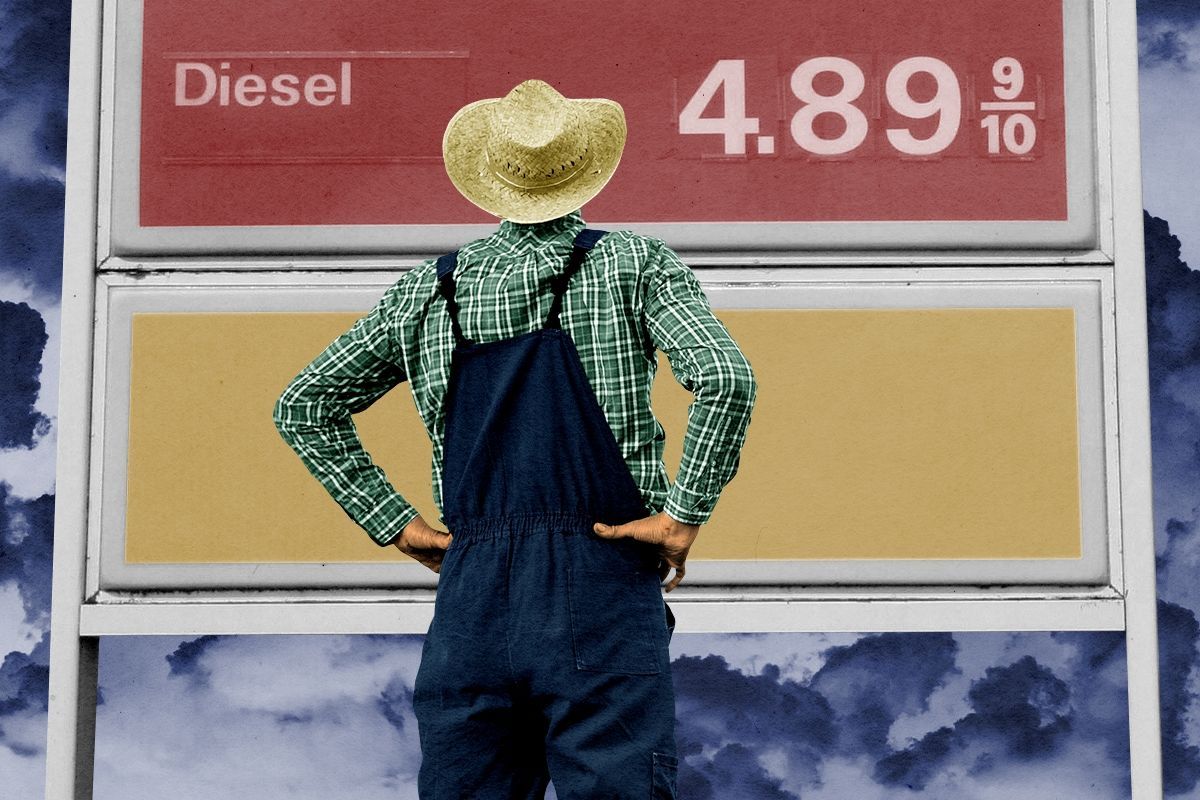
Gas prices are climbing again.
As the United States and Iran confusingly engage following the end of a 60-day “memorandum of understanding” between the two warring countries, the fuel market has begun to readjust yet again, continuing the volatility that has confounded analysts since mid-February. While the gasoline most drivers buy has seen its price increase — the national average gas price now sits at $4.09 a gallon, according to AAA, compared to $4 a month ago and $3.13 a year ago — the most dramatic increase has been in diesel. The price of that fuel — a crucial input to the agricultural economy, as well as an important heat source in certain parts of the U.S. — now sits at $5.50 a gallon, up around 14 cents on the week and close to its peak price for the year in June. It’s also dramatically higher than the $3.70 a gallon it was selling at a year ago.
“Diesel is probably the most important product when it comes down to the global economy in particular,” Tom Kloza, chief energy advisor for Gulf Oil, told me.
While there’s probably never a good time for fuel prices to spike, the increase in diesel prices right now will likely translate to increased costs for farmers as they rev up their equipment for the harvest season. If the price stays high, New Englanders who depend on fuel oil for heat will face increased costs.
“In the U.S., we’re looking at just stunning, stunning numbers with the harvest season coming up and the heating season maybe 60 days from now,” Kloza told me.
The continued disruption could mean record setting costs.
“We’re looking — without question — at the most expensive harvest season on record.”
The federal government’s response to these price spikes, to the extent it has one almost six months after the United States and Israel attacked Iran, has been to talk up oil exports that avoid the Strait of Hormuz and to encourage increased production and refining. Secretary of Energy Chris Wright told reporters on Monday that he had met with refiners to figure out what the government could do to boost output, but didn’t announce any specific next steps.
Congressional Democrats have seized on the high prices — and specifically the threat to farm country — to criticize the Trump administration.
“With global fuel supplies now severely disrupted, [farmers’] situation has been made even worse. And when farmers are forced to pay more for diesel, the prices at the grocery store go up for everyone,” Emmanuel Cleaver, a Democratic congressional representative from Missouri wrote on X.
The Farm Bureau, the agriculture industry’s biggest lobbying group, has warned for months of the effect of high input prices on fuel and fertilizers derived from hydrocarbons, writing in July, “Fertilizer and fuel costs were already elevated heading into 2026, and the conflict with Iran has added further pressure to those markets.”
The high price of diesel and the attendant strain on farmers and truckers has translated to high margins for refineries. The margin between diesel and crude prices has grown to over $100 a barrel, an all-time high, according to data collected by Bloomberg. Before this year, the previous high was under $90.
Even going into this new stage of the U.S.-Iran war, oil companies were already running their refining operations flat out, to record or near-record profits in the most recent quarter. Shell even reported that it was able to operate its refineries at beyond 100% of their capacity, something its chief executive Wael Sawan attributed to the Wall Street Journal to removing “bottlenecks.”
Overall refinery utilization in the U.S. has hit 97%, according to Patrick De Haan of GasBuddy, marking three consecutive months of utilization over 95%, a record.
It’s not just the widely documented strangulation of the Strait of Hormuz that’s driving up diesel prices. The Russian government has instituted a ban on diesel fuel exports through the beginning of next year due to persistent Ukrainian drone attacks on Russian refineries.
“My routine now starts with checking the overnight wires to see if there were any drone strikes on refineries. That’s what this business has come down to,” Kloza told me (drones hit a Russian refinery in Bashkortostan on Wednesday).
The United States faces this new stage of the Iran energy crisis having already boosted both its own exports of oil and authorized the release of over 170 million barrels of crude oil from the Strategic Petroleum Reserve.
Stockpiles of diesel and fuel oil in the United States currently stand at around 106 million barrels. Those inventories have fallen by 1.5 million barrels in the past week and “are about 13% below the five-year average for this time of year,” according to the EIA. Meanwhile, the U.S. Strategic Petroleum Reserve is holding just under 300 million barrels of crude oil, after releasing about 115 million barrels since the war began.
SPR releases will likely continue through September, Arnab Datta, the director of policy implementation at the Institute for Progress, told me. The effect those releases have on prices will largely depend on what forces they’re trying to counteract. A full, persistent closure of the Strait of Hormuz would likely overwhelm SPR releases, as could China deciding to rebuild its oil stockpiles.
“You get a Hormuz-level disruption of that size, no single stockpile really is going to be able to overcome that,” Datta said. “It depends on how much is coming out of Hormuz.”