GLOBALVARS
0
Current conditions: Tropical Storm Lala could strengthen into a hurricane before hitting Hawaii’s Big Island, becoming the first such storm to make landfall there since 1900 • A glacial outburst at Suicide Basin near Juneau, Alaska, is raising the Mendenhall River • Temperatures surpassed 107 degrees Fahrenheit in Zaragoza, the inland capital of Spain’s Aragon region.
THE TOP FIVE
1. The U.S. is set to produce record amounts of natural gas this year
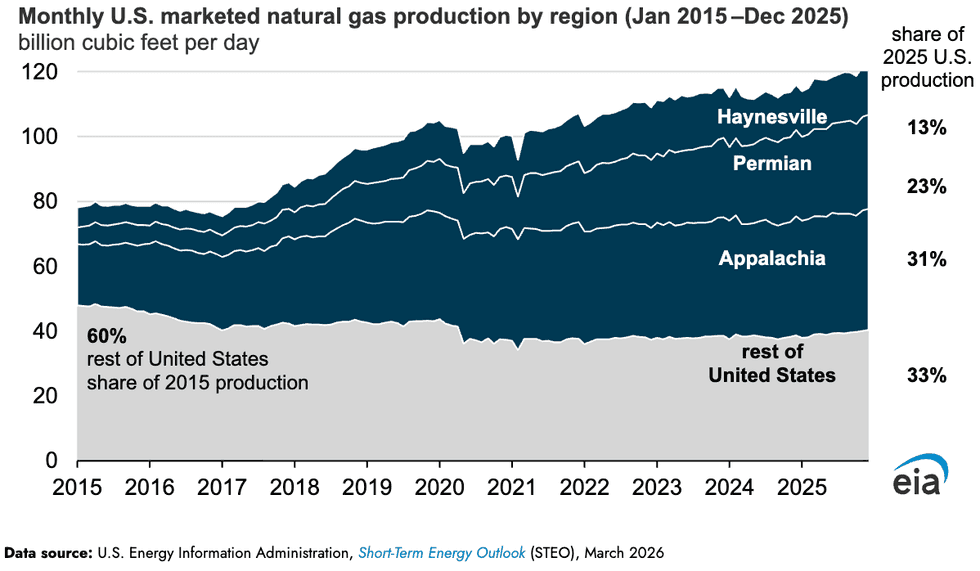
The United States is rapidly approaching a two-decade streak as the world’s No. 1 producer of natural gas. The country held the top spot between 2009 and 2024, the latest year for which the U.S. Energy Information Administration has data. But America pumped record volumes of natural gas last year. And now the federal energy research agency forecasts 2026 will be another record year. Marketed natural gas production — the total volume that actually makes it to market, minus what’s burned off or leaks as waste — is set to reach an average of 122.5 billion cubic feet per day in 2026, up from 2025’s record of 118.5 billion cubic feet per day. The new milestone is the result of expanded drilling in the Permian region that straddles Texas and New Mexico, and in the Haynesville area, between Texas and Louisiana.
2. Democrats ask federal watchdogs to investigate Trump’s mineral deals
When the Trump administration first started buying up equity stakes in mining companies, former officials from the Biden administration told my colleague Matthew Zeitlin they were “jealous” that the Republican White House had the guts to try something novel to compete with China on the metals needed for defense and energy technologies. Now, however, top Democrats are asking federal watchdogs to probe whether the American taxpayer is actually getting good deals. New Mexico Senator Martin Heinrich, the ranking member of the Senate Energy and Natural Resources Committee, and Representative Jared Huffman, the top Democrat on the House Natural Resources Committee, called on the Government Accountability Office to open an investigation into potential conflicts of interest. In a letter sent last week to Acting U.S. Comptroller General Orice Williams Brown and published Thursday on E&E News, the lawmakers accused the White House of violating rules to assess the financial risk of federal purchases. “These equity acquisitions also create potential conflicts of interest for federal agencies because a significant portion of the planned mining operations are located on federal lands,” they wrote. “With the executive branch now holding direct financial equity in these private mining operations, the federal government is required to act simultaneously as a mining investor and land-use regulator, an inherent conflict of interest.”
3. Yet another gas turbine giant’s backlog grows
Mitsubishi’s backlog of orders for large-frame gas turbines is now more than twice its output from last year. In the 2025 fiscal year, the Japanese industrial giant delivered 16 gigawatts of gas turbines and had a backlog of 23 gigawatts. Just halfway through 2026, that backlog has ballooned to 35 gigawatts, executives told investors on the latest quarterly earnings call. The update, announced in Japan last week and covered in English by Utility Dive on Thursday, shows that “demand for large-frame gas turbines remains broadly in line with, or slightly above, the strong level we had anticipated,” Hiroshi Nishio,the chief financial officer of Mitsubishi Heavy Industries.
Power electronics maker Heron Power, meanwhile, unveiled plans for a $100 million factory in Morgan Hill, California. The startup, led by a former Tesla executive, aims to produce next-generation transformers that can patch more solar panels and batteries on the grid and help ease some of the issues that arise from the direct current-based electricity sources. The first factory is designed to churn out 40 gigawatts of Heron Links, the transformer product, per year. “America's grid has to grow faster than it has in decades. We’re seeing new demand from AI and EVs, and at the same time new supply from solar and storage,” Drew Baglino, Heron Power’s chief executive and founder, said in a statement. “The equipment running the grid hasn’t changed in 50 years. Heron Factory One in Morgan Hill is how we fix that. We’re manufacturing the leapfrog technology our grid needs, at scale, in America first.”
Sign up to receive Heatmap AM in your inbox every morning:
* indicates required
Email Address *Our Privacy Policy & Terms Apply.
4. Turkey and Azerbaijan advance plans for offshore wind
Offshore wind is in retreat in the U.S., where, as my colleague Robinson Meyer wrote this week, the Trump administration is paying billions to kill projects that were already dead or dying. The industry’s tide is also ebbing in Japan, where the new right-wing government of Sanae Takaichi is putting a heightened focus on nuclear power. Elsewhere, however, offshore wind is booming. Europe is only expanding its plans. China is steadily dominating the industry. And East Asian countries such as South Korea and Taiwan are expanding their sectors.
Now two of the richest countries in the Turkic world are laying plans for more offshore turbines. Turkey announced plans this week for its first offshore wind tender in the first quarter of 2027, Renewables Now reported. Azerbaijan, meanwhile, this week formally designated a 275-square-mile section of water in the Caspian Sea for offshore wind development, per offshoreWIND.biz. The moves highlight the extent to which the U.S. government stands alone in its view that offshore wind has no role in a modern electricity mix. Turkey, after all, is doubling its domestic production of gas and completing its first nuclear plant. Azerbaijan is famously rich in natural gas and produces a decent amount of hydropower. Yet both countries are still charging ahead on offshore wind.
5. U.S. and Japan plan the world’s deepest underwater mine
Deep-sea mining isn’t yet technically legal in international waters. But the Trump administration isn’t waiting, creating the regulatory frameworks for domestic approvals and opening the area around one of America’s Pacific territories to exploration. Japan has been eager to follow suit. Now Washington and Tokyo are planning to meet “centuries’ worth of industrial demand” by establishing what Mining.com called the world’s deepest undersea mine in a bid to take on China’s mineral dominance. The mineral extraction would take place more than 1,000 miles southeast of Tokyo on an uninhabited speck of land called Minamitorishima, where Japanese scientists carried out tests pulling rare earths out of mineral-rich mud.
THE KICKER
China is actively building more reactors at home than all other countries combined and singlehandedly restarted the race for novel technologies after hooking the world’s only commercial high-temperature gas-cooled reactors up to the grid in 2023. So far, Beijing’s two state-owned nuclear companies have remained focused on building light water reactors. Just one new high-temperature gas-cooled unit, designed to have more than twice the output of the first version, is currently underway at a facility where the fourth-generation, helium-cooled technology will be paired with third-generation, water-cooled reactors. Now the developer, the China National Nuclear Corporation, has made plans to procure a contract for the reactor for the first time, laying the groundwork for future deals to purchase units specifically designed to reach high temperatures. The “first concrete” for the plant is expected to be poured by the end of 2026, World Nuclear News reported.