0
President Trump’s war in Iran is not popular. More than half of Americans disapprove of the conflict, according to Nate Silver, while fewer than 40% approve it — a 17-point deficit that has dragged down the president’s overall approval rating with it. The major polling averages now show the president’s approval in the high 30s, compared to 42% at the beginning of the year.
America’s interpreting class has, I think, absorbed this truth about the war. What has attracted less attention, perhaps, is that the war has left Trump’s energy policy dead in the water.
The Trump administration is not over: He will remain president for the next two years and nine months, and I expect many of his officials’ ideas — including their ambitious nuclear energy buildout — to move forward. But Trump’s ambitious plans to remake the country’s energy system — and the bargain that he made with the American people and the world — have been defeated by reality.
Trump’s energy policy was premised on a simple idea: If Americans gave the fossil fuel industry whatever it wants, then they would enjoy cheap and boundless energy — and especially cheap gasoline. Beginning on day one, his administration struck down air and water pollution rules, canceled energy efficiency standards, and waged bureaucratic war on any state government or rival industry that dared to withhold market share from oil or gas. It aimed to make the market for fossil fuels as large as possible, essentially locking in compulsory demand for oil, natural gas, and coal across the economy.
In return, the unshackled energy industry was supposed to bless Americans with unlimited cheap electricity and gasoline. Trump described this bargain with characteristic blunt eloquence. He would end Biden’s “war on energy,” he promised crowds before the 2024 election: “We will frack, frack, frack, and drill, baby, drill.” In return, he said, “I will cut your energy prices in half within 12 months.”
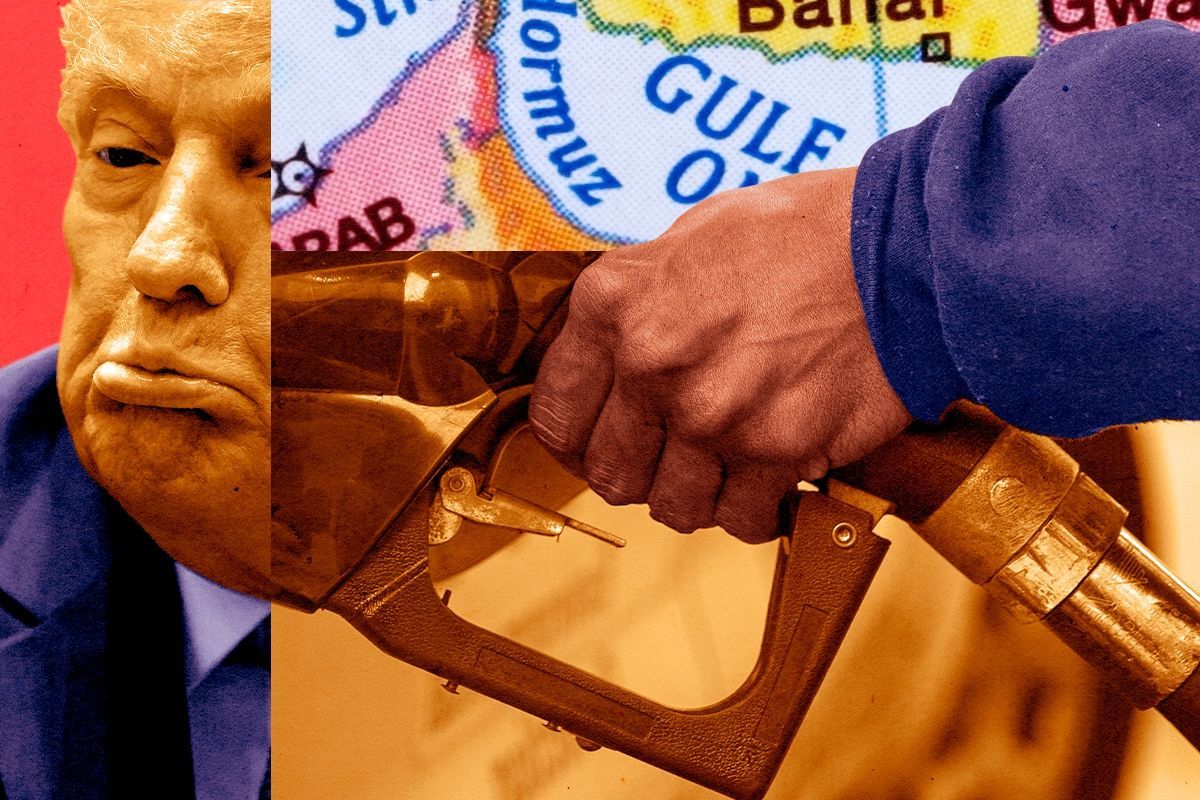
Trump has manifestly failed to cut energy prices at all. Instead, his war of choice in Iran has sent gas prices surging, rising more than a dollar in a month. Americans are operating fewer drilling rigs today than they were a year ago.
Meanwhile, the country and the world are spiraling into the worst energy crisis in years. Yet Trump’s policy is not doomed because of these broken promises or high prices. The entire premise and justification of Trump’s strategy is now moot — and the administration is likely to spend the better part of its remaining time in office picking up the pieces.
The plan has failed. What is striking, however, is that I’m not sure Trump’s energy team has realized it yet.
To understand the Trump approach, look first to the power sector. The president began his administration by repealing a slew of energy efficiency rules for household appliances — a surefire way to drive up long-term electricity demand. He embraced the artificial intelligence boom, appointing techno-libertarians such as the venture capitalist David Sacks to senior administration positions and revelling in the surge in energy demand.
Higher electricity demand, to be clear, can be a good thing; demand from data centers could help build grid resiliency over the long term. But the Trump administration has instead fought efforts to meet the coming surge in demand with additional generation capacity from renewables. Even as the supply chain for new utility-scale natural gas plants has become clogged and backed up, the president’s agencies waged an all-out bureaucratic war on new wind, solar, and battery projects, condemning hundreds of new power plants to regulatory purgatory. They have even tried to keep companies from building wind farms on private land. In other words, the Trump administration kept America from diversifying its energy sources, doubling down on fossil fuels while preparing to upend the global fossil fuel supply chain.
Trump’s transportation policies followed the same logic. Most Americans know Trump and the Republican leadership have tried to crush the American electric vehicle sector, yanking consumer-side incentives and creating a new EV rust belt. But Republicans have also fatally weakened long-standing rules meant to improve the efficiency of gasoline-burning cars and trucks. Back during the mid-2000s oil shock, Congress revived the Corporate Average Fuel Economy rules, which in the years since have helped to improve the U.S. vehicle fleet’s fuel efficiency even as cars got larger and heavier. But last year, congressional Republicans set the penalties for violating those rules at zero dollars, essentially wiping them from the books. At the same time, the Trump administration has tried to terminate a similar EPA program for regulating car and truck gas mileage. It also shut down the emissions credit-swapping mechanisms that helped support new American EV companies such as Tesla, Rivian, and Lucid.
Combined, these policies have reduced the American economy’s ability to withstand an oil shock. And yet many of the president’s most important messengers appear not to have realized this. In late March, I attended the CERAWeek by S&P Global conference in Houston, the so-called “Super Bowl of energy” that brings together 11,000 professionals from across the oil, gas, utilities, and clean energy sectors. Interior Secretary Doug Burgum and Energy Secretary Chris Wright spoke to the group, but the administration’s most memorable spokesperson by far was Lee Zeldin, the New York Republican who leads the Environmental Protection Agency.
The conference was an odd one. The Iran War had ruined every oil executive’s talking points, which had seemingly been prepared by an unseen phalanx of communications staff early in Q1, so a curious and unspeakable unease permeated the proceedings. Despite the many emergency panels devoted to the topic, few seriously wanted to address the closure of the Strait of Hormuz; nobody knew what to say about the biggest convulsion in the oil trade since the 1970s. Was gas about to go to $7 per gallon? Was the oil and gas industry about to transform forever? The best most executives could manage was say that they were working overtime to keep Persian Gulf employees safe.
CERAWeek sprawls across Houston’s 24-story Hilton Americas hotel and a neighboring convention center. At its spiritual and literal center is a huge, dark ballroom, where hundreds of attendees watched as Daniel Yergin — the author of the comprehensive oil history The Prize and de facto dean of energy analysts — chatted amicably with energy CEOs and government officials on a lit central stage. Yergin’s interview style could not be described as grueling, but it revealed how attendees were thinking and feeling, and their comfort on stage.
It fell to Zeldin, who spoke uncomfortably with Yergin on on Wednesday, to reveal the perishing of the president’s energy policy. Unlike Burgum, a former governor, Zeldin lacks a certain political subtlety; unlike Wright, a former fracking executive, Zeldin never gained a working knowledge of the oil and gas industry. His greatest qualification for the EPA job seemed to be a visceral hatred of offshore wind projects near his Long Island home — and although as a congressman Zeldin could boast a somewhat moderate environmental record, he has since reformed himself, denouncing the “Green New Scam” and “the climate change religion” in his new role. It has worked: He is reportedly on the short list to replace Pam Bondi as attorney general.
The risks of this flexibility were on display, however, when Zeldin chose to defend Trump’s policies to Yergin on the basis of affordability. By cutting pollution rules for cars and trucks — and repealing the regulatory finding that let the EPA regulate heat-trapping tailpipe pollution at all — the EPA was making life cheaper for regular Americans, Zeldin claimed.
Americans “want government to heed and apply pragmatism and common sense to help achieve the American dream, to make life more affordable,” Zeldin said. “Anyone who cares about affordability — anyone who cares about being able to have access to heat your home and to fuel your car — people who right now, are choosing between heating their homes or filling their refrigerator or getting their prescription drugs — these Americans put President Trump back in office in November of 2024, and they deserve a vote,” he said.
Someone should tell those voters that Trump’s Iran war is likely to drive up costs of gasoline and food and prescription drugs. But it is all the more painful because Zeldin did not appear to understand his own agency’s conclusions. The problem is that Zeldin’s rollback — and the rest of the Trump administration’s war on EVs — will not actually make gasoline cheaper at all. According to the EPA’s own analysis, the rollback will instead make gasoline more expensive because it will increase the amount of gasoline that people have to use to do the same amount of driving. The rollback is, instead, supposed to make cars cheaper because it will reduce the amount of emissions-lowering technology that automakers must install in each vehicle.
Especially now, the rollback is unlikely to save Americans money. As Zeldin was forced to concede at a Politico-hosted event a day earlier, the EPA rollback only brings economic benefits to the American people if you assume oil prices will stay unreasonably low — on the order of $47 a barrel, or about $2 a gallon for gas. “I don’t think anyone is making believe that the fluctuation that’s taking place over the last few weeks is indicative of where the price of oil is going to be months from now, or years from now,” Zeldin said when asked about the discrepancy. But $47 oil is so low, so unbelievable, that it would spell economic doom for most American oil drillers.
Yergin did not make this apocalyptic scenario clear on stage, but he didn’t need to: I did not get the sense that Zeldin particularly captivated the energy executives in the audience, either. When Yergin asked him to give an example of the kind of regulations that the EPA is cutting, Zeldin cited the agency’s accelerated effort to clear hazardous material after the Los Angeles wildfires, then meandered into a multi-minute denunciation of the mainstream media that ended with his thoughts on how to properly construct a news diet in 2026.
“People would ask me, like, ‘What's the best place to go to get caught up on the news?’” Zeldin said. (Yergin, the winner of the 1992 Pulitzer Prize for general nonfiction, had not asked.) “Honestly, my best answer is, if you have the time to be able to read five different sources and to form your own independent judgment, because unfortunately, right now, there’s some of these outlets — you go to one outlet and you’re not getting the full story.”
“So we'll get back to the environment now,” Yergin replied. Laughter filled the ballroom.
It is not only the domestic aspect of Trump’s energy policy that has suffered a setback. It is the foreign policy, too. Trump, Wright, and Burgum have argued to Americans (with varying levels of sophistication) that America’s economic future lies in selling fossil fuels to the world, and that countries with more aggressive decarbonization strategies will eventually turn away from electric technologies and back toward the affordability and reliability of oil and gas. (Even before his time in government, Wright framed America’s fossil fuel exports in humanitarian terms, casting them as a form of “energy freedom” provided to developing states.) Zeldin could not help himself at CERAWeek from mentioning that the Strait of Hormuz’s closure had made Asian countries even more interested in America’s energy exports.
Yet the Iran debacle, too, has undercut this policy of fossil exporterism. It has convinced Asian and European countries that oil and liquified natural gas are too volatile to enthrone in the transport and power sector when alternatives are available. And it has forced them to abruptly rethink several kinds of fossil-exposed risks at once: the geographic risk of Persian Gulf-supplied energy and the political risk of American-supplied energy. That’s roughly a quarter of global oil capacity — and half of LNG export capacity.
The Iran War and the resulting Hormuz closure are testing the compact at the heart of America’s security relationship with East Asia — that the United States will guarantee freedom of navigation, and with it a secure supply of seaborne energy, to its allies and partners. No wonder that in the days and weeks since that pact’s termination, we have seen more East Asian countries immediately shift their energy policies to more closely resemble China’s, which designed its own energy system precisely to survive the lack of these American guarantees. In the months to come, we will see these countries do exactly what Trump officials said they would not do — build more solar and batteries, and buy more Chinese-made electric vehicles. They will probably burn more coal, too. And many of them will deepen their trade relationships with China, whose homegrown electric automakers are already seeing surging demand for new vehicles. Donald Trump may hate decarbonization, but few have done more than him to make it attractive.
Not that the war has shown that an energy transition is inevitable — or immediately possible. Like the Ukraine invasion, it has revealed the world’s reliance on other essential molecules derived from hydrocarbons, such as plastics, medications, and fertilizer. The existence and persistence of these molecules is, of course, known to would-be decarbonizers and economic planners. But most countries — other than China — have not invested in ways to pursue them at home or with lower emissions. (The United States made a number of plays to diversify its feedstocks for those industries during the Biden administration, but Trump largely gutted those efforts.) China, meanwhile, has invested in both low-emissions industrial processes and, more ominously, a new fleet of coal-to-chemical facilities seemingly designed to bolster the country’s energy security. These facilities, which have boosted China’s heat-trapping pollution in recent years, now seem less like a preparation for future military adventurism and more like a prudent investment.
So even as the crisis has undercut Trump’s hazy vision of a cheap, carboniferous, American-led world, it will not exactly redound to the benefit of clean energy. Perhaps Trump’s energy officials can savor that irony as they descend into political irrelevance.