
0
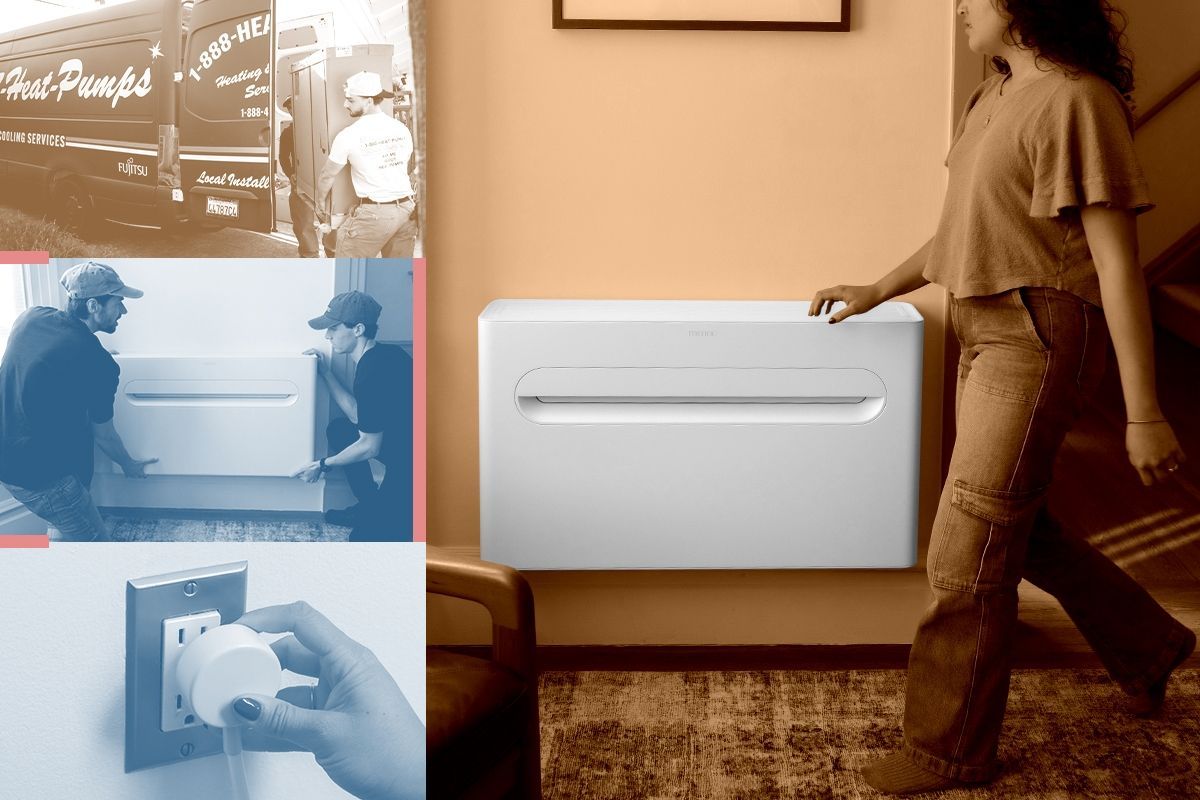
Kitting out your home with heat pumps can mean embarking on a serious construction project. Contractors have to map out how to run the various pipes and drains necessary to connect the system’s indoor and outdoor components through the walls of your house — a bespoke process since each home is different. Some projects involve installing or updating ductwork. Either way, the contractor usually needs to coordinate with an electrician, and sometimes with the local utility if the house requires a service upgrade.
All this complexity is a big part of why installing heat pumps — especially minisplits, compact units that heat and cool a single room rather than the whole house — is so expensive. Merino Energy, a startup that emerged from stealth today, is aiming to simplify the process and bring heat pumps to the masses with the Merino Mono, an all-in-one, wall-mounted heat pump that can plug into a 120-volt outlet and be installed in just one hour.
Among climate hard-tech startups, heat pump innovators are a pretty small group. There’s Gradient, which introduced a window heat pump to the market in 2022, enabling renters to access the technology. Then there’s Quilt, which redesigned the standard minisplit heat pump with a sexier looking facade and improved user interface, attempting to make it as envy-inducing as a Tesla.
Merino has some DNA from both of those companies. Its founders are Mary-Ann Rau, the former lead firmware engineer for Quilt, and Brad Hall, the former director of mechanical engineering for Gradient. The Merino Mono mounts onto the wall like Quilt’s minisplit, requiring a professional installation team, but it has no outdoor unit, reducing the time it takes to deploy. It’s nearly as simple as Gradient’s window unit, but it doesn’t take up space in the window or require a specific type of window to work.
“We like to say that we're the Goldilocks solution between a temporary window heat pump, which a renter might consider, and a permanent whole-home solution that is as expensive as a car,” Rau told me.
Rau was inspired to start the company after her own eye-opening experience trying to install heat pumps in her 1906 San Francisco Victorian. She thought solar panels were going to be the biggest investment she’d make in her home, so she was shocked when heat pump installers quoted her $35,000 to $40,000 to electrify her heating. Unlike solar panels, which directly reduce electricity bills, any potential savings from switching to heat pumps will be too small to pay off the upfront cost. (Whether heat pumps save you money at all depends on what you were using to heat your home previously and whether or not you already had air conditioning.)
“When I realized that it was out of reach for me, I started to wonder how this was going to be adopted by the majority of Americans,” Rau told me. “I started digging into, how much does the hardware really cost? Is this a problem that's going to be solved with economies of scale? And the answer is no, because at the end of the day, installation is what makes it really expensive.”
Rau was working for Apple at the time on the AirPods team. She joined Quilt in 2023, but she soon came to the conclusion that minisplits were fundamentally flawed as a form factor. The need to run lines of refrigerant through the walls — and take the time to design those routes, and sometimes even open up the walls to install them — was exactly what made the systems so expensive.
Rau left Quilt in 2024 and embarked on a quest to learn how different kinds of heat pumps worked, aiming to bring all of the components that are typically divided between the indoor and outdoor unit into one wall-mounted device. One of the first units she took apart was a cheap, portable heat pump by the legacy brand Midea that sits on the ground and has a hose that hooks up to the window. She told me that the fact that that unit could be sold for a few hundred bucks confirmed her theory that the hardware itself wasn’t that expensive, and that cutting down the cost of labor was key. She later enlisted Hall to help her miniaturize the components of a minisplit and build a compact system that exchanges heat with the outdoors through two small holes drilled through the wall behind it.
Merino isn’t the first to come up with such a concept. There’s already a heat pump company called Ephoca, the U.S. subsidiary of an Italian HVAC company, that sells a similar device called AIO — short for “all-in-one.” The AIO is about the same size as the Mono, has comparable technical specifications, and also exchanges heat with the outdoors through two small holes drilled through the wall.
Where Merino differs is the company’s transparent pricing and focus on the installer and customer experience. Merino customers don’t have to go through the process of getting quotes and vetting contractors. Instead, the company has a dedicated network of partner installers who offer the Mono for a flat rate of $3,800 per unit. While Ephoca does not publicly list the price for its wall-mounted AIO, I found a case study that reported all-in costs of $5,000 to $6,000 per unit.
So far, Merino has six dedicated installers, all based in California. Rau said her partner contractors will make twice as much per hour on each job installing Merino’s heat pumps as they would installing minisplits because of how much time they’ll save. “If it takes them eight hours to install a minisplit, they are actually not making very high margins on that sale, even though the product is very expensive,” she said.
When I asked her about what else differentiates the Mono from the AIO, she emphasized that it comes with all of the components needed for installation right in the box and requires no customization.
Ultimately, the variability between houses, and — perhaps more significantly — between climates, means that no single heat pump design can unlock widespread adoption. To bring all the components into one indoor device, Merino had to make a number of trade-offs. The Mono is designed to perform well in smaller spaces — 350 square feet or less — so it won’t help homeowners with open floorplans. It’s also tuned to work efficiently within the mild temperatures of the Golden State, but it would be expensive to run in significantly hotter or colder areas. Rau said the company may develop a cold climate product in the future, but that’s not the focus right now.
Quilt, for its part, is bullish on minisplits remaining a big part of the market. “Ductless is one of the fastest-growing segments in HVAC, 87% of contractors already offer installation, and Quilt has scaled to over 100 Certified Partners across 30+ states and provinces in under a year,” Mark Schmidt, Quilt’s chief revenue officer, said in an email. “The market and installer demand speak for themselves.” As of December, when the company raised a $20 million Series B, it had installed nearly 1,000 units.
Merino did its first commercial installations last week at an affordable housing project in Richmond, California. Rau’s hope is that the company can help make California’s target of installing 6 million heat pumps by 2030 a reality.
“If you do the math right now, the pace of installation for California, it would take until 2045 to install 6 million heat pumps,” she said. “So we need a dramatic shift in the market, a catalyst that speeds up installation by a factor of eight to 10. And that's what you get with Merino.”