0
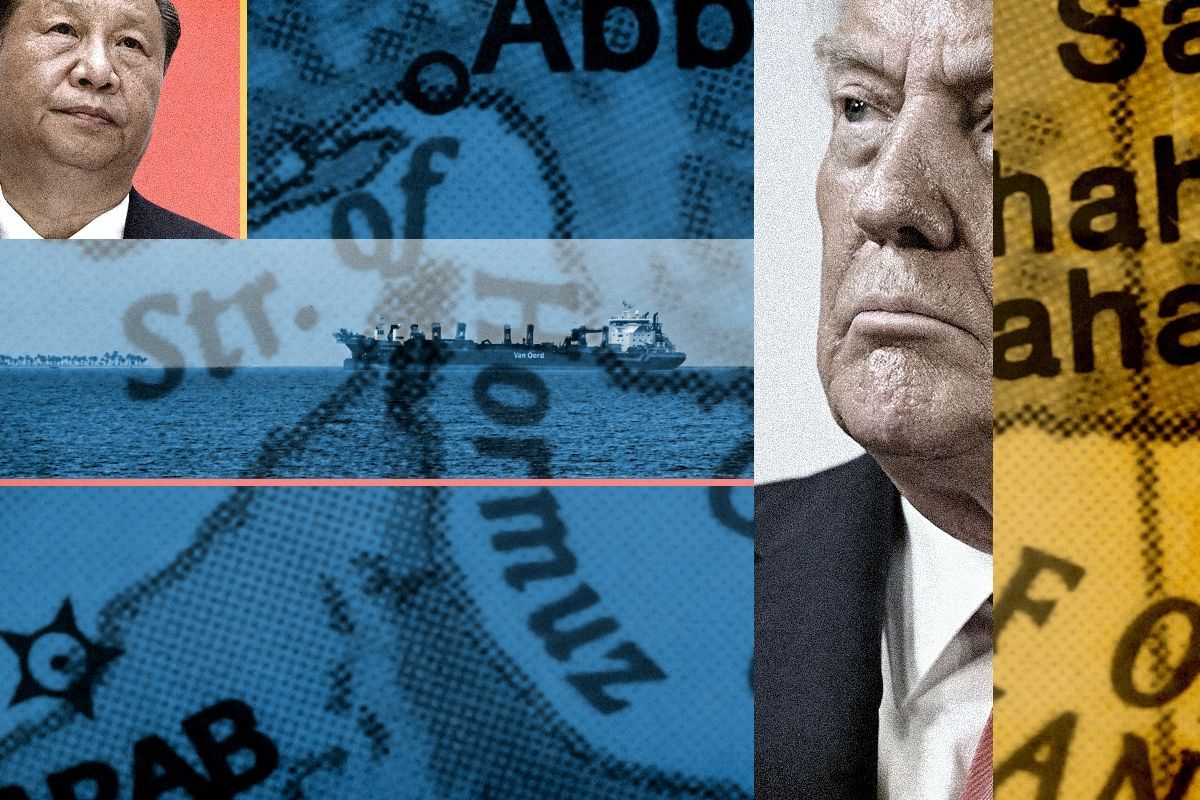
The Strait of Hormuz appears to maybe be opening up eventually — and the price of oil is collapsing.
Iranian Foreign Minister Abbas Araghchi said Friday morning that the waterway was “completely open,” shortly before President Trump declared on Truth Social that the strait was “COMPLETELY OPEN AND READY FOR BUSINESS AND FULL PASSAGE,” though the president also clarified that “THE NAVAL BLOCKADE WILL REMAIN IN FULL FORCE AND EFFECT AS IT PERTAINS TO IRAN.”
Eurasia Group analyst Greg Brew cautioned me that, as was the case when Trump announced a ceasefire last week, the actual status of the Strait of Hormuz has remained unchanged. Iran’s position is that traffic from non-hostile countries can go through the strait as long as ships coordinate with its government and follow a route that hugs its coastline; the U.S. has insisted for over a week that the strait is open, and has been blockading traffic from Iran.
That’s not to say today’s announcement was meaningless. “There has been movement from both the U.S. and Iran on the issues that matter — namely, Iran’s nuclear program,” Brew told me. Meanwhile, “there’s a lot of ambiguity, and there’s a lack of clarification on the status of the strait. The upshot of that is shippers don’t feel secure in using the strait.”
As for the mutual statements, Brew said they were a sign that “both sides have acknowledged a mutual interest in having the strait reopen.” The market, meanwhile “is responding to the positive vibes that the president and, to some extent, the Iranians are putting out regarding the status of Hormuz moving forward.” Oil prices fell substantially Friday, with the West Texas Intermediate benchmark price down 10.5% to around $85 per barrel.
While the final disposition of the conflict between the U.S. and Iran — and thus the flow of traffic through the Strait of Hormuz — remains unclear, the global energy system may be at the beginning of the end of the crisis that started at the end of February.
This doesn’t mean an immediate return to the status quo from the beginning of the year, however, which saw a glut of fossil fuels depressing global prices. Several hundred million barrels of oil that would otherwise have been pumped in the Persian Gulf remain in the ground after producers shut in production, temporarily suspending operations to protect their infrastructure and minimize their exposure to the conflict. This has created what Morgan Stanley oil analyst Martijn Rats called an “air pocket” in the market — and anyone who’s watched a hospital drama knows how dangerous an air pocket can be.
As happened with Russia’s war against Ukraine, the consequences of the Hormuz closure cannot simply be undone. That leaves countries — especially poorer countries dependent on fossil fuel imports — with a stark choice about how to fuel their future economic growth. The crisis may have tipped the balance towards renewable and storage technology from China over oil and natural gas from the Persian Gulf, Russia, or the United States.
“There is a huge shift in total supply available in the fossil system,” Jeremy Wallace, a professor of China studies at Johns Hopkins University, told me. “I think the fossil system has been demonstrated to be vastly less reliable, riskier than it was seen to be in February.”
For gas specifically, recovering from Iranian attacks on Qatar could take years, not just the weeks and months necessary to clear the backlog in the Persian Gulf.
That will serve to reinforce China’s dominant position as a producer and exporter of solar panels, batteries, and electric vehicles. “It’s hard for me to not see this as a huge win for Chinese firms that produce these products, upstream and downstream in those supply chains — as well, arguably, for the Chinese government itself,” Wallace said.
There’s already been some institutional movement away from fossil fuel investments and towards clean energy as well. A Vietnamese conglomerate, for instance, has proposed scrapping a planned liquified natural gas terminal for a solar and renewables project, while the county has also signed a deal with Russia to build the region’s first operational nuclear plant. And even as electric vehicle sales in China have slowed down, the share price of the battery giant CATL has surged since the war began despite rising costs of metals due to disruptions of chemicals necessary for refining from the closure of the strait.
Kyle Chan, a fellow at the Brookings Institution who studies Chinese technology and economic policy, summed up the situation by calling the energy shock of the war “the best marketing program you could possibly imagine for China’s clean tech sector.”
It’s not just China’s technology that is likely to be more attractive in light of this latest energy crisis, but also its energy model, which fuses energy security and decreasing dependence on imported fossil fuel (thanks, in part, to domestic coal supplies and hydropower) with a vast buildout of renewables and nuclear energy.
“The way that China has weathered the Iran war energy shock so far has really validated its strategy of investing heavily in alternative energy,” Chan said.
Going forward, Asian countries will have to decide on future investments in energy infrastructure, especially the extent they want to build out infrastructure for importing and processing oil and especially liquefied natural gas.
While the United States, especially under Trump, is more than happy to sell LNG to any taker, the fact that oil and LNG are global markets could make countries leery of depending on it at all if it’s risky to supply and price shocks, even if U.S. exports are dramatically less likely to get bottled up in the Gulf of Mexico.
“It seems like once in 100-year storms happen every year. Now it feels like that in the fossil energy system,” Wallace told me. “We’ve been talking about the crises of the 1970s for 50 years afterwards. We don’t need to be talking about those now..”
The 1970s saw major investments in non-oil energy generation, especially nuclear power, in Japan and France and large scale investments in energy efficiency. Today, Wallace said, “the alternatives are much more attractive.”
“In the months to come, I think we will see a lot of bottom up industrialists and probably wealthy consumers in Southeast Asia and South Asia who are going to vote for energy security of their own as best they can,” he told me, pointing to the mass adoption of solar in Pakistan since 2022.
But Asian countries embracing renewables and storage will not have entirely freed themselves from geopolitics. While batteries, solar panels, and electric vehicles do not require a flow of fuel from abroad the same way oil and gas infrastructure does, China has shown itself to be perfectly willing to use economic leverage to achieve political ends.
Relations between China and Japan, the second largest Asian economy and a close American ally, quickly devolved into crisis following the ascent of Sanae Takaichi to Prime Minister of Japan in October, after the new leader suggested that if China were to blockade Taiwan, it would constitute “an existential threat.” China responded with an array of economic punishments, including discouraging Chinese tourism in Japan and restricting shipments of rare earths elements and magnets.
China’s economic coercion, Chan told me, “reminds everyone that while you can buy all this really affordable, highly scaled-up clean energy equipment, China has been able to and has been willing to leverage that supply chain dominance in certain ways. There’s a degree of trust that you can’t really make up for.”
Countries embracing Chinese energy technology will “always have to have a Chinese-hedging discount in the back of their minds,” he said.