The past few years have seen wild, rapid swings in energy policy in the United States, from President Biden’s enthusiastic embrace of clean energy to President Trump’s equally enthusiastic re-embrace of fossil fuels.
Where energy industrial policy goes next is less certain than any other moment in recent memory. Regardless of the direction, however, we will need creative and effective policy tools to secure our energy future — especially for those of us who wish to see a cleaner, greener energy system. To meet the moment, we can draw inspiration from a largely forgotten piece of energy industrial policy history: the Energy Security Act of 1980.
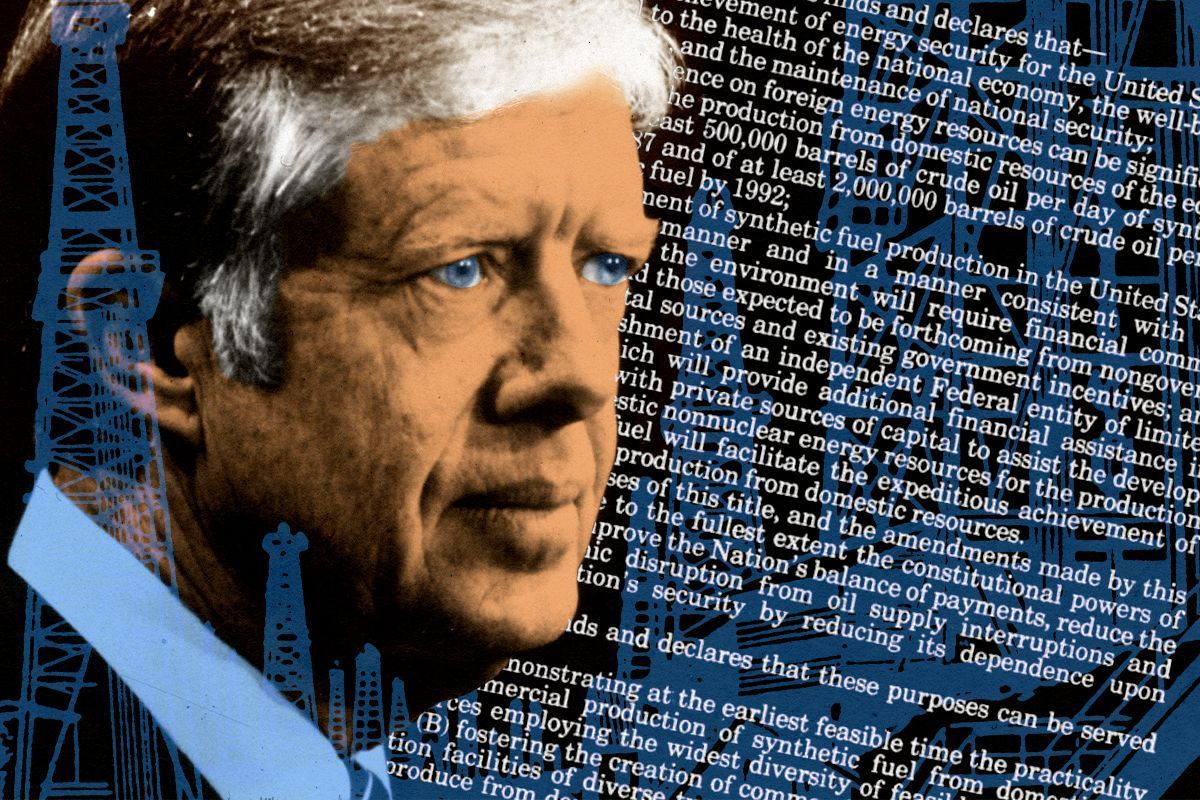
After a decade of oil shocks and energy crises spanning three presidencies, President Carter called for — and Congress passed — a new law that would “mobilize American determination and ability to win the energy war.” To meet that challenge, lawmakers declared their intent “to utilize to the fullest extent the constitutional powers of the Congress” to reduce the nation’s dependence on imported oil and shield the economy from future supply shocks. Forty-five years later, that brief moment of determined national mobilization may hold valuable lessons for the next stage of our energy industrial policy.
Taming volatility
The 1970s were a decade of energy volatility for Americans, with spiking prices and gasoline shortages, as Middle Eastern fossil fuel-producing countries wielded the “oil weapon” to throttle supply. In his 1979 “Crisis of Confidence” address to the nation, Carter warned that America faced a “clear and present danger” from its reliance on foreign oil and urged domestic producers to mobilize new energy sources, akin to the way industry responded to World War II by building up a domestic synthetic rubber industry.
To develop energy alternatives, Congress passed the Energy Security Act, which created a new government-run corporation dedicated to investing in alternative fuels projects, a solar bank, and programs to promote geothermal, biomass, and renewable energy sources. The law also authorized the president to create a system of five-year national energy targets and ordered one of the federal government’s first studies on the impacts of greenhouse gases from fossil fuels.
Carter saw the ESA as the beginning of an historic national mission. “[T]he Energy Security Act will launch this decade with the greatest outpouring of capital investment, technology, manpower, and resources since the space program,” he said at the signing. “Its scope, in fact, is so great that it will dwarf the combined efforts expended to put Americans on the Moon and to build the entire Interstate Highway System of our country.” The ESA was a recognition that, in a moment of crisis, the federal government could revive the tools it once used in wartime to meet an urgent civilian challenge.
In its pursuit of energy security, the Act deployed several remarkable industrial policy tools, with the Synthetic Fuels Corporation as the centerpiece. The corporation was a government-run investment bank chartered to finance — and in some cases, directly undertake — alternative fuels projects, including those derived from coal, shale, and oil.. Regardless of the desirability or feasibility of synthetic fuels, the SFC as an institution illustrates the type of extraordinary authority Congress was once willing to deploy to address energy security and stand up an entirely new industry. It operated outside of federal agencies, unencumbered by the normal bureaucracy and restrictions that apply to government.
Along with everything else created by the ESA, the Sustainable Fuels Corporation was also financed by a windfall profits tax assessed on oil companies, essentially redistributing income from big oil toward its nascent competition. Both the law and the corporation had huge bipartisan support, to the tune of 317 votes for the ESA in the House compared to 93 against, and 78 to 12 in the Senate.
Seeding the market
The Synthetic Fuels Corporation was meant to be a public catalyst where private investment was unlikely to materialize on its own. Investors feared that oil prices could fall, or that OPEC might deliberately flood the market to undercut synthetic fuels before they ever reached scale. Synthetic fuel projects were also technically complex, capital-intensive undertakings, with each plant costing several billion dollars, requiring up to a decade to plan and build.
To address this, Congress equipped the corporation with an unusually broad set of tools. The corporation could offer loans, loan guarantees, price guarantees, purchase agreements, and even enter joint ventures — forms of support meant to make first-of-a-kind projects bankable. It could assemble financing packages that traditional lenders viewed as too risky. And while the corporation was being stood up, the president was temporarily authorized to use Defense Production Act powers to initiate early synthetic fuel projects. Taken together, these authorities amounted to a federal attempt to build an entirely new energy industry.
While the ESA gave the private sector the first shot at creating a synthetic fuels industry, it also created opportunities for the federal government to invest. The law authorized the Synthetic Fuels Corporation to undertake and retain ownership over synthetic fuels construction projects if private investment was insufficient to meet production targets. The SFC was also allowed to impose conditions on loans and financial assistance to private developers that gave it a share of project profits and intellectual property rights arising out of federally-funded projects. Congress was not willing to let the national imperative of energy security rise or fall on the whims of the market, nor to let the private sector reap publicly-funded windfalls.
Removing barriers to development
Employing logic that will be familiar to many today, Carter was particularly concerned that alternative fuel sources would be unduly delayed by permitting rules and proposed an Energy Mobilization Board to streamline the review process for energy projects. Congress ultimately refused to create it, worried it would trample state authority and environmental protections. But the impulse survived elsewhere. At a time when the National Environmental Policy Act was barely 10 years old and had become the central mechanism for scrutinizing major federal actions, Congress provided an exemption for all projects financed by the Synthetic Fuels Corporation, although other technologies supported in the law — like geothermal energy — were still required to go through NEPA review. The contrast is revealing — a reminder that when lawmakers see an energy technology as strategically essential, they have been willing not only to fund it but also to redesign the permitting system around it.
Another forgotten feature of the corporation is how far Congress went to ensure it could actually hire top tier talent. Lawmakers concluded that the federal government’s standard pay scales were too low and too rigid for the kind of financial, engineering, and project development expertise the Synthetic Fuels Corporation needed. So it gave the corporation unusual salary flexibility, allowing it to pay above normal civil service rates to attract people with the skills to evaluate multibillion dollar industrial projects. In today’s debates about whether federal agencies have the capacity to manage complex clean energy investments, this detail is striking. Congress once knew that ambitious industrial policy requires not just money, but people who understand how deals get done.
But the Energy Security Act never had the chance to mature. The corporation was still getting off the ground when Carter lost the 1980 election to Ronald Reagan. Reagan’s advisers viewed the project as a distortion of free enterprise — precisely the kind of government intervention they believed had fueled the broader malaise of the 1970s. While Reagan had campaigned on abolishing the Department of Energy, the corporation proved an easier and more symbolic target. His administration hollowed it out, leaving it an empty shell until Congress defunded it entirely in 1986.
At the same time, the crisis atmosphere that had justified the Energy Security Act began to wane. Oil prices fell nearly 60% during Reagan’s first five years, and with them the political urgency behind alternative fuels. Drained of its economic rationale, the synthetic fuels industry collapsed before it ever had a chance to prove whether it could succeed under more favorable conditions. What had looked like a wartime mobilization suddenly appeared to many lawmakers to be an expensive overreaction to a crisis that had passed.
Yet the ESA’s legacy is more than an artifact of a bygone moment. It offers at least three lessons that remain strikingly relevant today:
- First, the ESA emerged from an era of “affordability politics,” when volatile prices, supply insecurity, and consumer frustration forced political leaders to think in structural terms about the energy system. That dynamic is not so different from today’s debates about energy affordability, geopolitical risk, and domestic capacity. The ESA shows what a forceful, mission-oriented response to affordability concerns can look like.
- Second, some of the ESA’s forgotten tools deserve another look. Congress in 1980 experimented with flexible public finance mechanisms, rapid permitting pathways, government ownership backstops, and even salary flexibilities to attract top-tier talent. Some of these features resemble elements of the 2021 Infrastructure Investment and Jobs Act and the Inflation Reduction Act, but others have fallen out of the current industrial policy playbook without good reason.
- Third, the ESA is a reminder that Congress can build ambitious tools in moments of crisis, and also that those tools depend on political continuity to mature. The Synthetic Fuels Corporation barely had time to find its feet before the national mood shifted and a new administration dismantled it. A durable corporation could have altered the trajectory of the past four decades of energy policy, evolving into an investment vehicle for other energy sources outside of synthetic fuels.
As we now scramble to make up for lost time, today’s clean energy push requires institutions that can survive electoral swings. Nearly half a century after the ESA, we must find our way back to that type of institutional imagination to meet the energy challenges we still face.