0

Current conditions: Heavy thunderstorms are pummeling the central United States with rain through the weekend • Once Good Friday’s rainclouds clear over Vatican City, the Catholic capital is set for sun and 70-degree Fahrenheit temperatures on Easter Sunday • Just days after Cyclone Narelle turned the skies over Western Australia blood red, the country is bracing for another storm brewing in the Coral Sea that could make landfall on the Christian holiday.
THE TOP FIVE
1. EPA goes after microplastics in drinking water
The Environmental Protection Agency vowed Thursday to attempt to lower the levels of microplastics and pharmaceuticals in the drinking water of hundreds of millions of Americans. At a press conference, EPA Administrator Lee Zeldin said his agency would propose adding both categories to a list of priority pollutants, a move that could free up more federal research dollars for examining how the substances get into the environment, how they harm human health, and what treatment solutions exist for contaminated reservoirs. The effort could lead to what The New York Times called “costly new standards that water utilities would need to meet.” But the environmental litigators at Earthjustice dismissed the announcement as “a PR stunt that doesn't require a single test, set a single drinking water standard, or protect a single community.”
Critics of plastic pollution point to the groundswell of new single-use materials made from petrochemicals, which have been some of the fastest-growing divisions within major oil companies.
2. Maine is poised to be the first state to ban data centers
Maine is one of the last states to maintain a ban on nuclear reactors, and its voters sided with local fossil fuel producers just a few years to block construction of a power line connecting New England’s grid to Quebec’s hydroelectric system. Now the state is poised to freeze construction of large data centers. A new bill would put a moratorium in place until November 2027, so the state can assess the impact the artificial intelligence boom is having on its environment and the power grid. The freeze would apply to data centers of at least 20 megawatts, which The Wall Street Journal noted was enough to power more than 15,000 homes. The legislation picked up a few Republican votes when it passed a floor vote last month in the Democratic-controlled Maine House of Representatives. Governor Janet Mills, a Democrat running for U.S. Senate, has endorsed the bill.
Overall, Maine saw a nearly 60% spike in the total cost of electricity bills between 2021 and 2026, according to data from Heatmap and the Massachusetts Institute of Technology’s new Electricity Price Hub. With Maine’s Senate race captivating Democrats amid Mills’ showdown with left-wing populist Graham Platner, it’s worth remembering that, as Heatmap’s Jael Holzman wrote last November, the “data center backlash is swallowing American politics.”
Get Heatmap AM directly in your inbox every morning:
* indicates required
Email Address *Our Privacy Policy & Terms Apply.
3. Gas turbine prices are up nearly 200% from 2019
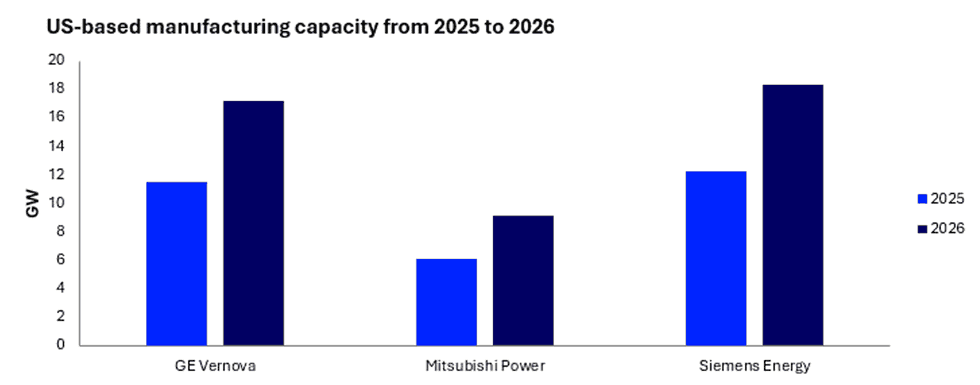
You know that demand for gas turbines to power data centers and power plants is so high that manufacturers are backordered through the end of the decade. Let me put a price on that supply and demand mismatch for you. New data from the consultancy Wood Mackenzie shows that turbine prices are headed to $600 per kilowatt by the end of next year. That’s up 195% since 2019. Global orders today sit at 110 gigawatts as of the end of 2025, but global manufacturing capacity is only capable of about 65 gigawatts. But as this chart shows and Heatmap’s Matthew Zeitlin predicted would happen last year, U.S.-based manufacturing capacity is expanding:
Sign up to receive Heatmap AM in your inbox every morning:
* indicates required
Email Address *Our Privacy Policy & Terms Apply.
4. Rooftop solar is now 20% of Puerto Rico’s power-generating capacity
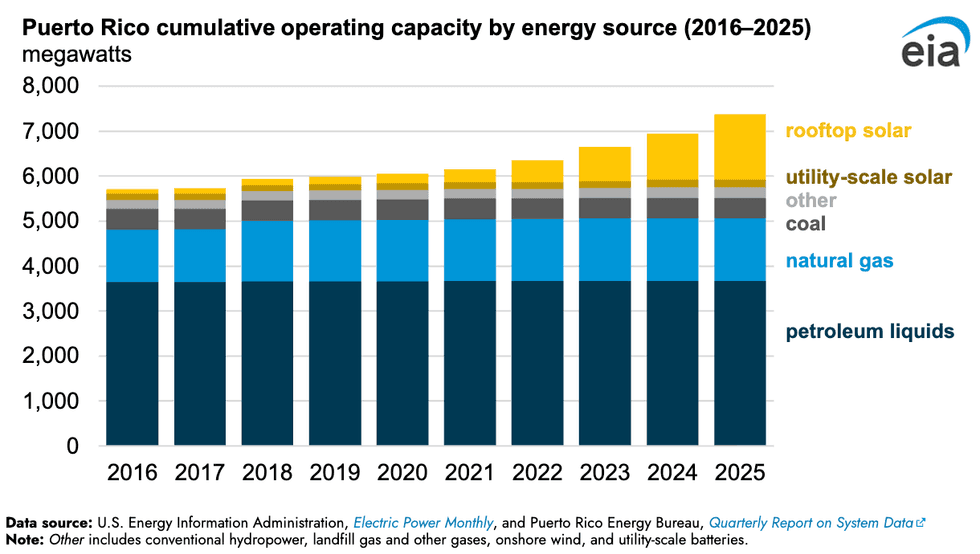
Puerto Rico’s grid is a disaster. When Governor Jenniffer González Colón, a pro-statehood Republican, took power earlier this year, one of her first moves was to extend the life of the island’s lone coal plant and step up efforts to get more gas infrastructure operating in America’s most populous territory. But one bright spot has been rooftop solar, as thousands of Puerto Ricans — frustrated by weekly if not daily outages and bleeding dry from the cost of keeping diesel generators fueled — install solar panels on their roofs. A virtual power plant set up to tap many of those systems is already making a big impact. And new data from the Energy Information Administration shows why. Rooftop solar made up 81% of all new generating capacity installation in Puerto Rico between 2016 and 2025, totaling 1,456 megawatts:
5. The leading U.S. fusion company inks a deal to speed up commercialization of a rival
Commonwealth Fusion Systems, a spinout from MIT, is considered the top fusion startup racing to commercialize the holy grail of clean energy in the U.S., raising more money than any other firm in the space so far. Now the company is teaming up with another fusion startup, Realta, which is looking to make small, scalable reactors. Both startups vowed to work together in a strategic partnership on the design and manufacturing of high-temperature conducting magnets. “This partnership allows Realta to tap into the world-class supply chain we built to support our advanced manufacturing capabilities, and that will help it to bring commercial fusion energy to the grid faster,” Commonwealth Fusion Systems CEO and co-founder Bob Mumgaard said in a statement. In an interview with Axios, Rick Needham, Commonwealth’s chief commercial officer, said the Iran War “really does open the world’s eyes to what could be a solution that doesn’t rely on those geopolitically fraught supply chains.”
U.S. companies are also facing more competition. As I told you last year, China is now outspending the entire world on fusion — right as, as Heatmap’s Katie Brigham put it two years ago, “it is possibly, finally, almost time” for the energy source to become a real thing.
THE KICKER

Reports of Jonathan the tortoise’s death have been greatly exaggerated. An account on X that was impersonating Joe Hollins, the veterinarian who serves the world’s oldest land animal, claimed on Wednesday that the giant tortoise had died at age 193. But the real Joe Hollins told USA Today: “Jonathan the tortoise is very much alive. I believe on X the person purporting to be me is asking for crypto donations, so it’s not even an April Food joke. It’s a con.” May Jonathan survive to see the rapid evolution of even more new kinds of online hucksters.